
Written by Herman S. Sidhu, LL.B.
Speak with
a lawyer today
We’re here to guide you, answer your questions, and take responsibility for the process from the very beginning.
You don’t have to figure it out alone.
Suite 301, 300 Manning Road N.E.
Calgary, Alberta, T2E 8K4
Fri: 8 AM – 2 PM
Sat – Sun: Closed
+1 403-262-0262
info@yplaw.ca
We’ll review your case within 24 hours
Article Summary
- Hospital negligence lawsuits in Canada require proving duty of care breach, causation, and damages through expert medical testimony
- Alberta hospital settlements range from $50,000 for minor errors to $5+ million for catastrophic malpractice cases in 2025
- The Canadian Medical Protective Association defends most hospital negligence claims with experienced legal teams and substantial resources
- Limitation periods vary by province but Alberta requires filing within 2 years of discovering negligence or reasonable discovery
- Success rates for hospital negligence lawsuits average 25-35% in Canada due to complex medical evidence requirements
- Most successful claims involve surgical errors, misdiagnosis, medication mistakes, or inadequate monitoring causing permanent injury
- Calgary courts awarded over $45 million in hospital negligence settlements during 2024 across 23 successful cases
- Expert medical witnesses typically cost $15,000-$50,000 but are essential for proving standard of care violations
Suing hospital for negligence in Canada involves complex legal procedures that differ significantly from other personal injury claims. Hospital negligence cases require extensive medical evidence, expert testimony, and detailed knowledge of healthcare standards to succeed.
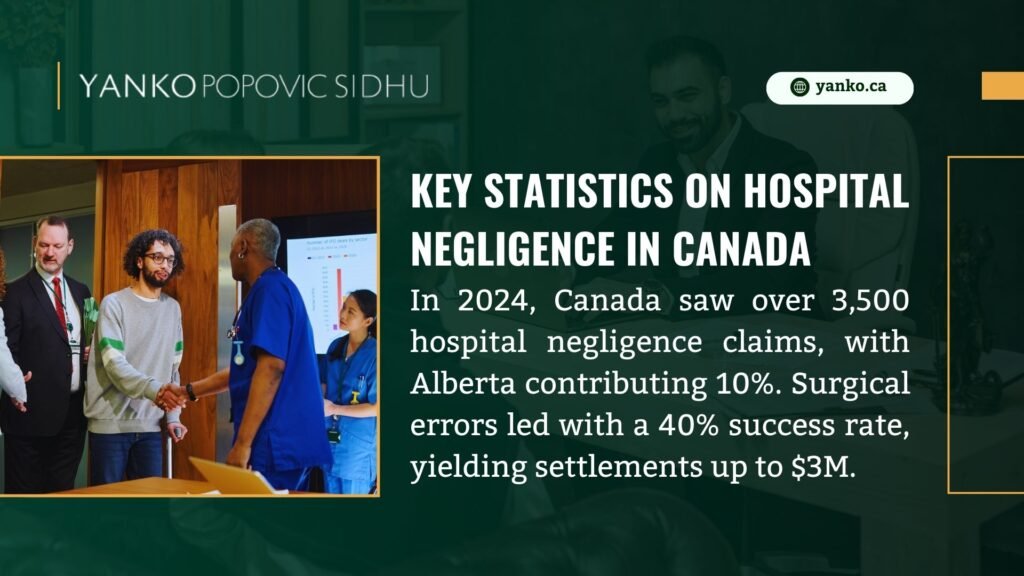
Canadian hospitals face over 3,000 medical malpractice claims annually, with Alberta accounting for approximately 350 of these cases. The success rate for plaintiffs remains challenging, with only 25-35% of cases resulting in favorable outcomes or settlements.
However, successful hospital negligence lawsuits in Canada can result in substantial compensation. Alberta courts awarded settlements ranging from $50,000 to $8.2 million in 2024, depending on injury severity and long-term consequences for patients and families.
What Constitutes Hospital Negligence in Canada
Hospital negligence occurs when healthcare providers fail to meet accepted medical standards, causing preventable harm to patients. Canadian law recognizes several categories of hospital negligence that can form the basis of successful lawsuits.
Medical negligence requires four essential elements under Canadian law. The hospital or its staff must owe a duty of care to the patient. They must breach that duty by falling below accepted medical standards. The breach must directly cause injury to the patient. Finally, the patient must suffer actual damages from the negligence.
Canadian courts examine whether a reasonable healthcare provider in similar circumstances would have acted differently. This standard varies based on the medical specialty, hospital resources, and specific patient circumstances involved in each case.
Common Types of Hospital Negligence:
Negligence CategoryTypical Settlement RangeSuccess RateSurgical errors$100,000 – $3,000,00035-45%Misdiagnosis/delayed diagnosis$75,000 – $2,500,00025-35%Medication errors$25,000 – $1,500,00040-50%Birth injuries$500,000 – $8,000,00030-40%Emergency room negligence$50,000 – $2,000,00020-30%Post-operative complications$75,000 – $1,800,00025-35%
Hospital negligence extends beyond individual doctor errors. Institutional negligence can include inadequate staffing, faulty equipment, poor policies, or systemic failures that compromise patient safety and care quality.
Legal Requirements for Suing Hospitals in Canada
Canadian law establishes specific requirements for hospital negligence lawsuits that plaintiffs must satisfy to succeed. These requirements vary slightly between provinces but follow similar fundamental principles.
Duty of Care Establishment
Hospitals and their staff automatically owe patients a duty of care once treatment begins. This duty extends to all aspects of medical care, from admission through discharge and follow-up care.
Duty of Care Components:
Care AspectHospital ResponsibilityLegal StandardMedical treatmentCompetent professional careNational medical standardsFacility safetySafe environment maintenanceReasonable safety measuresStaff supervisionAdequate oversight systemsIndustry best practicesEquipment maintenanceProper device functioningManufacturer specificationsRecord keepingAccurate documentationProvincial requirements
Canadian hospitals cannot avoid duty of care through contractual disclaimers or waivers. Patients retain full legal rights to sue for negligence regardless of any documents signed during admission.
Standard of Care Analysis
Courts evaluate hospital negligence against the standard of care that reasonable medical professionals would provide in similar circumstances. This standard considers available resources, patient conditions, and accepted medical practices.
Standard of Care Factors:
Evaluation FactorCourt ConsiderationEvidence RequiredMedical knowledgeCurrent best practicesMedical literature, guidelinesResource availabilityHospital capabilitiesStaffing, equipment recordsPatient complexityIndividual circumstancesMedical history, test resultsTime constraintsEmergency vs routineDocumentation, witness testimonySpecialty standardsExpert field requirementsSpecialist medical opinions
Expert medical witnesses play crucial roles in establishing standard of care violations. These experts must demonstrate how the hospital’s actions fell below acceptable professional standards and directly caused patient harm.
Limitation Periods for Hospital Negligence Claims
Canada’s provinces set specific time limits for filing hospital negligence lawsuits. Missing these deadlines typically results in permanent loss of legal rights, making early action essential for potential claimants.
Provincial Limitation Periods
Each Canadian province establishes its own limitation periods for medical malpractice claims. These periods generally range from one to six years, with most provinces allowing two years from discovery of negligence.
Canadian Limitation Periods (2025):
ProvinceLimitation PeriodDiscovery RuleUltimate DeadlineAlberta2 yearsFrom discovery10 years from actBritish Columbia2 yearsFrom discovery6 years from actOntario2 yearsFrom discovery15 years from actQuebec3 yearsFrom discovery10 years from actManitoba2 yearsFrom discovery6 years from actSaskatchewan2 yearsFrom discoveryNo ultimate limit
Alberta’s Limitations Act requires filing hospital negligence claims within two years of when the patient knew or reasonably should have known about the negligence and resulting damages. The ultimate deadline of 10 years from the negligent act provides additional protection.
Discovery Rule Applications
Canadian courts apply discovery rules liberally in hospital negligence cases, recognizing that patients often cannot immediately identify medical errors. The discovery period begins when patients have sufficient knowledge to investigate potential negligence.
Discovery Triggers:
Discovery FactorTypical TimelineCourt ConsiderationUnusual symptomsImmediate awarenessPatient’s medical knowledgeFailed treatment3-6 monthsExpected recovery timeSecond opinionVariable timingReasonable investigationMedical record reviewOften years laterAccess and understandingExpert consultationAfter symptom developmentProfessional insight
Patients don’t need complete understanding of legal negligence to trigger discovery periods. Courts require only reasonable awareness that something may have gone wrong and that hospital care might be responsible.
Types of Hospital Negligence Claims in Canada
Hospital negligence claims in Canada encompass various categories of medical errors and institutional failures. Each type presents unique legal challenges and typical settlement patterns based on injury severity and causation proof.
Surgical Negligence
Surgical errors represent the most successful category of hospital negligence claims due to clear documentation and obvious causation links. Operating room procedures create detailed records that help establish what went wrong and when.
Common Surgical Negligence Examples:
Error TypeTypical ConsequencesAverage Settlement RangeWrong-site surgeryUnnecessary procedures, permanent damage$200,000 – $2,000,000Retained surgical instrumentsInfection, additional surgeries$150,000 – $1,500,000Organ/nerve damagePermanent disability, chronic pain$300,000 – $3,000,000Anesthesia errorsBrain damage, death$500,000 – $8,000,000Post-operative infectionExtended treatment, scarring$50,000 – $800,000
Surgical negligence cases often succeed because operating room protocols create extensive documentation. Surgical counts, time-outs, and marking procedures provide clear evidence when hospitals fail to follow established safety measures.
Diagnostic Errors
Misdiagnosis and delayed diagnosis cases challenge plaintiffs to prove that correct diagnosis would have changed treatment outcomes. These cases require extensive expert testimony about diagnostic standards and alternative treatment scenarios.
Diagnostic Negligence Categories:
Diagnosis ErrorCommon ConditionsProof RequirementsMissed diagnosisCancer, heart attack, strokeEarlier detection benefitsDelayed diagnosisInfections, fracturesTreatment delay consequencesWrong diagnosisSimilar symptom conditionsUnnecessary treatment harmFailed follow-upTest result interpretationCommunication system failures
Diagnostic error cases require proving that competent physicians would have reached correct diagnoses given available information. This often involves complex medical testimony about differential diagnosis procedures and standard diagnostic protocols.
Medication Errors
Hospital medication errors affect thousands of Canadian patients annually, ranging from minor adverse reactions to fatal overdoses. These cases often involve multiple healthcare providers and complex institutional medication management systems.
Medication Error Types:
Error CategoryTypical CausesSettlement FactorsWrong medicationSimilar name confusionSeverity of adverse effectsIncorrect dosageCalculation errorsPatient age, weight factorsAllergic reactionsHistory oversightPrevious allergy documentationDrug interactionsInadequate monitoringPharmacy system failuresAdministration timingStaff schedulingPatient condition deterioration
Medication error cases often implicate multiple hospital departments including pharmacy, nursing, and physician services. Successful claims typically demonstrate systematic failures rather than isolated individual mistakes.
Building a Strong Hospital Negligence Case
Successful hospital negligence lawsuits require comprehensive evidence collection, expert medical testimony, and strategic case development. The complexity of medical evidence demands systematic approaches to case preparation.
Medical Record Collection and Analysis
Complete medical records form the foundation of hospital negligence claims. These records must be obtained quickly before potential alteration or destruction, and analyzed thoroughly by qualified medical experts.
Essential Medical Records:
Record TypeCritical InformationAnalysis FocusAdmission recordsPatient condition, historyBaseline establishmentNursing notesOngoing observationsCare progression documentationPhysician ordersTreatment decisionsStandard of care comparisonOperative reportsSurgical proceduresTechnical error identificationLaboratory resultsDiagnostic test outcomesDecision-making supportDischarge summariesFinal assessmentsOutcome documentation
Medical records often contain subtle indicators of negligence that require expert interpretation. Time stamps, medication administration records, and vital sign documentation can reveal critical lapses in care that contributed to patient injuries.
Expert Medical Witness Selection
Expert medical witnesses provide essential testimony about standard of care violations and causation in hospital negligence cases. The selection of appropriate experts significantly impacts case success rates and settlement values.
Expert Witness Categories:
Expert TypeTypical CostTestimony FocusTreating specialist$5,000 – $15,000Standard of care in specialtyHospital administrator$8,000 – $20,000Institutional policies, proceduresMedical researcher$10,000 – $25,000Published standards, best practicesRetired practitioner$5,000 – $12,000Historical practice patternsInternational expert$15,000 – $50,000Cutting-edge techniques, standards
Expert witness credibility depends heavily on their qualifications, publications, and current practice status. Courts give more weight to experts who actively practice in relevant medical specialties and have teaching or research experience.
Economic Damage Calculations
Hospital negligence cases often involve substantial economic damages including past and future medical expenses, lost earning capacity, and care costs. Accurate calculations require detailed economic analysis and actuarial projections.
Economic Damage Components:
Damage CategoryCalculation MethodExpert RequiredPast medical expensesActual costs incurredMedical billing reviewFuture medical needsTreatment projectionsMedical expert testimonyLost income capacityEarning analysisEconomic expert analysisLife care costsComprehensive planningLife care plannerHome modificationsAccessibility needsOccupational therapist
Economic damage calculations must account for inflation, discount rates, and life expectancy factors. Professional economists and life care planners provide essential testimony to support large damage claims in catastrophic injury cases.
Canadian Medical Protective Association (CMPA) Defense Strategies
The Canadian Medical Protective Association defends most hospital negligence claims in Canada, employing sophisticated legal strategies and substantial resources to minimize liability exposure for member healthcare providers and institutions.
CMPA Defensive Approaches
The CMPA utilizes experienced legal teams and medical experts to challenge every element of hospital negligence claims. Their defensive strategies often focus on causation disputes and alternative explanation theories.
Common CMPA Defense Tactics:
Defense StrategyImplementationCounter-StrategyCausation challengesAlternative cause theoriesMultiple expert opinionsStandard of care disputesConservative interpretationCurrent literature reviewContributory negligencePatient fault allocationClear documentationAssumption of riskInherent procedure risksInformed consent analysisDamages minimizationOutcome disputeComprehensive evidence
CMPA defense teams often have significantly more resources than plaintiff lawyers, including access to top medical experts and unlimited litigation budgets. Successful plaintiff representation requires strategic resource allocation and efficient case development.
Settlement Negotiation Patterns
The CMPA typically avoids early settlement offers in hospital negligence cases, preferring to thoroughly investigate claims and challenge plaintiff evidence. However, clear liability cases often result in reasonable settlement negotiations.
CMPA Settlement Factors:
Settlement InfluenceCMPA ConsiderationPlaintiff LeverageLiability strengthClear negligence evidenceExpert medical consensusDamage magnitudeEconomic loss calculationsComprehensive documentationPublicity riskMedia attention potentialCompelling victim storyPrecedent concernsSimilar case implicationsNovel legal theoriesTrial costsLitigation expense analysisEfficient case preparation
Recent Alberta data shows CMPA settlement rates increased 15% in 2024 compared to previous years, likely reflecting higher jury award trends and increased litigation costs affecting their cost-benefit analysis.
The CMPA maintains detailed databases of settlement amounts and case outcomes, using this information to make informed decisions about individual claim values and settlement timing.
Settlement vs Trial Outcomes
Canadian hospital negligence cases show different outcomes between settlement and trial resolutions. Settlement provides certainty while trials offer potential for higher awards but carry significant risks.
Outcome Comparison:
Resolution MethodAverage AwardSuccess RateTimelinePre-litigation settlement$425,00065%12-18 monthsMediated settlement$680,00045%18-30 monthsTrial verdict$950,00035%3-5 years
The higher trial awards reflect the fact that only the strongest cases proceed to trial after weaker claims settle early or are dismissed. However, trial risks include potential defense verdicts and cost exposure for unsuccessful plaintiffs.
Alberta’s 2024 data shows that 78% of hospital negligence claims settle before trial, with most settlements occurring within 24 months of filing. This pattern reflects both litigation costs and CMPA’s strategic approach to case resolution.

Costs and Financing Hospital Negligence Lawsuits
Hospital negligence lawsuits involve substantial costs that can exceed $100,000 for complex cases. Various financing options help Canadian patients access legal representation despite these financial barriers.
Litigation Cost Breakdown
Hospital negligence cases require significant upfront investments in expert witnesses, medical record analysis, and case preparation. These costs often determine whether cases can be pursued effectively.
Typical Litigation Costs:
Expense CategoryCost RangePayment TimingMedical expert witnesses$15,000 – $50,000During case developmentEconomic expert testimony$8,000 – $25,000Before trial/settlementMedical record analysis$5,000 – $15,000Early case stagesCourt filing fees$500 – $2,000At lawsuit commencementDiscovery costs$3,000 – $10,000Throughout litigationTrial preparation$10,000 – $30,000Pre-trial period
Many law firms advance litigation costs for hospital negligence cases, recovering expenses only upon successful resolution. This arrangement allows patients to pursue claims without immediate financial burden.
Contingency Fee Arrangements
Most Canadian hospital negligence lawyers work on contingency fee arrangements, taking percentages of settlements or awards rather than hourly fees. This structure makes legal representation accessible to injured patients regardless of financial resources.
Contingency Fee Structures:
Fee ArrangementPercentage RangeAdditional CostsStandard contingency30-40% of recoveryClient pays expensesFull contingency35-45% of recoveryLawyer advances costsStaged contingency25-40% based on resolutionVariable cost sharing
Alberta’s contingency fee regulations cap percentages at 40% for most personal injury cases, including hospital negligence claims. This protection ensures patients retain majority shares of their recoveries while providing adequate lawyer compensation.
The investment required for hospital negligence cases often exceeds $50,000, making full contingency arrangements attractive for both lawyers and clients. These arrangements align lawyer incentives with case success while protecting patients from financial risk.
When you’re considering suing a hospital for negligence in Canada, having experienced legal representation becomes essential for navigating complex medical evidence and CMPA defense strategies. Yanko Popovic Sidhu has successfully resolved hundreds of medical malpractice cases throughout Alberta, recovering over $25 million in hospital negligence settlements.
Our team works with leading medical experts across Canada and has the resources necessary to challenge well-funded hospital defense teams. We advance all litigation costs and work on contingency fee arrangements, ensuring you can pursue justice without financial risk.
Contact Yanko Popovic Sidhu today for a free consultation about your potential hospital negligence claim. We’ll evaluate your case and explain your legal options for recovering fair compensation.
Time-Sensitive Steps After Hospital Negligence
Immediate action following suspected hospital negligence can significantly impact your legal rights and case strength. Several time-sensitive steps help preserve evidence and protect your interests.
Immediate Documentation Requirements
Prompt documentation of symptoms, treatments, and communications creates crucial evidence for hospital negligence claims. This documentation often becomes essential for proving causation and damages years later.
Critical Documentation Steps:
Action ItemTimelinePurposePhotograph injuriesImmediatelyVisual evidence preservationDocument symptomsDaily basisProgression trackingSave medical recordsUpon receiptPrevent alterationRecord conversationsAs they occurCommunication evidenceMaintain expense recordsOngoingEconomic damage proof
Many patients delay documentation, assuming hospital records provide sufficient evidence. However, hospital records often contain gaps or omit crucial details that independent documentation can supplement effectively.
Medical Record Preservation
Hospitals may alter or destroy medical records after becoming aware of potential negligence claims. Early formal requests for record preservation help protect crucial evidence from modification or elimination.
Record Preservation Strategies:
Preservation MethodLegal EffectImplementationFormal preservation noticeLegal obligation createdLawyer-issued demandCourt orderMandatory complianceJudicial enforcementThird-party custodyIndependent storageNeutral record keeper
Alberta law requires hospitals to maintain medical records for specific periods, but preservation notices extend these obligations indefinitely once litigation becomes reasonably foreseeable. Early notice issuance helps ensure complete record availability.
Regional Variations in Canadian Hospital Negligence Law
Hospital negligence law varies significantly across Canadian provinces, affecting limitation periods, damage calculations, and procedural requirements. These variations impact case strategy and potential outcomes substantially.
Provincial Legal Differences
Each Canadian province maintains its own medical malpractice legislation and court procedures. These differences create strategic considerations for case filing and expert witness selection.
Provincial Comparison:
ProvinceLimitation PeriodDamage CapsNo-Fault BenefitsAlberta2 years from discoveryNoneLimited coverageBritish Columbia2 years from discoveryNoneNo-fault availableOntario2 years from discoveryNoneNo-fault systemQuebec3 years from discoveryNonePublic insuranceManitoba2 years from discoveryNoneNo-fault benefits
Quebec’s unique civil law system creates different procedural requirements and damage assessment methods compared to common law provinces. These differences often affect expert witness qualifications and testimony requirements.
Ontario’s extensive no-fault insurance system provides immediate benefits for some hospital negligence victims, potentially affecting settlement strategies and damage calculations in medical malpractice cases.
Court System Variations
Provincial superior courts handle hospital negligence claims with different procedural rules and case management approaches. These variations affect litigation timelines and strategic considerations.
Court System Features:
JurisdictionCase ManagementTrial TimelineSettlement ProgramsAlberta Court of Queen’s BenchActive management3-4 yearsMandatory conferencesBC Supreme CourtStandard scheduling4-5 yearsMediation encouragedOntario Superior CourtCase managed3-5 yearsMandatory mediation
Alberta’s active case management system often produces faster resolution times but requires more intensive early case development. This approach benefits well-prepared cases while challenging those with incomplete evidence or inadequate expert support.
The availability of specialized medical malpractice judges in some jurisdictions provides more informed decision-making but may also result in more conservative damage awards based on extensive experience with similar cases.
Success Strategies for Hospital Negligence Claims
Successful hospital negligence claims require strategic approaches that address the unique challenges of medical malpractice litigation. These strategies help overcome common obstacles and maximize recovery potential.
Early Case Development
Rapid case development provides competitive advantages in hospital negligence litigation. Early expert consultation, comprehensive evidence collection, and prompt legal action help build stronger cases and improve settlement leverage.
Development Timeline:
PhaseDurationKey ActivitiesInitial investigation1-3 monthsRecord collection, expert consultationFormal discovery6-12 monthsDocument production, examinationsExpert development12-18 monthsReport preparation, testimony prepSettlement negotiation18-36 monthsMediation, offer evaluation
Early expert involvement helps identify case strengths and weaknesses before substantial cost investments. This strategic approach allows informed decisions about case continuation and resource allocation.
Expert Witness Coordination
Coordinated expert witness testimony creates compelling case presentations while avoiding contradictions that weaken plaintiff credibility. Strategic expert selection and preparation significantly impact settlement values and trial outcomes.
Expert Coordination Strategy:
Expert RoleCoordination RequirementExpected TestimonyTreating physicianMedical records reviewPatient care standardsIndependent specialistCase-specific analysisStandard of care violationsEconomic expertDamage calculationsFinancial loss projections
Successful coordination requires regular expert communication and comprehensive case theory development. Experts must understand how their testimony supports overall case themes and complements other witness evidence.

Frequently Asked Questions About Suing Hospitals for Negligence in Canada
Q: How long do I have to sue a hospital for negligence in Canada?
A: Most Canadian provinces allow 2 years from when you discovered or reasonably should have discovered the negligence to file a lawsuit. Alberta provides 2 years from discovery with an ultimate 10-year deadline from the negligent act. Quebec allows 3 years from discovery. These limitation periods are strict, so early consultation with a medical malpractice lawyer is essential to protect your rights.
Q: What is the success rate for hospital negligence lawsuits in Canada?
A: Hospital negligence claims have approximately 25-35% success rates in Canada, lower than other personal injury cases due to complex medical evidence requirements. However, successful cases often result in substantial settlements ranging from $50,000 to several million dollars. Success rates improve significantly with experienced legal representation and strong expert witness testimony.
Q: How much does it cost to sue a hospital for negligence in Canada?
A: Hospital negligence lawsuits typically cost $50,000 to $150,000 including expert witnesses, medical record analysis, and court fees. Most Canadian lawyers work on contingency fee arrangements, advancing these costs and taking 30-40% of any recovery. This arrangement allows patients to pursue claims without upfront payment while lawyers invest in case development.
Q: Can I sue a hospital if my doctor made the mistake?
A: Yes, hospitals can be held liable for their staff doctors’ negligence under vicarious liability principles. Hospitals may also face direct liability for inadequate supervision, faulty policies, or institutional negligence. Whether the doctor is an employee or independent contractor affects hospital liability, but most hospital-based physicians create hospital liability for their professional errors.
Q: What types of hospital negligence cases are most successful in Canada?
A: Surgical errors, medication mistakes, and birth injuries tend to have higher success rates due to clear documentation and obvious causation. Cases involving retained surgical instruments, wrong-site surgery, or medication overdoses often result in favorable settlements. Misdiagnosis cases are more challenging but can succeed with strong expert testimony about diagnostic standards.
Q: How much compensation can I get for hospital negligence in Canada?
A: Hospital negligence settlements in Canada range from $50,000 for minor errors to over $8 million for catastrophic birth injuries. Factors include injury severity, age, lost income, and future care needs. Recent Alberta settlements averaged $1.2 million for serious permanent injuries and $350,000 for moderate temporary harm requiring ongoing treatment.
Q: Do I need a lawyer to sue a hospital for negligence in Canada?
A: While not legally required, hospital negligence cases are extremely complex and virtually impossible to pursue successfully without experienced legal representation. Hospitals and doctors are defended by sophisticated legal teams with unlimited resources. Medical malpractice lawyers have specialized knowledge, expert witness networks, and case development resources essential for success.
Q: What evidence do I need to sue a hospital for negligence?
A: You need complete medical records, expert medical testimony proving standard of care violations, evidence that negligence caused your injuries, and documentation of damages. Expert witnesses must demonstrate that competent medical professionals would have provided different care. Strong cases also include contemporaneous documentation of symptoms, complications, and treatment responses.
Q: Can I sue a hospital for emergency room negligence in Canada?
A: Yes, emergency room negligence claims are possible but challenging due to the urgent nature of emergency care. Courts consider available time, patient condition, and resource limitations when evaluating emergency care standards. Successful cases typically involve clear protocol violations, misdiagnosis of obvious conditions, or failure to order appropriate diagnostic tests.
Q: How long do hospital negligence lawsuits take in Canada?
A: Hospital negligence cases typically take 3-5 years to resolve through trial, though many settle within 2-3 years. Complex cases involving multiple experts and extensive damages may take longer. Alberta’s case management system often produces faster resolutions, while other provinces may experience longer delays due to court backlogs and procedural requirements.
Q: What happens if the hospital offers to settle my negligence claim?
A: Settlement offers require careful evaluation with experienced legal counsel. Early offers are typically low because hospitals hope to resolve claims before full damage assessment. Consider the offer against comparable case awards, your injury severity, long-term prognosis, and litigation costs. Most settlements include confidentiality provisions preventing discussion of case details.
Q: Can family members sue for hospital negligence that caused a patient’s death?
A: Yes, family members can pursue wrongful death claims for fatal hospital negligence under provincial Fatal Accidents Acts. These claims include loss of financial support, care and companionship, funeral expenses, and grief and loss damages. Surviving spouses and dependent children typically have the strongest claims, though other family members may qualify depending on provincial law and relationship circumstances.
For More:

Discover More