Written by Herman S. Sidhu, LL.B.
Speak with
a lawyer today
We’re here to guide you, answer your questions, and take responsibility for the process from the very beginning.
You don’t have to figure it out alone.
Suite 301, 300 Manning Road N.E.
Calgary, Alberta, T2E 8K4
Fri: 8 AM – 2 PM
Sat – Sun: Closed
+1 403-262-0262
info@yplaw.ca
We’ll review your case within 24 hours
An insurance company lowball offer car accident cases often starts with a number that feels quick and clean because that’s the point. When a letter or email lands with a final figure days after a crash, most people feel two things at once: relief that someone is paying, and dread that the amount won’t even touch the medical bills.
That emotional whiplash is exactly why an insurance company lowball offer car accident is so often. It catches you before the full picture shows up, before symptoms settle, before wage loss adds up, before treatment plans look long-term, before you understand the playing field.
This article breaks down what an insurance company’s lowball car accident offer looks like in real life, why the insurance adjuster leads with it, what evidence forces the number upward, and how to answer with a counter demand that reads like a file prepared for trial. That last part matters, even if your case settles.
Insurance Company Lowball Offer Car Accident
An insurance company lowball offer car accident is a settlement amount that fails to match the value of your insurance claims and your personal injury claim. It usually ignores future care, downplays pain, skips economic damages, or uses selective medical records to act as if you bounced back when you didn’t.
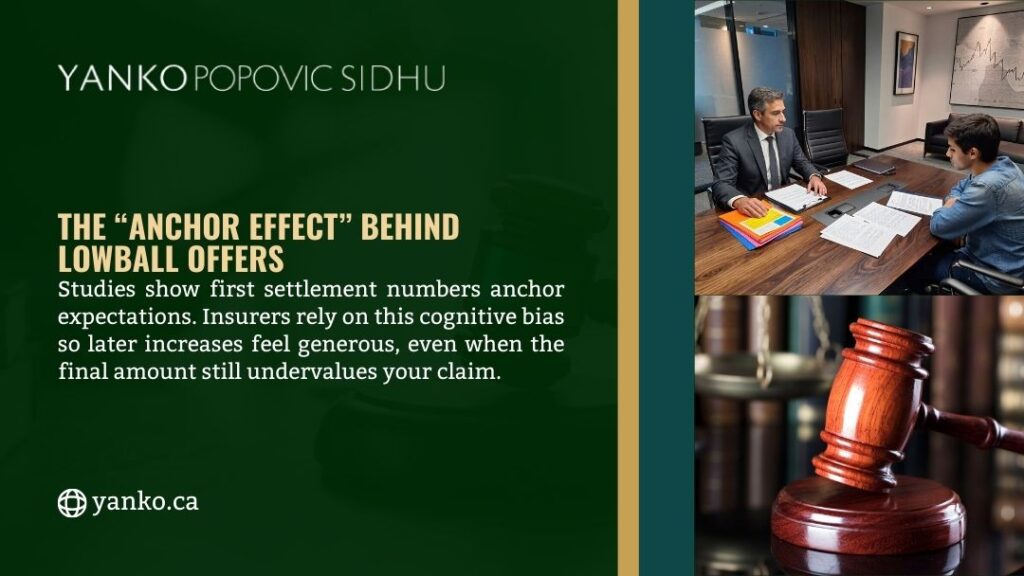
It helps to say this plainly: the first settlement offers often serve as an anchor. Once a low number enters the room, every later number feels high by comparison. If you accept a lowball insurance settlement offer early, you may trade short-term cash for long-term risk, especially if the release ends your right to pursue more money if symptoms worsen.
In Alberta, that risk has teeth because many injury costs show up late. Rehab schedules change. Specialists take time. A back injury can look minor at week one and become a daily problem by month three. So, when an insurance company lowball offer car accident offer arrives fast, speed alone should raise your eyebrow.
Why Insurance Companies Start with Low Settlement Offers?
A low number at the start does not always mean your claim lacks merit. It often means the adjuster plays a standard script.
First, insurance companies run on file volume. Adjusters must close claims, control payouts, and follow internal reserve targets. Second, early in a claim, the insurer holds more information power than you do. They see police reports, prior claim history, and their own databases. You see a sore neck, a wrecked car, and a calendar full of appointments. That gap lets an insurance company lowball settlement offer with confidence.
Third, the insurer counts on two predictable moments: the point when you feel overwhelmed by dealing with an insurance process, and the point when you feel financial pressure. Many people accept a lowball settlement offer because rent, childcare, or missed work leave no margin. The offer becomes less about fairness and more about survival.
That’s the problem. A settlement should reflect the physical, emotional, and financial costs of the crash. If the first number cannot do that, it’s not a starting point. It’s a test.
Signs you’re looking at a lowball insurance settlement offer
A lowball insurance settlement offer rarely announces itself. It arrives dressed as reasonable and “standard.” The best approach is to treat it like an audit: what did they include, what did they skip, and what did they assume without proof?
Here’s a clean way to spot an insurance company lowball offer car accident offer before you waste weeks negotiating in circles.
What you see in the offerWhat it often meansWhat to request in writingA fast deadline to acceptPressure tactic; they want a signature before treatment stabilizesA full breakdown of how the figure was calculatedA number that covers only current billsFuture care and long-term effects get ignoredTheir list of documents relied upon (medical records, notes, reports)“Soft tissue resolves quickly” languageThey downplay injuries without a specialist’s opinionThe medical basis for that claimWage loss dismissed as “unverified.”They haven’t received proper payroll proof, or they pretend it doesn’t existThe wage loss criteria they requirePain is valued as a token add-onThey treat non-financial harm as optionalTheir method for valuing non-pecuniary loss
If your offer matches more than one row above, it likely fits the pattern of an insurance company lowball offer car accident strategy, not a serious attempt to resolve the claim.
The Damage Categories Insurers Often Leave Out
Low offers often come from incomplete math. That sounds obvious, yet it’s the most common reason people accept a low number: they compare the offer to today’s medical bills, not the full cost of the crash.
Economic damages matter because they are measurable. They include medical bills, prescription costs, physiotherapy, mileage to treatment, paid help at home, and lost wages. They also include future expenses when doctors recommend more care. If the offer ignores future treatment, you’re not negotiating a settlement; you’re negotiating a discount.
Non-financial harm matters because pain changes a life even when X-rays look normal. In Alberta, people often search for pain and suffering compensation because that’s the category insurers tend to shrink into a one-liner. Understanding this helps you to know how these damages get assessed in practice and why documentation matters.
For people who want the legal vocabulary, Alberta claims often split losses into pecuniary and non-pecuniary damages. If the adjuster’s letter avoids that split entirely, that’s another hint you’re facing an insurance company’s lowball offer car accident approach.
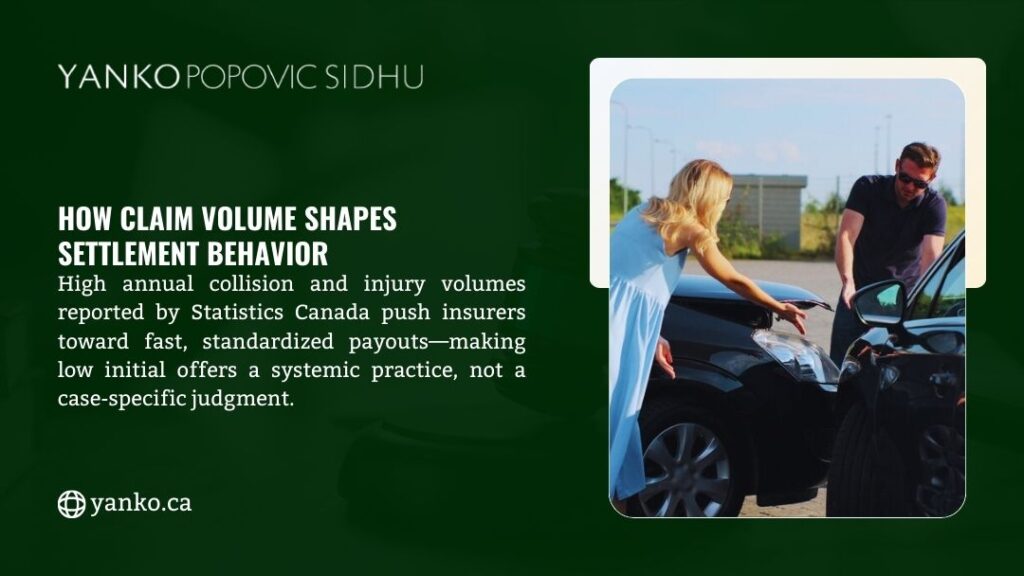
Now zoom out for a second. Collisions are not rare, and insurers know that. Transport Canada reported 1,964 fatalities and 118,838 total injuries in 2023, with serious injuries at 9,261. Alberta’s own annual collision statistics report provides province-level patterns and context, which matters because local conditions influence claim volumes and insurer behavior. When you see how many claims move through the system, the “factory” feel of some settlement offers makes more sense.
What to Do the Day You Get a Lowball Settlement Offer
When an insurance company lowball offer car accident offer arrives, your best move is boring and controlled. Emotion makes people type paragraphs. Control makes people win negotiations.
Start with one decision: do not accept a lowball. Do not sign a release. Do not treat a good-faith payment like a full and final settlement unless it clearly says it is not final. If anything in their letter sounds final, assume it is.
Next, request a written breakdown. Ask the insurance adjuster to show the line-item math and the documents used. If they claim your medical records show full recovery, ask which entry and which date. If they claim you missed no work, ask what wage information they relied upon. The point is simple: you are forcing the file to shift from opinion to proof.
Then build your evidence package. Most people collect documents. That’s too casual. Treat it as a narrative that a stranger can verify. Your package should connect police reports to fault, medical records to symptoms, treatment notes to limitations, and payroll proof to lost wages. If you leave those links unstated, the insurer will fill the gaps with assumptions that justify the low number.
How to Write a Counter-demand That Gets Taken Seriously
A counter-demand is not the same as a counteroffer. A counteroffer can be a number. A counter demand should read like a position: here is the value, here is why, and here is the proof.
This is where many people lose ground in an insurance company lowball offer car accident negotiation. They reply with emotion. They accuse the insurer of bad faith. They say the offer is insulting. All understandable. None persuasive.
A counter demand works when it stays professional and relentlessly specific. It should include a brief crash summary, an injuries summary, a damages summary, and a clear ask. It should also set a response deadline that feels reasonable, not theatrical.
Use the insurer’s own language against them, politely. If they wrote based on the documentation provided, then provide documentation that cannot be ignored. If they wrote no objective findings, then supply clinical findings, imaging, specialist referral notes, or functional assessments, whatever your case supports.
Here’s what a strong counter-demand package contains, and why each item raises the floor under your claim.
The evidence you sendWhat it provesWhat it blocksPolice reports and collision diagramFault context, sequence of impact“Shared blame” narratives without supportTreatment notes + referral lettersConsistent symptoms and care plan“You stopped treatment, so you must be fine.”Medical records plus a symptom timelineDuration and change over timeCherry-picked “good day” entriesWage proof + employer letterLost wages and missed shifts“Unverified income loss”Receipts, mileage log, out-of-pocket costsReal expenses beyond clinic invoicesThe “we only reimburse bills we like” routinePhotos of damage and injuriesMechanism of injury and severity cuesClaims that the crash was “minor.”
If you send this, your counter demand stops sounding like a complaint and starts sounding like a file that can survive scrutiny. That changes how insurers treat you, especially when they suspect you will not accept a lowball settlement offer.
Negotiation Timeline: What Usually Happens After You Counter
After your counter demand, the insurer often responds in one of three ways.
First, they ask for one more document. Sometimes that’s fair. Sometimes it’s delayed. Second, they increase the offer slightly to see if you’ll take the bait. Third, they go quiet and review. A quiet review usually means internal approvals, reserve checks, or supervisor sign-off.
During this phase, one Alberta-specific issue matters: limitation periods. Under Alberta’s Limitations Act, time limits can apply to when you commence a claim, subject to how discoverability applies in your circumstances. This is not an area to guess. A low offer can become a trap if you spend months negotiating without tracking the limitation risk.
That’s also why the playing field changes when counsel gets involved. Insurers treat represented claims differently because the risk model changes. They assume a stronger evidence package, tighter deadlines, and higher odds of litigation if they keep the offer low.
Insurance Adjuster Tactics After a Car Accident
Most people picture an insurance adjuster as a neutral referee. In reality, an adjuster’s job is to manage the insurer’s exposure while meeting claims handling requirements. That does not make every adjuster unfair, but it does explain common tactics in an insurance company lowball offer car accident file.
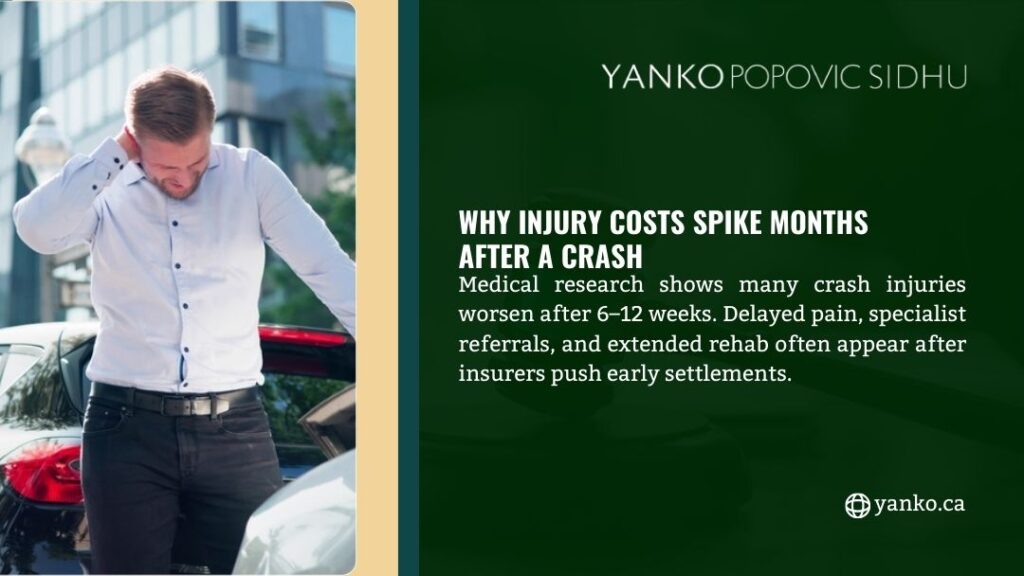
One tactic is selective focus: they highlight the one note that says it feels better and ignore the ten notes that show recurring symptoms. Another is broad authorization requests: they ask for wide medical access, then search for unrelated history to argue your symptoms predate the crash. Another is the gap argument: if you miss treatment because you couldn’t get an appointment, they frame the gap as proof you recovered. And one of the most common tactics is the early wrap-up call, the moment they push you to settle before your medical picture stabilizes.
If you feel pressure, pause. Pressure is not a reason to settle. Pressure is a reason to slow down and document.
Should You Accept the First Settlement Offer After a Car Accident?
Most of the time, no. The first offer often reflects incomplete information, conservative assumptions, and a strategy to see whether you will accept a lowball.
There are rare exceptions. If the injuries are minor, your recovery is complete, your medical bills are final, wage loss is zero, and you have no ongoing symptoms, then a quick settlement may make sense. Even then, it should come after you verify that the offer covers every cost and does not demand a release that blocks future claims you might reasonably foresee.
In a typical insurance company lowball offer car accident situation, the first offer arrives before those conditions exist. That’s why experienced lawyers often advise caution. The cost of settling too early is not theoretical. It shows up later as unpaid therapy, unpaid wage loss, or persistent pain that the insurer now calls not related.
Lowball Settlement Offer Examples: A Simple Valuation Worksheet
The practical way to evaluate whether an insurance company’s lowball car accident offer matches the evidence you have today, and the risk you still carry.
CategoryToday’s known costPossible future costProof that supports itMedical bills and rehabInvoices to dateAdditional treatment, specialist careClinic invoices, referral notesLost wagesPay periods missedReduced hours, modified dutiesPayroll, employer letterOut-of-pocket costsReceipts and mileageOngoing travel and aidsReceipts, mileage logHousehold helpPaid assistanceOngoing assistance if limits persistInvoices, caregiver notesNon-pecuniary lossNot “billed”Often increases with durationSymptom timeline, functional limits notes
If the insurer offers a figure that covers only the left column while your evidence supports the right column, you’re staring at a lowball settlement offer. If you accept a lowball insurance settlement offer in that state, you accept the risk that future costs become your problem.
If you’re in Alberta and want a grounded sense of how settlements typically work, understanding personal injury settlement structures can make it a lot easier to see what the insurer’s paperwork is actually saying—and what it’s quietly leaving out.
When to Call an Experienced Personal Injury Lawyer in Alberta
Not every case needs a lawyer. Many serious cases do. If you face an insurance company lowball offer car accident situation, and any of the following are true: ongoing symptoms, disputed fault, significant lost wages, complex medical records, a denied claim, or pressure to settle fast, you may want counsel before you answer. A lawyer can also stop the endless “send one more document” loop that keeps claims in limbo.
If you’re dealing with a crash in Calgary, working with a car accident lawyer Calgary can clarify how the process actually works, from fees to evidence, while looking at car accident settlement payouts Alberta helps ground expectations in what compensation realistically looks like across different situations.
It’s also worth noting the broader system pressures that shape insurer behavior. Statistics Canada has discussed the cost and claims factors that influence premiums and insurer financial pressures in Canada’s auto insurance landscape. That context does not justify a low offer, but it helps explain why insurers resist higher numbers unless you support them with documentation.
Where Low Offers Show Up Fast in Related Alberta Claims
An insurance company lowball offer car accident pattern shows up in more than standard collisions. Rear-end crashes often produce early low offers because insurers label them minor impact even when the body disagrees. If your crash matches that situation, a rear-end collision lawyer in Calgary can help you understand where you stand.
Low offers also appear in hit-and-run files, where insurers may push back hard on proof. In cases like this, a hit-and-run lawyer deals with these issues every day.
And when injuries cross into catastrophic territory, insurers often fight the long-term care component the hardest. A catastrophic injury lawyer is familiar with how serious and life-changing situations like this can be.
Questions People Ask After an Insurance Company’s Lowball Settlement Offer
People often ask whether they should speak to the adjuster on the phone. You can, but a written follow-up protects you. A phone call can clear up confusion; it can also create confusion. Keep records of dates, names, and what was said.
People also ask what happens if the insurer blames them for the accident. Fault disputes change claim value fast. Police reports and witness details matter. If the insurer raises fault without evidence, your response should request their basis and provide your own supporting proof.
Another common question: “What if my symptoms worsen after I settle?” In many cases, a release blocks reopening the claim. That’s why people regret an early insurance company lowball offer car accident settlement. If you still face uncertainty in your medical picture, it’s usually too early for a full and final agreement.
What This Means for Your Recovery and Your Rights
A low offer after a crash can feel personal. Most of the time, it’s procedural. The insurer starts low because it works, and because many people accept a lowball when life gets expensive.
If you remember one thing, make it this: an insurance company lowball offer car accident is not a verdict on your case. It’s a starting move. Your job is to respond with proof, calm pressure, and a counter-demand that forces a fair review of medical bills, lost wages, and the physical, emotional, and financial impact that does not vanish just because an adjuster wants it to. If you received an insurance company lowball offer car accident in Alberta, and you want a straight answer on what it should cover, consider a free consultation with an experienced personal injury lawyer who can review your documents, spot what the insurer skipped, and map the next steps before you sign anything that locks you in.

Discover More