Written by Herman S. Sidhu, LL.B.
Speak with
a lawyer today
We’re here to guide you, answer your questions, and take responsibility for the process from the very beginning.
You don’t have to figure it out alone.
Suite 301, 300 Manning Road N.E.
Calgary, Alberta, T2E 8K4
Fri: 8 AM – 2 PM
Sat – Sun: Closed
+1 403-262-0262
info@yplaw.ca
We’ll review your case within 24 hours
A future earning capacity claim compensates an injured person whose ability to earn income has been reduced after an accident. Unlike short-term wage loss, this type of claim focuses on long-term financial impact. Courts in Calgary examine whether injuries have created a real and lasting disadvantage in the labour market, and that’s where compensation begins. In this guide, understanding how this works can make a significant difference in the outcome of a personal injury claim.
Future Earning Capacity Claim
A future earning capacity claim is one of the most important parts of a personal injury case, yet it’s often misunderstood. It addresses a simple but critical question: how has this injury changed your ability to earn a living going forward?
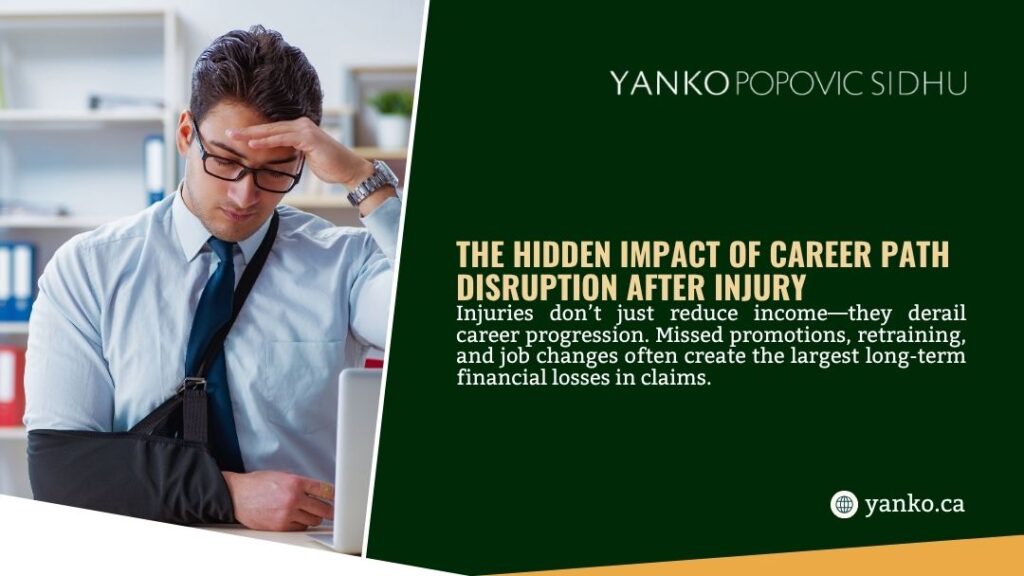
Here’s what I’ve seen time and again. People focus on immediate losses: missed paycheques, medical bills, and time off work. But the more serious financial damage shows up quietly over time. Careers stall. Opportunities shrink. Promotions disappear.
A future earning capacity claim addresses that long-term loss. Courts in Alberta recognize this. That’s why they allow compensation for both loss of future earnings and loss of earning capacity. These are not the same thing, even though they’re often used interchangeably.
It’s not about what you earned before. It’s about what you could have earned if the injury had never happened. Even if you return to work, a reduced ability to compete in the labour market may still justify compensation.
Loss of Future Earnings vs Loss of Earning Capacity
FactorLoss of Future EarningsLoss of Earning CapacityFocusActual lost incomeReduced ability to earnTimelineShort to medium termLong-term career impactProofPay stubs, tax recordsMedical + vocational evidenceApproachMathematicalPredictive and contextual
Here’s what many people miss. You don’t have to prove exact future losses down to the dollar. Courts understand that predicting a lifetime of income isn’t precise. Instead, they assess probabilities.
So if your injury affects your ability to compete in the labour market, even slightly, that can form the basis of a future earning capacity claim.
How Alberta Courts Assess Future Earning Capacity Claims
Courts rely on a principle called the real and substantial possibility test. That means certainty isn’t required. Judges look at whether there’s a realistic chance your income will be affected.
The Alberta Court stated that courts do not require proof of exact future loss; instead, they assess whether there is a real and substantial possibility of income loss. But here’s where it gets more nuanced.
Courts look at a range of factors, some obvious, others less so:
- Whether the injury affected the plaintiff’s ability to earn
- Changes in job performance or stamina
- Limitations in career advancement
- Labour market realities at the time of trial
Sometimes, a person continues working but under very different conditions. Lower-paying roles. Reduced hours. Less stability. That shift matters. And that’s where the court steps in to assess future consequences at the time of trial.
Methods Courts Use to Calculate Future Income Loss
Courts typically rely on two primary approaches.
MethodWhen UsedKey FeatureCapital Asset ApproachUncertain or evolving careerFocus on the ability to earnEarnings ApproachStable income trajectoryProjects the actual income loss
Capital Asset Approach
This approach treats earning ability as an asset. If the injury damages that asset, compensation may be awarded.
It’s often used when the plaintiff is young, their career path is not fully established, and their income fluctuates. Instead of strict calculations, courts evaluate how the injury has affected the plaintiff’s overall ability to earn in the future.
Earnings Approach
This method works when income is predictable. Courts compare pre-accident earnings, expected future earnings, and post-accident earnings. The difference becomes the basis for compensation.
Key Factors That Affect a Future Earning Capacity Claim
Several elements shape the value of a future earning capacity claim. Age plays a role. A younger individual with a long career ahead may face greater long-term loss. Career path matters too. Someone in a physically demanding job may face more severe limitations than someone in a sedentary role.
The nature of the injury is critical. Brain injuries, spinal cord damage, or chronic pain can significantly reduce earning ability. In many cases, mental health also affects long-term employability, especially when trauma or anxiety follows an accident.
Courts also consider:
- Pre-accident income
- Education and training
- Labour market conditions
- Opportunities for advancement
The key question remains consistent: has the injury affected the plaintiff’s ability to earn income in a meaningful way? And here’s the reality: sometimes the biggest losses aren’t immediate. They unfold slowly, over years.
Real Alberta Case Examples (Court Decision Insight)
If you really want to understand how a future earning capacity claim works, it helps to look at how courts deal with real cases, not just theory.
Alberta Case Example: 2012 Decision (Court of Queen’s Bench)
Decide 2012 ABQB 777. The court had to decide whether the plaintiff’s injury would affect their ability to earn down the road, not just right away. At first glance, nothing seemed unusual. The plaintiff was still working. Income hadn’t dropped in any dramatic way. But that wasn’t the end of the analysis.
The judge looked a little deeper. There were physical limitations. Certain tasks were harder. Some opportunities were no longer realistic. Over time, those restrictions meant fewer options and less flexibility in the labour market.
So even without an immediate loss of income, the court accepted that there was a real and substantial possibility that earnings would be affected later on.
That was enough. Compensation followed, not because of what had already been lost, but because of what was likely to be lost in the future. And that’s really the point of a future earning capacity claim.
Recent Alberta Case Example: 2025 Decision
A more recent example comes from 2025 ABKB 24. Different facts, same underlying issue. What does the future look like for this person after the injury? In that case, the court took a careful look at where the plaintiff stood before the accident and where things were heading afterward.
Before the injury, there was a clear path, steady work, room for growth, and a fairly predictable income trajectory. After the injury, things shifted.
Work was still possible, but not in the same way. There were physical limits. There were also psychological effects that made consistency harder to maintain. Some jobs were no longer an option. Others became more difficult to keep over time.
The court didn’t need exact numbers to see the problem. It was enough to recognize that the plaintiff’s future earning potential had changed. One idea stood out in the reasoning: a future earning capacity claim isn’t about certainty; it’s about risk that’s grounded in reality.
Why These Cases Matter
When you step back and look at both decisions, a pattern starts to emerge. You don’t need to prove that your income has already dropped. You don’t need to calculate every dollar you might lose years from now.
What matters is this: Is there a real, measurable disadvantage compared to where you would have been without the injury? If the answer is yes, that can support a future earning capacity claim.
What This Means in Practice
These kinds of claims aren’t always straightforward. They don’t come down to a single document or one clear number. Instead, they’re built piece by piece, including medical evidence, work history, expert opinions, and a realistic picture of what the future might look like.
That’s where experience matters. At Yanko Popovic Sidhu, clients deal directly with experienced lawyers who handle these issues every day. There’s no handoff, no layers in between. The focus stays on understanding the full impact of the injury and making sure nothing important gets missed along the way.
Real-Life Scenario: How a Claim Is Calculated
Let’s break it down with a simple example. Consider a construction worker who earned a steady income before an accident. After suffering a spinal injury, they return to work, but only in a limited, lower-paying role.
ScenarioPre-IncomePost-IncomeEstimated Annual LossConstruction Worker$75,000$52,000$23,000
Now stretch that over 20 years. That’s nearly half a million dollars, before accounting for wage growth or inflation. On paper, they still earn an income. But here’s what changed: reduced physical capacity, fewer job opportunities, and no overtime or advancement. The court would assess the pre-accident earning trajectory, post-accident limitations, and labour market disadvantage.
Even without total disability, a future earning capacity claim may still apply because the injury has narrowed long-term earning potential. This is why even a modest reduction in earning ability can result in significant compensation.
Evidence Required to Prove Loss of Earning Potential
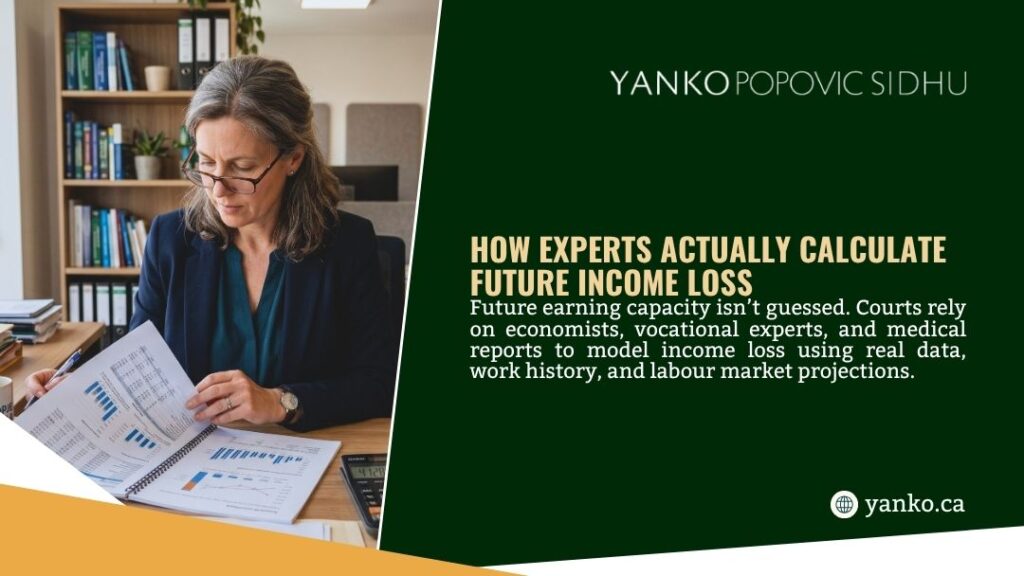
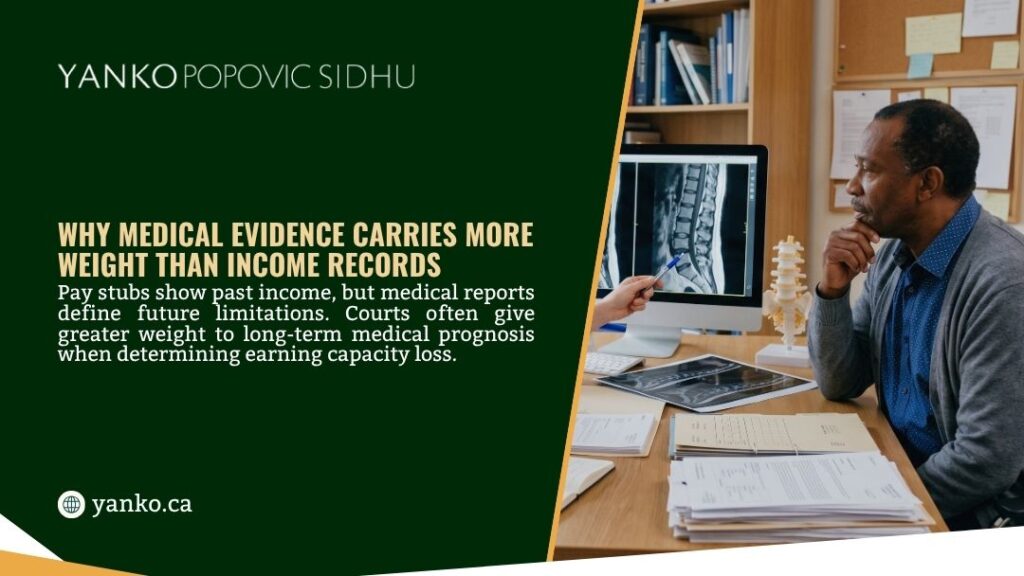
Strong evidence makes or breaks a future earning capacity claim. Medical reports establish the nature and permanence of injuries. Vocational experts evaluate how those injuries affect employment options. Economic experts may project long-term income loss. Employment history also matters. Courts look at past income, job stability, and career trajectory.
This is why working with experienced counsel matters. At Yanko Popovic Sidhu, clients work directly with experienced lawyers, not intermediaries, ensuring every aspect of a future earning capacity claim is handled with precision and accountability. That level of involvement often makes the difference between an average claim and a fully supported one.
The Link Between Future Care Costs and Earning Capacity
Future earning loss rarely exists in isolation. Serious injuries often come with long-term care needs.
Medical treatments, rehabilitation, and ongoing support can affect a person’s ability to maintain employment. That’s why claims often include both earning capacity loss and future care costs, as well as personal injury. Together, these elements paint a full picture of the financial impact of an injury.
Data & Statistics: Why These Claims Matter
Research shows that long-term disability significantly affects income potential. According to Statistics Canada, individuals with disabilities earn approximately 21.4% less on average than those without disabilities. That gap widens over time, especially when injuries affect career growth or job stability. This is exactly what a future earning capacity claim is designed to address.
Common Mistakes That Reduce Compensation
Many injured individuals unknowingly weaken their own claims. Accepting an early settlement is one of the most common mistakes. Insurance companies often make quick offers before the full extent of injuries becomes clear. This can significantly undervalue a future earning capacity claim.
Understanding whether to accept an offer matters. Should I accept the first settlement offer car accident highlights the potential risks involved and the importance of carefully evaluating any initial offer before making a decision
Another issue is the lack of expert evidence. Without medical and vocational analysis, it becomes difficult to prove long-term loss.
How a Personal Injury Lawyer Strengthens Your Claim
A future earning capacity claim requires more than basic legal work. It demands strategy, evidence, and persistence. An experienced legal team will build a comprehensive case, work with medical and economic experts, challenge insurance company assumptions, and present a clear narrative to the court.
For example, working with a skilled car accident lawyer in Calgary ensures your case reflects the full scope of your loss, not just immediate damages.
Future Earning Capacity Claim in Serious Injury Cases
Some injuries almost always affect earning capacity. Brain injuries can impair memory, focus, and decision-making, which is why working with a brain injury lawyer is often necessary when these effects disrupt daily life and long-term independence.
Spinal cord injuries frequently lead to permanent limitations in mobility and physical function, making a Spinal cord injury lawyer important for addressing the long-term legal and financial impact.
In difficult, life-altering situations, a catastrophic injury attorney typically handles cases involving extensive damage, ongoing care needs, and significant changes to quality of life. The loss of earning capacity may represent the largest portion of a settlement.
What Makes These Claims So Valuable
Here’s what many people overlook. A future earning capacity claim can extend over decades. Even a modest reduction in income can translate into substantial long-term loss.
Courts often consider:
- Remaining working years
- Inflation and wage growth
- Career advancement opportunities
That’s why these claims often exceed immediate wage loss by a significant margin.
FAQs About Future Earning Capacity Claim
Do I need to be unemployed to make a claim?
No. Even if you return to work, you can still claim if your earning potential has been reduced.
How do courts calculate loss of earning capacity?
Courts assess whether there is a real and substantial possibility of future income loss using medical, vocational, and economic evidence.
How long does a future earning capacity claim take?
These claims typically take months to years, depending on complexity and medical evidence.
Can mental health impact a claim?
Yes. Mental health conditions can affect employability and are considered in assessing earning capacity.
What evidence is needed for a future earning capacity claim?
Strong claims rely on medical reports, employment history, vocational assessments, and expert economic analysis to demonstrate how injuries affect long-term earning ability.
Can I settle my claim early?
You can, but early settlement may reduce compensation if long-term effects are not fully understood. It is often wise to evaluate the full impact of injuries before agreeing to any settlement.
Take the Next Step Toward Protecting Your Financial Future
A future earning capacity claim is not just about numbers. It’s about protecting your future, your career, and your financial stability after an injury. If your ability to earn has changed, even slightly, it deserves proper evaluation.
Working with experienced legal professionals ensures your claim reflects the full impact of your injuries. If you’re unsure where you stand, exploring your options through personal injury claims is a practical first step. The sooner you understand your rights, the stronger your position becomes.

Discover More