Written by Herman S. Sidhu, LL.B.
Speak with
a lawyer today
We’re here to guide you, answer your questions, and take responsibility for the process from the very beginning.
You don’t have to figure it out alone.
Suite 301, 300 Manning Road N.E.
Calgary, Alberta, T2E 8K4
Fri: 8 AM – 2 PM
Sat – Sun: Closed
+1 403-262-0262
info@yplaw.ca
We’ll review your case within 24 hours
A car accident settlement for back injury in Alberta depends on far more than pain alone. Diagnosis, recovery length, work impact, credibility of medical records, and insurer strategy all shape compensation. Understanding how these pieces fit together can mean the difference between a rushed payout and a fair result.
In this article, we explore how a car accident settlement for back injury works in Alberta, what insurers actually look at, and why timing, documentation, and strategy matter more than any so-called average payout.
From understanding which back injuries qualify for compensation to knowing when legal advice becomes essential, this guide breaks down the process in plain terms, without shortcuts or guesswork.
Car Accident Settlement For Back Injury: What You Can Realistically Expect in Alberta
When people search for a car accident settlement for back injury, they usually want a number. What they get instead is uncertainty. That frustration is understandable, but it reflects how injury compensation works in Alberta. There is no fixed payout, no chart that applies cleanly to every injury in a car accident, and no universal average that insurers follow.
Back injuries range from short-lived soft tissue pain to permanent spinal damage. Some resolve within months. Others evolve into chronic pain that alters work, sleep, and daily function long-term.
Alberta’s system separates immediate accident benefits from later personal injury settlements, which further complicates expectations. A car accident settlement for back injury only becomes clear once recovery stabilizes and losses can be measured.
What matters most is how the injury affects real life. Medical expenses, time away from work, future treatment needs, and pain and suffering all shape the final injury settlement amount. That is why two people with the same MRI result may receive very different outcomes.
What Counts as a Back Injury After a Motor Vehicle Accident
Back injuries after a motor vehicle accident aren’t limited to dramatic X-ray findings or surgical cases. Alberta law recognizes a wide range of injuries, provided they are supported by medical evidence and linked to the crash. What matters is how the injury affects function, work, and daily life, not just what shows up on imaging.
Type of back injuryHow it typically presentsWhy insurers scrutinize itSoft tissue injuriesMuscle strain, stiffness, limited range of motion, flare-ups with activityOften labeled “minor,” even when symptoms lingerDisc bulge or herniationRadiating pain, numbness, weakness, worsening with sitting or liftingInsurers argue degeneration rather than traumaFacet joint injuryLocalized pain, pain with twisting or extensionFrequently missed on imagingNerve compressionShooting pain, tingling, and strength lossRequires consistent neurological findingsSpinal fractureSevere pain, instability, mobility limitsLess disputed but heavily documented
What often gets overlooked is aggravation of a pre-existing condition. In Alberta, a back injury that worsens an underlying issue remains compensable when the accident clearly triggered new or intensified symptoms.
How Insurers and Personal Injury Lawyers Calculate Car Accident Settlements
A car accident settlement for back injury reflects both economic and non-economic loss. Insurers begin with measurable costs, then dispute what they cannot easily quantify.
Medical bills form the foundation. These include physiotherapy, chiropractic care, medications, diagnostic imaging, and specialist referrals. Lost wages follow closely behind. Missed time, reduced hours, or inability to return to prior employment weigh heavily in settlement discussions.
Pain and suffering, referred to legally as non-pecuniary damages, account for the physical discomfort and lifestyle disruption caused by the injury. Alberta places limits on these awards, but they remain a critical part of any personal injury settlement involving chronic pain.
Credibility often matters more than severity. Consistent reporting, timely treatment, and clear medical opinions strengthen a personal injury case. Gaps in care or inconsistent complaints invite insurer skepticism, regardless of how real the pain feels.
Experienced accident lawyers understand how insurers assign value and where they attempt to minimize injury settlement amounts. Their role is not just negotiation but framing the evidence in a way that reflects real impact.
Accident Benefits Settlement Vs Personal Injury Settlement in Alberta
Alberta operates under a dual system. After a motor vehicle accident, injured individuals access accident benefits immediately, regardless of fault. A personal injury settlement follows later if another party caused the crash.
Accident benefits settlements cover treatment costs, income replacement, and certain expenses while recovery continues. These benefits provide short-term relief but do not account for full pain and suffering or future loss.
A personal injury settlement addresses the broader consequences of a back injury, including long-term limitations, reduced earning capacity, and ongoing care needs. Understanding the difference prevents premature settlement decisions.
CategoryAccident benefitsPersonal injury settlementTimingImmediately after the accidentAfter recovery stabilizesFault requiredNoYesCovers pain and sufferingLimitedYesCovers long-term lossNoYes
What Usually Increases or Reduces Injury Settlement Amounts for Back Pain
Settlement value rises or falls based on evidence, consistency, and long-term impact. Pain alone doesn’t drive compensation. The story told by medical records, employment history, and recovery patterns does.
FactorEffect on settlementWhy it mattersEarly medical treatmentIncreases valueEstablishes injury timing and seriousnessConsistent physiotherapyIncreases valueShows effort to recoverSpecialist involvementIncreases valueAdds independent credibilityGaps in treatmentReduces valueInsurers argue that the symptoms resolvedDelayed reportingReduces valueRaises causation doubtsInconsistent symptomsReduces valueUndermines reliability
Back pain that evolves into chronic pain carries more weight when supported by steady documentation over time. Files that look rushed or incomplete almost always settle lower than they should.
Settlement Timeline: From Crash Day to Final Payout
A car accident settlement for back injury unfolds in stages, not moments. The process begins immediately after the crash, but rarely ends quickly.
In the first phase, the focus stays on medical stabilization. Treatment begins, accident benefits apply, and symptoms evolve. During this period, insurers gather records but avoid meaningful settlement discussions.
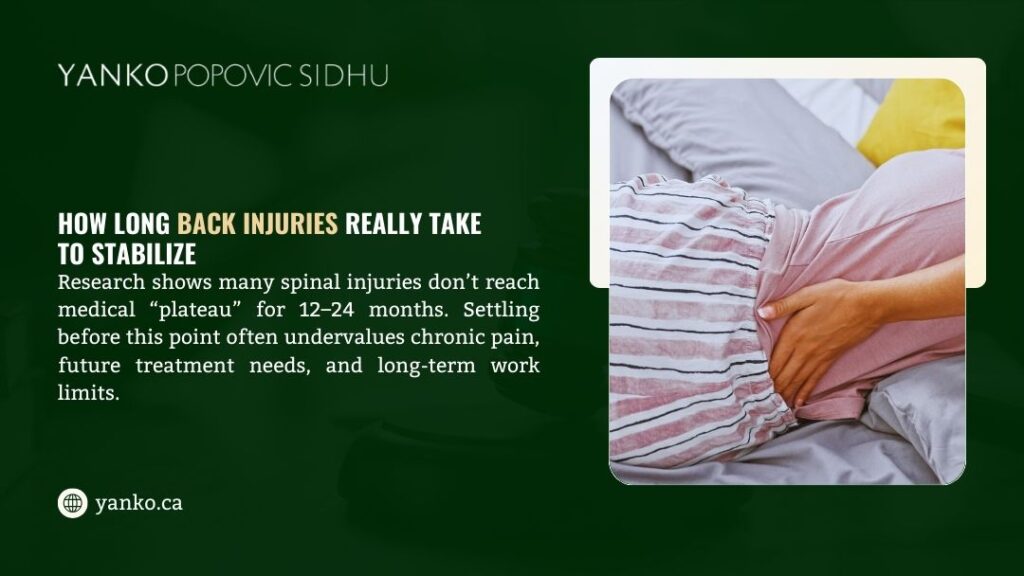
The second phase starts once recovery reaches a plateau. This does not mean full recovery. It means doctors can reasonably predict long-term impact. At this point, wage loss, future care needs, and pain and suffering can finally be assessed.
The final phase involves negotiation or litigation. Some cases resolve through direct settlement talks. Others require mediation or court proceedings, particularly when chronic pain or work limitations remain disputed.
Rushing this timeline almost always benefits the insurance company, not the injured person.
Common Insurance Company Tactics With Back Injury Claims
Insurance companies rarely accuse claimants of exaggeration outright. Instead, they rely on quieter strategies that slowly reduce claim value.
One common tactic involves focusing on degenerative findings in imaging, even when symptoms appeared only after the collision. Another involves selective reading of treatment notes, highlighting isolated improvements while ignoring setbacks.
Independent medical examinations often play a role, especially in back injury claims involving chronic pain. These assessments may minimize symptoms or attribute them to non-accident causes.
Surveillance, social media review, and repeated document requests also appear frequently. Each tactic aims to create doubt, delay resolution, or pressure early settlement.
Understanding these patterns helps injured people recognize when negotiation has shifted from evaluation to attrition.

Documents That Support a Higher Back Injury Settlement
A stronger back injury settlement is built on records that consistently show when the injury began, how it progressed, and how it continues to affect daily life and work. Clear, organized documentation reduces room for dispute and helps tie symptoms directly to the accident.
Document typeWhat it showsWhy it matters to settlement valueEmergency room recordsImmediate symptoms and mechanism of injuryEstablishes a clear link between the crash and the back injuryFamily physician notesOngoing complaints and clinical findingsDemonstrates persistence rather than short-term discomfortPhysiotherapy and chiropractic recordsFunctional limitations and response to treatmentConfirms effort to recover and tracks objective changeDiagnostic imaging reportsStructural findings such as disc or nerve involvementSupports severity, especially when symptoms alignSpecialist assessmentsIndependent medical opinionsAdds credibility and long-term prognosisMedication recordsPain management and symptom controlShows injury impact on daily functioningEmployment and payroll recordsLost wages or modified dutiesQuantifies financial lossWorkplace accommodation lettersReduced capacity or restrictionsSupports long-term earning impactPersonal symptom journalDay-to-day pain and activity limitsProvides context missing from clinical charts
When these records align over time, they form a narrative that insurers find difficult to dismiss, strengthening both negotiation leverage and overall settlement outcomes.
When to Speak With a Car Accident Lawyer About a Back Injury Settlement
Legal advice becomes critical once a back injury affects work, daily function, or recovery timelines. This is especially true when insurers push early settlement or raise pre-existing condition arguments.
Cases involving nerve symptoms, chronic pain, or inconsistent insurer communication benefit from early review. A consultation often clarifies options, timelines, and realistic expectations without committing to litigation.
Waiting too long can narrow choices. Speaking too early rarely does.
Car Accident Settlement Examples for Back Injury in Alberta
Settlement outcomes depend on facts, not formulas. The scenarios below illustrate how value shifts based on impact and proof rather than promises of average payouts.
ScenarioInjury profileWork impactTypical settlement rangeMild soft tissueResolves within monthsMinimal time offLower rangeDisc injuryOngoing symptomsModified dutiesMid rangeChronic painLong-term limitsReduced capacityHigher range
For a more localized perspective, many people take time to review car accident settlement payouts in Alberta to better understand how compensation is typically approached before entering negotiations.

Conclusion:
A car accident settlement for back injury isn’t about finding the highest number online. It’s about understanding how Alberta law values evidence, credibility, and long-term impact. Back injuries change lives quietly and often permanently, which makes careful handling essential.
If symptoms persist, work suffers, or insurers begin pushing for a quick resolution, it’s time to step back and get informed. The lawyers at Yanko Popovic Sidhu have spent decades guiding injured Albertans through this exact process, from first treatment to final settlement.
A focused conversation can clarify what your case is truly worth and what steps protect it. When the injury is real, the approach should be as well.

Discover More