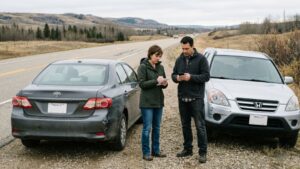
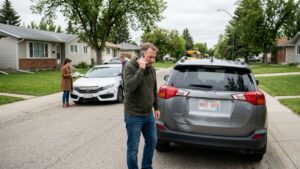
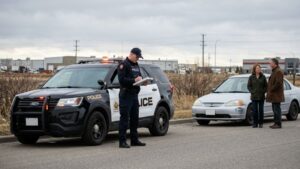
A car accident can turn an ordinary day upside down in seconds. One moment, you are driving to work, picking up your kids, or heading home in winter traffic. The next, you are standing beside a damaged vehicle, trying to think clearly while everyone around you is upset.
In this article, we explore what to do immediately after a car accident in Alberta, including when to call 911, when to report the accident, what information to exchange, how to deal with your insurance company, and when legal help may protect your claim. The goal is simple: help you make calm, practical decisions at a moment when most people feel anything but calm.
What to Do Immediately After a Car Accident in Alberta
If you are wondering what to do immediately after a car accident in Alberta, start with safety. Stop your vehicle. Check yourself and your passengers. Look for injuries. Call 911 if anyone is hurt, if a vehicle cannot be driven, if the road is blocked, or if the crash scene feels unsafe.
After that, the next steps are about record-keeping. Exchange contact information, insurance information, and licence plate numbers. Take photos before the scene changes. Write down what you remember while it is still fresh. Report the accident if Alberta law or local police rules require it. Contact your insurer, but stick to facts and avoid guessing.
That last part matters more than people think. A driver may say too much at the roadside, especially when nerves are high. The Government of Alberta gives clear advice: “Do not admit fault, take responsibility, or sign any statements. Do not pay for damages or make promises at the scene.” That guidance appears on Alberta’s official automobile collisions and insurance page, and it is worth following.
Calgary’s own road safety numbers also show why this topic deserves care. In 2025, Calgary’s Vision Zero reporting noted that 15 pedestrians and 20 motorists lost their lives on city roads. Not every crash is fatal or catastrophic, of course. Still, even a crash that looks minor at first can lead to injuries, insurance disputes, and questions about fault.
A good rule is this: handle the scene carefully now so you are not trying to fix missing details later.
First, Stop and Check for Injuries
Leaving the scene after a motor vehicle collision can create serious legal problems. Even if the crash seems small, stop as close to the scene as safety allows. Turn on your hazard lights and take a moment before stepping out. Look for traffic, ice, broken glass, leaking fluid, or a vehicle sitting in a dangerous position.
Check yourself first. Then check passengers, the other driver, pedestrians, cyclists, or anyone else involved in a collision. Pain, bleeding, confusion, dizziness, chest pain, trouble breathing, or possible head, neck, or back injuries should be treated seriously. Call 911 and wait for emergency help.
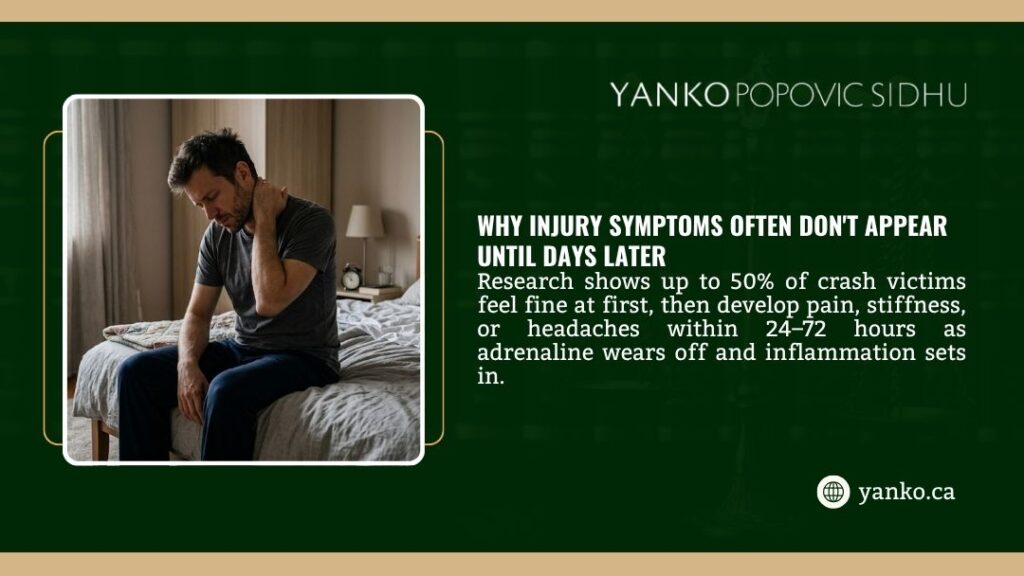
It is also worth remembering that some injuries take their time. A person may feel “fine” at the scene and wake up the next morning with neck pain, headaches, shoulder stiffness, back pain, or concussion symptoms. That is not unusual. Shock and adrenaline can hide pain for a while.
So, even if everyone is standing and talking, do not rush the situation. Take it seriously. Keep records. Get checked if anything feels off.
When to Call 911 After a Car Accident in Alberta
Call 911 after a car accident in Alberta if anyone is injured, a vehicle is not drivable, traffic is blocked, a driver may be impaired, or the crash involves a pedestrian, cyclist, or serious hazard. If the other driver leaves the scene, that should also be reported.
In Calgary, police say a collision must be reported if someone is injured, the damage is more than $5,000, or the crash is a hit and run. Calgary Police also directs drivers to call 911 or the non-emergency line at 403-266-1234 when someone is hurt, or a vehicle cannot be driven. Understanding the claims process after reporting the accident can also help ensure the necessary documentation is in place for your insurance or legal claim.
The repair cost can be hard to judge at the scene. A bumper may look scratched, but sensors, cameras, mounts, panels, and frame parts can make the final estimate much higher. When in doubt, report the accident properly and let the paperwork support the claim.
| Situation at the Scene | What to Do |
| Someone is hurt or may be hurt | Call 911 |
| A vehicle cannot be driven | Contact police and arrange a tow truck |
| Damage may exceed $5,000 | Report the accident and get a police file number |
| The other driver leaves | Report it as a hit and run |
| Vehicles are drivable, and no one seems hurt | Exchange information, take photos, and follow reporting rules |
| A driver seems impaired or aggressive | Stay back, avoid argument, and call police |
Move the Vehicles Only When It Is Safe
A crash on Deerfoot Trail, Stoney Trail, a rural highway, or a narrow winter road can become more dangerous fast. If the vehicles are drivable and no one is seriously hurt, move them away from live traffic when it is safe. If a vehicle cannot move, get yourself and your passengers to a safer spot and wait for help.
Winter adds another layer. Alberta roads can change from clear to slick in a short distance. Black ice, blowing snow, freezing rain, slush, poor visibility, and sudden braking can all affect how a collision happens. If road conditions played a role, take photos. Those details may matter later if fault is disputed.
Avoid standing between vehicles. Avoid walking around in a live lane. Avoid arguing where traffic is still moving. The safer choice is usually to step away from the road and let police, emergency workers, or a tow truck manage the risky parts.
Exchange Contact Information, Insurance Information, and Licence Plate Numbers
Once everyone is safe, exchange information with the other driver. Keep the conversation short and factual. You do not need to decide who caused the crash at the roadside.
The information you collect may later be used by police, your insurance company, a repair shop, or a lawyer. Missing details can slow the claim or make fault harder to prove.
| Information to Collect | Why It Matters |
| Full name and contact information | Helps identify the driver and support the claim |
| Driver’s licence details | Confirms who operated the vehicle |
| Insurance information | Needed when contacting your insurer |
| Vehicle registration | Confirms ownership and vehicle details |
| Licence plate number | Helps identify the vehicle if facts are disputed |
| Vehicle make, model, year, and colour | Supports the police report and insurance record |
| Witness names and phone numbers | Useful if the other driver’s story changes |
| Police file number | Helps your insurer connect the claim to the report |
If the other driver refuses to share information, do not chase, threaten, or argue. Record what you can. The licence plate number, vehicle description, driver description, location, and time can all help. Then contact police.
Take Photos Before the Scene Changes
A car accident scene rarely stays the same for long. Vehicles get moved. Snow covers road marks. Traffic resumes. Witnesses leave. People calm down and sometimes remember things differently.
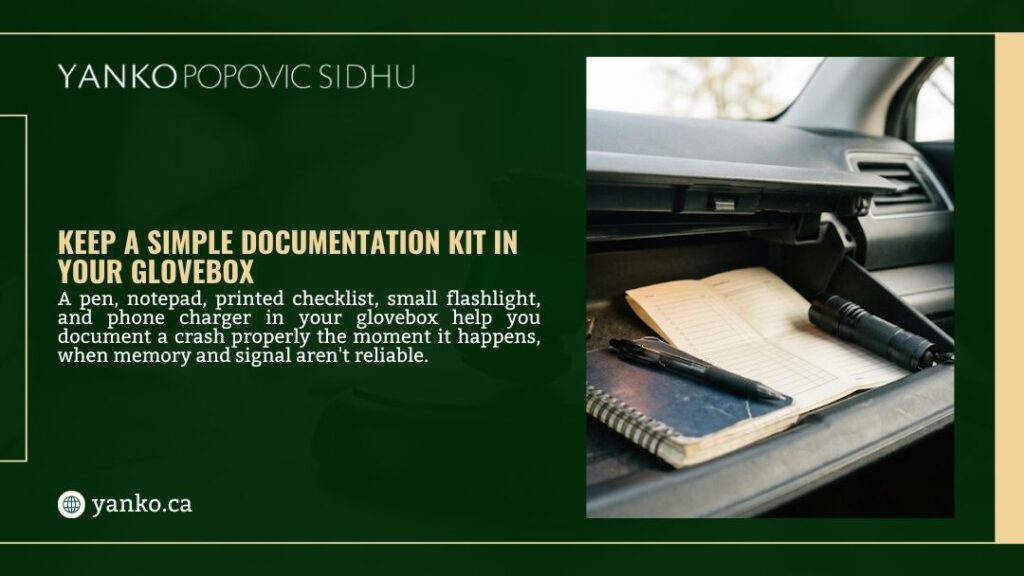
Take photos if it is safe. Capture the full scene, not only close-up damage. Include vehicle positions, licence plates, traffic lights, stop signs, lane markings, skid marks, debris, weather, road surface, and visibility. If you have visible injuries, photograph those too.
Dashcam footage should be saved quickly. Some systems overwrite old files. Nearby businesses, homes, parking lots, or transit cameras may also have footage, but it can disappear if no one asks for it.
A short note on your phone can also help. Write down where you were going, what lane you were in, how traffic was moving, what the road looked like, and what anyone said at the scene. Keep it factual. You are not writing an argument. You are preserving memory.
Alberta Collision Report Rules: When You Must Report the Accident
Alberta has specific reporting rules. A collision must be reported to police if someone is injured, if a driver does not have proper documents such as a licence, registration, or insurance, if a vehicle is not drivable, or if the combined damage is $5,000 or more.
That $5,000 threshold is important, but it can be tricky. A driver may think the damage is minor because the vehicle still runs. Later, the estimate may show hidden damage. If the repair cost may be near the limit, report the accident.
Calgary Police uses the same practical triggers: injury, damage over $5,000, or hit and run. If one of those applies, complete the required collision report before repairs move too far ahead.
| When Reporting Is Required | What Should Happen Next |
| Someone is injured | Call 911 or contact police as directed |
| Damage exceeds $5,000 | File the required collision report |
| The accident is a hit and run | Report to police right away |
| A driver lacks documents | Contact police and keep records |
| A vehicle cannot be driven | Contact police and arrange safe removal |
| Repairs require a police file | Complete the report before repair work proceeds |
How to File an Alberta Collision Report
How you file an Alberta collision report depends on the crash. Police may attend serious scenes. For less severe collisions, you may need to go to a police station, district office, collision reporting centre, or use an approved online option.
Alberta’s Report My Collision service may apply to certain collisions where there are no injuries, no fatalities, and no existing police report. Calgary Police also lists online reporting as one option for eligible non-injury crashes.
If you report in person, bring the documents you have. Your driver’s licence, vehicle registration, proof of insurance, the other driver’s information, photos, and any tow truck records may all be useful. Ask for the police file number and keep it somewhere easy to find. Your insurer may ask for it.
Contacting Your Insurer After an Accident in Alberta
Contacting your insurer is usually one of the next steps after the scene is handled. Even when the accident was not your fault, your insurer needs to know what happened.
Keep the report factual. Give the date, time, location, names, vehicle details, police file number, and a basic description of what happened. Avoid guesses. Avoid saying you caused the crash. Avoid downplaying injuries too early.
A common mistake is saying, “I’m fine,” because you feel embarrassed or want to end the call. If symptoms have not settled yet, say that. You can tell the insurer you are monitoring your condition or plan to see a doctor.
Your insurance company has a job to do, but it is not the same job as your personal injury lawyer. The insurer handles the claim from its side. A lawyer looks at what protects you, especially if you were hurt, fault is disputed, or a settlement offer arrives before your injuries are fully understood.
If an adjuster asks for a recorded statement and you are unsure what to say, get advice before giving one. A rushed statement can leave out pain, confusion, or details that only become clear later.
See a Doctor Even If You Think You Are Fine
Medical care matters after a car accident. It matters for your health first. It also matters because an injury claim depends on proof.
Some symptoms show up right away. Others do not. Whiplash, soft tissue injuries, concussion symptoms, back pain, shoulder injuries, nerve pain, headaches, and sleep problems can develop after the first shock passes.
A doctor can assess your symptoms, recommend treatment, and create a record that links the injury to the accident. That record may matter later if you claim pain and suffering, lost income, future care, therapy costs, or reduced earning capacity.
Do not skip follow-up visits if symptoms continue. Long gaps in treatment can give an insurance company room to argue that the injury was not serious or was not caused by the crash. If work becomes harder, say so. If driving, lifting, sleep, childcare, or daily tasks become painful, make sure that is recorded.
What Not to Say or Do at the Accident Scene
The roadside is not the place to settle fault. It is also not the place to make promises. Do not admit fault. Do not say the accident was your fault. Do not offer cash. Do not promise to pay for damage. Do not sign a statement. Do not agree to keep the accident away from insurance if there may be injuries or serious damage. Do not post about the crash online.
Being polite is fine. Taking responsibility before the evidence is reviewed is different. Let the photos, witness details, collision report, vehicle damage, and road conditions tell the story.
If the other driver pressures you, stay calm. Exchange information, contact police if needed, and avoid a roadside argument.
Small Car Accident: What to Do If the Damage Looks Minor
A small car accident can still turn into a complicated claim. Maybe the bumper looks scratched. Maybe both drivers feel okay. Maybe the other person says, “Let’s not make this a big deal.”
That can be tempting. Still, take the basic steps. Exchange information, photograph the damage, note the location, and contact your insurer. If the damage may exceed $5,000 or anyone feels hurt, report the accident.
So, small car accident: what to do? Treat it like a real incident, not a casual inconvenience. A minor-looking crash can still involve hidden damage, delayed symptoms, or a driver who changes their story later. A clear record protects everyone.
I Got in an Accident, and It Wasn’t My Fault: What Changes?
Many people search “I got in an accident, and it wasn’t my fault” because they want to know if they can skip certain steps. You should not.
Even if the other driver ran a red light, rear-ended you, or apologized at the scene, you still need to protect the record. Stop. Exchange information. Take photos. Get witness names. Report the accident when required. Contact your insurer. See a doctor if you may be hurt.
Fault can be reviewed later. The stronger your evidence, the harder it is for an insurer or another party to rewrite the story. If the insurance company disputes fault, delays the claim, or makes an offer that feels too low, speaking with an experienced Calgary car accident lawyer can help you understand where you stand before you sign anything.
What Happens After an At-Fault Car Accident in Alberta?
An at-fault car accident may affect insurance and can also affect an injury claim. That does not mean you should decide fault yourself at the scene.
Accidents can involve shared responsibility. One driver may have braked suddenly. Another may have followed too closely. Poor road conditions, unsafe lane changes, distraction, speed, visibility, or traffic control signs may all matter.
If an insurance company says you caused the crash, ask what evidence supports that decision. Keep your own photos, notes, medical records, and police report details. Fault should be based on evidence, not pressure.
Yanko Popovic Sidhu’s overview on how fault is determined after a car accident can help Alberta drivers understand how these disputes may affect a personal injury claim.
What If Someone Drove My Car and Got in an Accident?
“Someone drove my car and got in an accident” is a question that depends heavily on the facts. Did they have permission? Were they licensed? Were they covered under the policy? Were they impaired? Was anyone injured?
Insurance coverage may depend on the policy, the driver’s permission, and the details of the crash. Contact your insurer promptly and write down what happened. If there are injuries, serious damage, disputed fault, or an uninsured driver issue, get legal advice before making assumptions.
These situations can become messy because the owner, driver, insurer, injured person, and other parties may all have different interests. A clear paper trail helps.
What If the Other Driver Leaves the Scene?
A hit and run is stressful because the person who caused the problem may be gone before you can get answers. Stay at the scene if it is safe. Call police. Write down anything you remember: licence plate number, vehicle colour, make, model, direction of travel, driver description, and damage location.
Ask witnesses for their contact information. Look around for cameras. Homes, stores, parking lots, buses, dashcams, and traffic cameras may have recorded something. That evidence can disappear quickly, so act early.
If the at-fault driver is unknown and you were injured, Alberta’s Motor Vehicle Accident Claims program may apply in some cases. The Government of Alberta says potential claims involving an unknown driver should be reported within 90 days of the accident.
That deadline is short. If you were hurt in a hit and run, early advice matters. Yanko Popovic Sidhu helps injured people with hit-and-run accident claims and can explain what steps may apply when the other driver cannot be found.
How Long After an Accident Can Someone Sue You in Alberta?
People often ask, “How long after an accident can someone sue you?” In Alberta, many personal injury claims are subject to a two-year limitation period. That said, limitation periods can depend on the facts, the parties involved, the type of claim, and when a person knew or should have known key details.
Do not rely on a general internet answer if legal papers, insurer letters, or a possible injury claim are involved. If you receive a demand letter or court document, deal with it promptly. If you were injured and may need to bring a claim, do not wait until the deadline is close. Evidence fades. Witnesses move. Medical records take time to build.
Car Accident Settlement Payouts in Alberta Depend on the Evidence
Car accident settlement payouts Alberta drivers receive can vary widely. There is no honest flat number that applies to everyone.
A settlement may depend on fault, injury severity, medical records, lost income, future earning capacity, treatment needs, long-term pain, disability, age, work duties, and how the injuries affect daily life. Car accident settlements Alberta insurers review tend to be document-heavy. The clearer the record, the clearer the claim.
If an insurance company makes an offer before you understand your diagnosis or future care needs, slow down. A quick settlement may not account for long-term symptoms, missed work, future treatment, or permanent impairment. Yanko Popovic Sidhu’s explains why settlement value depends on evidence, not guesswork.
Common Mistakes That Can Hurt an Alberta Car Accident Claim
Most people do not ruin a claim with one dramatic mistake. More often, the problem is a series of small gaps. No photos. No witness names. No doctor visit. No police file number. A rushed statement. A quick settlement offer before the injury picture is clear.
| Mistake | Why It Can Hurt |
| Leaving the scene too soon | It can create legal and credibility problems |
| Not collecting information | It makes the insurance process harder |
| Skipping photos | It leaves fewer records once the scene changes |
| Waiting too long for medical care | It may weaken the injury record |
| Admitting fault | It may be used before the evidence is reviewed |
| Taking a fast settlement | It can close the claim before future losses are known |
| Posting online | Photos or comments may be taken out of context |
| Ignoring insurer letters | Delays and missed steps can hurt the claim |
Here’s the problem: most injured people do not know what matters until the insurer starts asking questions. By then, some evidence may already be gone.
When to Speak With a Car Accident Lawyer in Alberta
You may not need a lawyer for every minor fender-bender. But if you were injured, symptoms continue, you missed work, the insurer blames you, the other driver left the scene, a commercial vehicle was involved, or the settlement offer feels low, it is worth getting legal advice.
Yanko Popovic Sidhu is a personal injury law firm focused on helping injured clients across Alberta. The firm’s approach is direct and lawyer-led. At Yanko Popovic Sidhu, clients work directly with experienced lawyers from day one, not through layers of case managers or unclear handoffs. Their lawyers handle the file, explain the process, and help protect the client’s interests from start to finish.
That matters after a car accident. The legal process can feel cold, slow, and technical. Injured people often want plain answers. Is the insurer being fair? Should I give a statement? Should I sign the release? What if my pain gets worse? What if I cannot work the way I used to?
A hands-on lawyer-to-client model can make those choices easier. It gives clients a person to speak with, not a system to chase.
If a crash caused serious injuries, long-term symptoms, or a dispute with an insurance company, Yanko Popovic Sidhu can review the situation and explain the next step. Claims involving commercial vehicles may also require guidance from a truck accident claim in Alberta lawyer, while injured riders may need support from a motorcycle accident lawyer who understands the risks riders face on Alberta roads.
Alberta Car Accident Checklist
A short checklist can help when your memory feels scattered after a crash. Use it as a guide, but put safety and medical emergencies first.
| Timeframe | What to Do |
| At the scene | Stop, check for injuries, call 911 if needed, and stay safe |
| Before vehicles move | Take photos if it is safe and note road conditions |
| Before you leave | Exchange contact information, insurance information, and licence plate numbers |
| Same day | Report the accident if required and contact your insurer |
| Within 24–48 hours | See a doctor if you have pain, stiffness, dizziness, headaches, or new symptoms |
| Over the next week | Keep receipts, medical notes, photos, repair records, and insurer messages |
| Before settlement | Understand your injuries, income loss, future care needs, and legal options |
FAQs About What to Do After a Car Accident in Alberta
Do I have to report every car accident in Alberta?
No. Not every minor collision requires the same reporting process. You must report the accident if someone is injured, damage exceeds the reporting threshold, the collision is a hit and run, a vehicle is not drivable, or other reporting rules apply.
What information must I exchange after a collision?
Exchange contact information, driver’s licence details, insurance information, registration details, and the licence plate number. It also helps to record the vehicle make, model, colour, location, time, witness details, and scene photos.
Can I leave the scene after a minor crash?
Do not leave until you stop, check for injuries, exchange information, and complete any required reporting. If the other driver leaves without providing details, report it as a hit and run.
Should I call a tow truck or drive away?
Call a tow truck if the vehicle is unsafe, leaking fluid, has steering or brake problems, has airbag damage, has major body damage, or cannot legally be driven. If you are unsure, do not take the risk.
What if road conditions caused the accident?
Road conditions may be relevant, especially in Alberta winter months. Poor weather does not automatically decide fault. Take photos of snow, ice, visibility, lane markings, traffic signs, and vehicle positions.
What if the insurance company blames me?
Ask what evidence supports that decision and keep all correspondence. Fault should be based on evidence. If the insurer’s position seems unfair, a lawyer can review the collision report, photos, statements, and medical evidence.
What if I was a passenger?
Passengers can still have injury claims. A passenger may have a claim even if the at-fault driver was in the same vehicle. Speak with a lawyer if you were hurt, especially when more than one driver may share responsibility.
Protect Your Health, Your Claim, and Your Next Step
Knowing what to do immediately after a car accident in Alberta can make a hard day less confusing. Stop. Check for injuries. Call 911 when needed. Exchange information. Take photos. Complete the Alberta collision report if required. Contact your insurer. Get medical care if anything feels wrong.
Just as important, avoid fault admissions, roadside deals, rushed statements, and quick settlements before the full picture is clear.
If you are hurt, worried about missed work, unsure what the insurer is asking for, or tired of trying to handle the claim alone, Yanko Popovic Sidhu can help you understand the next step before you make a decision that affects your future. The firm provides direct, hands-on legal support for personal injury clients across Alberta, with experienced lawyers who guide clients through the process without the runaround.
For clear advice after a crash, contact Yanko Popovic Sidhu through their Alberta personal injury law firm website and speak with a lawyer who can help protect your health, your claim, and your peace of mind.