If you were in a crash and left without calling police, you may be worried that your claim is already ruined. In Alberta, that is not always true. A police report can help prove what happened, but it is not the only evidence an insurance company or personal injury lawyer can use. The bigger questions are whether the accident legally had to be reported, whether anyone was hurt, how much property damage occurred, and whether you can still gather reliable proof.
In this article, we explore whether you can still make a claim after an Alberta accident without a police report, what evidence may help, and when legal advice becomes important.
Can I Still Make a Claim If I Didn’t Call Police After Accident Alberta?
Many drivers ask the same question after a stressful crash: can I still make a claim if I didn’t call police after accident alberta? In many cases, yes, you may still be able to start an insurance claim or personal injury claim even if police were not called at the scene. A missing police report can make the claims process harder, but it does not automatically end your right to seek compensation.
Here’s the thing. Insurance companies do not rely on one document alone. They may review photos, repair estimates, witness names, medical records, vehicle damage, dashcam footage, driver statements, and the timeline of events. If the accident in Alberta caused injury, major damage, or a hit and run, the lack of an Alberta collision report can raise concerns. Still, a late report, proper medical records, and clear evidence may help repair the situation.
For injured clients, the issue is rarely just paperwork. Pain can appear hours or days later. A motor vehicle accident that seemed minor at the roadside may later involve neck pain, back pain, concussion symptoms, lost work, or long-term treatment. That is why it is wise to document the accident as soon as possible and speak with an experienced Alberta car accident lawyer if symptoms have started or the insurance company is pushing back.
When Do You Need to Report a Car Accident in Alberta?
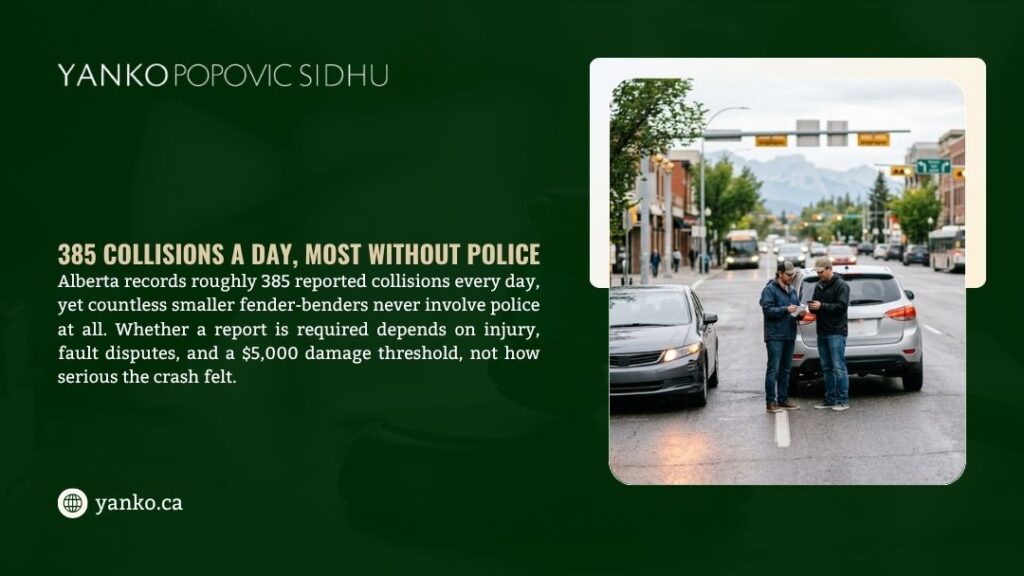
Alberta does not require police at the scene for every small bump. But certain collisions must be reported. As of January 1, 2024, Alberta raised the property damage reporting threshold from $2,000 to $5,000, which means drivers must report a collision to police when estimated property damage is over $5,000. Collisions that involve injury or death must also be reported, regardless of the repair cost, according to public Alberta collision-report guidance.
That detail matters because a person may think the crash was minor at first, only to find out later that the repair estimate is far above the threshold. Modern vehicles are expensive to repair. A cracked bumper, damaged sensor, hidden frame issue, or airbag-related repair can push a claim past $5,000 faster than most drivers expect.
| Accident situation | Police report usually needed? | Why it matters for your claim |
| Someone is injured | Yes | Injury creates medical, insurance, and legal issues that need a clear record. |
| Someone dies | Yes | Fatal collisions require immediate police involvement. |
| Combined property damage appears over $5,000 | Yes | Alberta’s reporting threshold changed to $5,000 as of January 1, 2024. |
| Public property is damaged | Yes | Damage to signs, barriers, posts, or public structures can trigger report duties. |
| A driver refuses to provide information | Yes | Police involvement helps record identity, insurance, and driver’s license details. |
| A driver leaves the scene | Yes | Hit-and-run claims depend heavily on early reporting and evidence. |
| Minor car accident: no police report, no injury, damage clearly under $5,000 | Not always | You should still notify your insurer and keep a record. |
So, do I need a police report to file a claim? Not in every case. But if the accident met Alberta’s reporting rules, the insurance company may ask for a police file number or a driver’s copy of the collision report. If you skipped that step, it is better to deal with it promptly than hope it will not come up.
What If the Accident Seemed Minor at First?
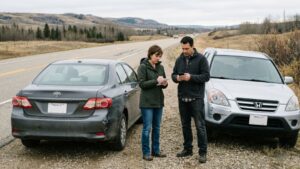
A minor car accident no police report situation is common. Two drivers pull over, exchange names, look at the bumpers, and decide not to involve police. At the time, that can feel reasonable. The trouble starts when the next morning brings pain, the body shop estimate is higher than expected, or the other driver changes their story.
A car accident without a police report is not always a legal disaster. Still, it leaves more room for dispute. Without a police file, the insurance company may lean more heavily on photos, statements, estimates, and medical notes. If you have very little evidence, the claim may turn into one driver’s word against the other’s.
If pain developed after the crash, do not brush it off just because you did not call police. Soft tissue symptoms, headaches, dizziness, and back pain may need medical review. If whiplash is part of the injury, understanding the whiplash settlement cap in Alberta can help explain how Alberta treats certain minor injury claims.
Can You File an Insurance Claim Without a Police Report?
Yes, you can often file an insurance claim without a police report, but the claim may need stronger supporting evidence. The insurance company will want to know when the collision involved each vehicle, where it happened, who was there, whether a driver was at fault, and whether the vehicle damage matches the story.
This is where people usually ask several versions of the same question. Can you claim a car accident without a police report? Can you file an insurance claim without a police report? Do you need a police report for an insurance claim? The practical answer is that a police report is helpful, and sometimes required by law, but an insurer can still review an insurance claim without a police report if there is enough proof.
For example, if you were stopped at a red light and rear-ended, the insurer may look at photos of rear-end damage, witness statements, repair records, and medical reports. If the other driver admits fault in writing, that may help. If a nearby business has security video, that may be important. If you took photos of the other driver’s license plate and insurance card, that can help too.
The problem is delay. Alberta’s automobile collision guidance warns that late contact with an insurer or missing details may make a claim harder to process. That does not mean the claim fails automatically. It means the insurer may ask more questions.
What Evidence Can Help If There Is No Police Report?
When there is no police report for an insurance claim, evidence becomes more important. A police report can serve as a neutral record of the collision, but other proof may still support your version of events.
| Evidence | How it can support a claim |
| Scene photos | They can show road conditions, traffic lights, lane position, skid marks, weather, and vehicle placement. |
| Vehicle damage photos | Impact points may help show how the accident happened. |
| Driver information | Names, phone numbers, insurance details, and driver’s license information help confirm who was involved. |
| Witness names | Independent witnesses can make a disputed claim much stronger. |
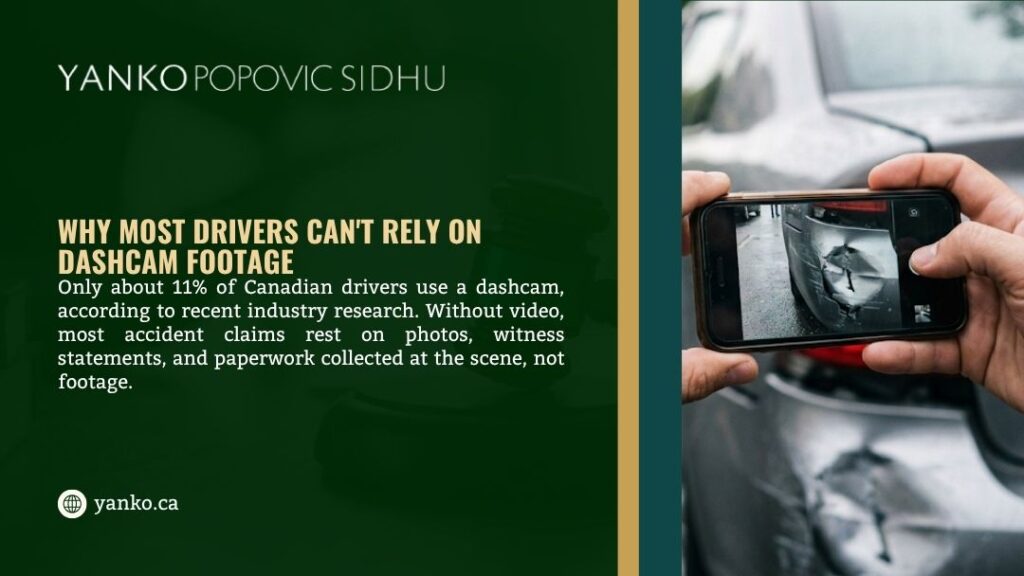
| Dashcam footage | Video can settle arguments about speed, lane changes, traffic signals, and fault. |
| Surveillance footage | Nearby stores, homes, or parking lots may have cameras. |
| Medical records | They connect symptoms to the accident and support a personal injury claim. |
| Repair estimates | They help prove property damage and may show whether the accident had to be reported. |
| Written timeline | A dated note can preserve details before memory fades. |
| Insurer correspondence | Emails and claim numbers help show that you acted after the collision. |
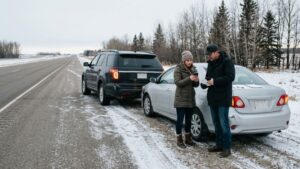
If you did not call police, write down what happened while the memory is fresh. Include the date, time, location, weather, direction of travel, traffic conditions, names, vehicle descriptions, and what each driver said. Small details may matter later.
What Should You Do Now If You Did Not Call Police?
If the accident happened recently, do not panic. Start with the facts. Was anyone hurt? Is the vehicle damage close to or above $5,000? Did a driver leave the scene? Was public property damaged? Did the other driver refuse to share information? If the answer is yes to any of these, contact the proper police service or attend a police station to ask how to report the accident now.
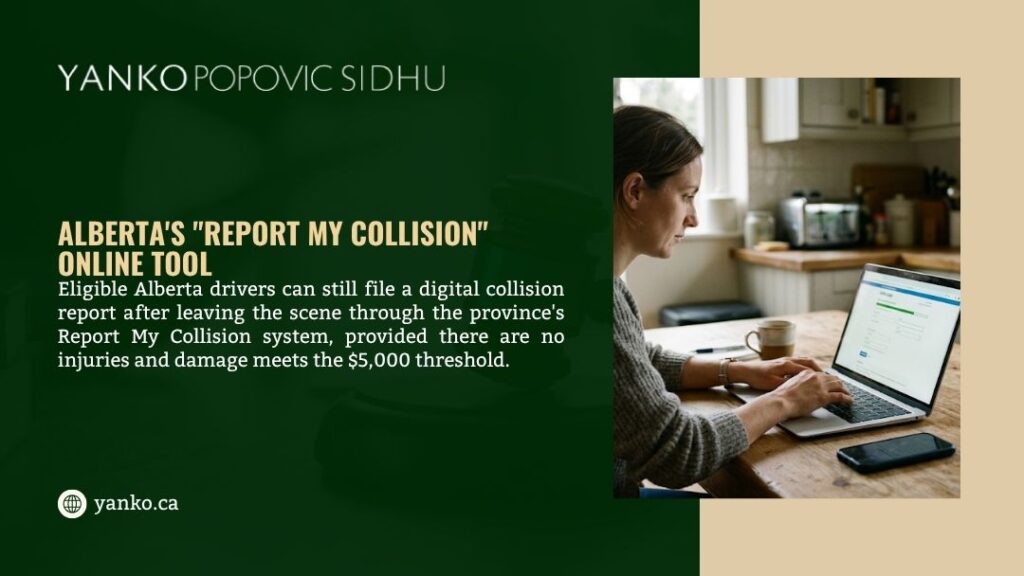
Alberta also provides collision report information and online collision-report options for certain eligible collisions. If a driver’s copy of the collision report becomes available, Alberta says that document can be used to start the insurance claim.
After that, notify your insurer. Give clear facts. Avoid guesses. Do not exaggerate, but do not minimize injuries either. If you have pain, book a medical appointment and explain that the symptoms followed a motor vehicle accident. Medical records are often one of the most important parts of car accident claims.
If the insurance company is already questioning the delay or refusing the claim, knowing what to do when a car accident claim is denied in Alberta can clarify the next steps. A denial is not always the end of the road.
Will Late Reporting Hurt My Claim?
Late reporting can hurt a claim, but it depends on the facts. If the collision clearly should have been reported and there is no police file, the insurer may ask why. If you waited weeks to see a doctor, the insurer may argue the injuries came from something else. If you waited too long to notify your insurer, you may face policy problems.
That said, real life is not tidy. People get shaken up. Some drivers believe the other person will handle it honestly. Others feel fine at the scene and only notice pain later. A late report may still help if you act quickly once you realize the accident was more serious than expected.
For personal injury claims in Alberta, timing matters. Medical attention, insurer notice, witness preservation, and repair evidence all become harder with delay. If you are unsure what to do next, get legal advice before giving broad statements to an adjuster.
Does a Police Report Decide Who Was at Fault?
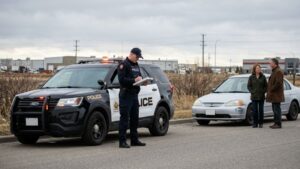
No. A police report can be useful, but it does not automatically decide who was legally responsible. The Government of Alberta states that “Police do not determine liability; this is determined in part by insurance companies.” That matters because a missing police report does not always destroy a claim, and a police report by itself does not always settle fault.
An insurance company may still review the collision scene, the damage pattern, witness statements, road rules, repair records, photos, and driver statements. If the insurer says the driver was at fault and you disagree, there may be ways to challenge that decision.
Yanko Popovic Sidhu’s information on how fault is determined after a car accident in Alberta can help clarify liability disputes for drivers seeking a clearer understanding of the process.
What If I Was in an At Fault Car Accident?
An at-fault car accident does not always mean there is nothing to claim. Fault can affect compensation, but it may not erase every available benefit or insurance option. Some accident benefits may still be available under an auto policy, depending on the policy, injury, and circumstances. If another driver was also partly responsible, fault may need a closer review.
This is especially relevant when both drivers made mistakes. One driver may have turned left too soon while the other was speeding. One driver may have changed lanes without care while the other failed to brake. Alberta claims can involve shared fault, and the percentage assigned to each driver may affect the result.
For shared responsibility situations, information on a both drivers at fault car accident in Alberta can provide clarity on how fault is assessed.
What If I Got Hurt but Did Not Report the Accident?
If you were injured and did not report the accident, take the situation seriously. An injury claim needs proof. A police report may help, but medical records, photos, witness details, treatment notes, and insurer communication can also matter.
Do not wait to see whether the pain disappears if symptoms are persistent or severe. A doctor, physiotherapist, or other health care provider can assess the injury and create a record. If you later seek compensation for pain, income loss, treatment costs, or future care, those records may become central to the claim.
Alberta injury claims often involve more than a repair bill. A person may need treatment, time off work, help at home, future medical care, or compensation for pain.
Parking Lot Accident No Police Report: Can You Still Claim?
A parking lot accident no police report situation can still lead to an insurance claim. Drivers often treat parking lot crashes as casual because speeds are low. But parking lots can still involve neck injuries, back injuries, pedestrian impacts, hit and runs, and costly repairs.
If the damage is over Alberta’s reporting threshold, someone is injured, or a driver leaves the scene, reporting becomes much more important. If the accident was small and no one was hurt, you may not need police at the scene, but you should still exchange information, take photos, and notify your insurer.
Parking lot fault can also be less obvious than people think. Right-of-way, reversing vehicles, stop signs, lane markings, speed, and driver attention may all matter. Understanding parking lot accident fault in Alberta can help explain why these claims are not always straightforward.
Hit and Run With No Police Report
A hit and run should be handled differently from an ordinary two-driver exchange. If the other driver left the scene, a police report can become very important. Do not chase the vehicle. Try to record the licence plate, make, model, colour, direction of travel, and any driver description. Look for witnesses and nearby cameras.
Alberta has a Motor Vehicle Accident Claims Program for certain situations involving uninsured or unknown drivers. For hit-and-run accidents, the program states that notice to MVAC must be provided within 90 days of the accident. Missing that notice deadline can create serious problems.
If you were hurt by a driver who left the scene, speak with a hit and run lawyer in Alberta before assuming there is no way to recover compensation.
How Long After an Accident Can Someone Sue You in Alberta?
In Alberta, limitation periods can affect injury claims, lawsuits, and legal rights. Many personal injury claims must be started within two years, but the exact deadline can depend on the facts, the parties involved, the type of claim, and when the injury was discovered. Some claims may have shorter notice rules, especially where unknown drivers, government-related issues, or specific insurance processes are involved.
This is why “how long after an accident can someone sue you” is not a question to answer casually. If you may have a claim, or if someone is claiming against you, get legal advice early. Waiting too long can limit options.
For people thinking about compensation, Yanko Popovic Sidhu’s personal injury settlement guide explains how settlement discussions may work once liability, injuries, treatment, and losses are better understood.
Common Mistakes After a Car Accident Without Police Report
Small mistakes after a collision can create large problems later. When there is no police report, those mistakes matter even more because there may be less neutral documentation.
| Mistake | Why it can create trouble |
| Waiting too long to notify your insurer | The insurance company may question the delay or say important details were lost. |
| Admitting fault at the scene | A shaken driver may apologize even when the evidence tells a different story. |
| Skipping medical care | The insurer may argue the injury was not caused by the accident. |
| Failing to take photos | Damage, road conditions, and vehicle positions can disappear quickly. |
| Not collecting witness names | Independent witnesses may be hard to find later. |
| Accepting a quick offer | Early offers may not reflect treatment needs, lost income, or lasting pain. |
| Leaving without driver information | Missing insurance and driver’s license details can slow the claim. |
| Assuming no police report means no claim | Many claims can still be reviewed if other evidence exists. |
If the insurance company makes an early offer, be careful. A fast settlement may sound useful when bills are due, but it can close the claim before the full injury picture is known. The firm’s resource on whether to accept the first settlement offer after a car accident explains why timing and medical clarity matter.
How Compensation May Be Affected Without a Police Report
A missing police report does not set the value of a claim. Compensation depends on injury severity, medical evidence, fault, treatment, income loss, future care, pain, and how the accident changed daily life. But the lack of a report can affect proof, and proof affects negotiation.
For example, a person with strong medical records, clear photos, repair estimates, witness support, and consistent statements may still have a solid claim. A person with no photos, no witnesses, late medical care, and conflicting accounts may face a harder fight.
If your injuries caused pain, time away from work, or long-term limits, the firm’s information on pain and suffering compensation in Alberta may be relevant. If the injury is serious enough to require ongoing care, details on future care costs after a serious injury may also be useful.
Insurance Claim Without Police Report: What the Adjuster May Ask
When you file an insurance claim without a police report, the adjuster may ask more detailed questions. That does not mean the claim is doomed. It means the insurer is trying to fill the gap left by the missing collision report.
| Adjuster question | What they are trying to confirm |
| Why were police not called? | Whether reporting was legally required and why the report is missing. |
| When did you notify your insurer? | Whether the claim was reported promptly under the policy. |
| Was anyone injured? | Whether medical records, accident benefits, or injury claims are involved. |
| What is the repair estimate? | Whether the damage crossed Alberta’s reporting threshold. |
| Do you have photos or video? | Whether there is proof beyond driver statements. |
| Did anyone witness the crash? | Whether a neutral person can confirm what happened. |
| Did the other driver admit fault? | Whether liability is supported by statements or messages. |
| Did you attend a police station later? | Whether a late collision report or file number exists. |
Answer carefully and truthfully. If you are unsure, say so. Guesswork can create contradictions. If the claim involves injury, denied benefits, disputed fault, or a low settlement offer, it may be wise to talk to a lawyer before giving a detailed recorded statement.
Do You Need a Police Report for a Car Insurance Claim Every Time?
No, not every time. A small scrape with no injury and damage clearly below the Alberta reporting threshold may not require a police report. Still, that does not mean you should treat it casually. You should exchange information, take photos, notify your insurer, and keep written notes.
The phrase “do you need police report for car insurance claim” has a practical answer: it depends on the facts. If the accident had injuries, death, hit and run, public property damage, or damage above the threshold, a report is important. If not, the insurer may still process the claim without one, but evidence will matter.
Can I Make an Insurance Claim Without a Police Report If It Wasn’t My Fault?
If you are saying, “I got in an accident, and it wasn’t my fault,” the missing police report can feel especially frustrating. You may still be able to claim, but you need to prove what happened. The other driver may admit fault at the scene and later deny it. That is why photos, witnesses, messages, and insurer records are important.
A police report can help create an official record, but fault is still reviewed through evidence. If the insurer unfairly blames you, legal advice can help. Information on insurance companies blaming drivers for an accident in Alberta may be useful if the adjuster’s version does not match the facts.
What to Say to the Insurance Company
When you notify your insurer, keep the report factual. Say where and when the accident happened, who was involved, what damage you noticed, whether you have injuries, and whether police were contacted. If police were not contacted, explain why. For example, you may have believed the damage was minor, no one appeared hurt, and both drivers exchanged information.
Do not say you are “fine” if symptoms are still unclear. Do not admit fault just to be polite. Do not guess the speed, distance, or injury diagnosis if you do not know. A clean, factual report is better than a rushed statement full of assumptions.
If injuries have appeared, say that you are seeking medical assessment. If the insurer asks for a broad release or quick settlement before your recovery is clear, pause before you sign.
When a Lawyer Should Review the Claim
Not every small accident needs a lawyer. But legal advice becomes more important when the accident caused injury, the other driver denies fault, the insurance company delays payment, the insurer says the missing police report is a problem, or you are offered a settlement before you know the full impact of the injury.
Yanko Popovic Sidhu’s approach is hands-on. Clients work directly with experienced lawyers, not case managers. That matters in a no police report claim because the file may need careful evidence work, insurer communication, medical documentation, and a clear explanation of why the claim is still valid.
For people with more serious injuries, settlement value can depend on many factors, including diagnosis, treatment, income loss, future care, and lasting pain. Information on car accident settlement payouts in Alberta provides useful context for understanding how compensation may be assessed.
FAQ: Alberta Car Accident Claims Without a Police Report
Do I need a police report to file an insurance claim in Alberta?
Not always. A police report may not be required for every minor accident, but it can be important if someone was hurt, the damage was over Alberta’s threshold, a driver left the scene, or public property was damaged. If the collision should have been reported, the insurer may ask for a police file number.
What if I did not report the accident right away?
Late reporting can make the claim harder, but it does not always end it. Report the accident as soon as you realize it should have been reported, notify your insurer, gather evidence, and seek medical care if you have symptoms.
What if I left the scene after exchanging information?
If no one was hurt and damage appeared minor, leaving after exchanging information may not ruin the claim. If there were injuries, serious damage, refusal to provide information, or a hit and run, contact police and your insurer promptly.
Can I claim compensation for pain without a police report?
Possibly. A personal injury claim depends heavily on medical evidence, proof of the accident, fault, and the effect on your life. A police report helps, but it is not the only proof.
Should I call 911 after every accident?
Call 911 if someone is injured, there is danger at the scene, a driver appears impaired, a vehicle cannot be moved safely, a driver becomes aggressive, or the collision is serious. For non-emergency collisions, local police reporting procedures may apply.
Can I still make a claim if I didn’t call police after the accident in Alberta months later?
It may still be worth a legal review, especially if you were injured. Delay can create proof and limitation issues, so do not wait longer. Gather your documents and ask a lawyer what options remain.
The Step That Protects Your Claim Now
If you are still asking, can I still make a claim if I didn’t call police after accident alberta, the safest answer is this: do not assume the claim is over. A missing police report can create problems, but it may not erase your right to insurance benefits or injury compensation. What matters now is how quickly you act, how well the accident is documented, and whether your injuries are properly connected to the collision.
Yanko Popovic Sidhu helps injured Albertans deal with car accident claims, insurance disputes, fault issues, and personal injury compensation. The firm’s lawyer-led approach means clients work directly with experienced lawyers from the start, with no case manager runaround and no guesswork about who is handling the file.
If you were hurt in an Alberta accident and did not call police at the scene, contact Yanko Popovic Sidhu today for a free consultation. A lawyer can review what happened, explain your next steps, and help you deal with the insurance company before one missing report becomes a bigger problem than it needs to be.