If you’ve been asked to attend an independent medical examination, you’re likely dealing with an injury claim or insurance dispute. Knowing what to expect at independent medical exam can make a real difference. This guide explains how IMEs work, what doctors assess, how the results affect compensation, and how to protect your case, especially if you’re dealing with insurers.
What to Expect at Independent Medical Exam
Understanding what to expect at independent medical exam starts with a simple truth: this isn’t your regular doctor’s visit. An independent medical examination (IME) is typically arranged by an insurance company to evaluate your injury, your recovery, and whether your claim is justified.
In practical terms, many people also ask what happens at an independent medical exam or how the independent medical exam process works. Both refer to the same structured evaluation used by insurers to assess your injury and recovery.
Here’s what happens. You’ll attend an appointment with a physician you’ve likely never met before. This doctor is not there to treat you. Instead, they assess your medical condition and prepare a report that may influence your compensation, benefits, or legal outcome.
In most cases, IMEs come into play after a personal injury claim, especially following accidents where insurance companies want a second opinion.
What Is an IME and Why Does It Matter in Injury Claims?
What is an IME exam? An IME exam is a one-time medical evaluation requested by an insurance company to assess your injury, recovery, and ability to function. The results are used to determine whether your claim or benefits should continue, change, or end.
The IME, meaning medical context, refers to a formal assessment used to determine:
- The severity of your injuries
- Whether your symptoms align with medical findings
- Your ability to return to work
- The necessity of ongoing treatment
But here’s the problem. While the exam is called independent, it is often requested and paid for by the insurance company. And that can influence outcomes.
According to NCBI, independent medical examinations are often requested by insurers to obtain a second opinion, but they are not truly independent in many cases.
According to Canadian insurance guidance, IMEs are widely used to validate claims and control costs, particularly in injury-related disputes. That’s why understanding what to expect at independent medical exam is critical, as it directly affects how your claim is viewed.
Who Requests an Independent Medical Examination?
Most IMEs are requested by insurance companies reviewing claims, employers in disability or workplace injury cases, and defense lawyers in litigation.
In Alberta, IMEs are common in accident-related claims handled by insurers. If you’ve been injured in a collision and are working with a car accident lawyer in Calgary, you may be required to attend one as part of the process.
Insurance providers use IMEs to verify whether your condition matches your reported symptoms and whether continued benefits are justified.
What Happens During an IME Exam?
What happens at an independent medical exam? During an IME, the doctor reviews your medical history, asks questions about your injury, performs a physical examination, and evaluates how your condition affects your daily life. The goal is to produce a report that may influence your claim outcome.
Let’s break down what to expect at an independent medical exam step by step. When you arrive, the doctor may begin by reviewing your medical history. They’ll ask about your injury, symptoms, and how the incident occurred. You might be asked to describe how your condition affects your daily routine, simple things like walking, sitting, or lifting.
The physical examination follows. This can include testing your range of motion, checking reflexes, and assessing pain levels. Some doctors also observe how you move when you’re not being formally tested. Small details matter.
They may review medical records, imaging reports, and past treatments. Unlike your regular doctor, their goal is not to help you recover but to evaluate whether your injury aligns with objective findings.
What Do IME Doctors Look For?
During the exam, the IME doctor focuses on consistency. They compare your statements with medical records and physical findings.
They look at whether your symptoms match clinical evidence, your behavior aligns with reported limitations, and there are signs of improvement or exaggeration. In other words, they assess credibility. Even minor inconsistencies can raise questions.
That’s why knowing what to expect at independent medical exam helps you avoid mistakes that could harm your case.
How Long Does an IME Take?
Most independent medical examinations take between 30 minutes and 2 hours, depending on the type of injury, the complexity of your case, and the scope of the evaluation requested by the insurance company.
Here’s the thing. The length of the exam doesn’t always reflect its importance. Even a short IME can carry significant weight in your claim because the doctor’s report may influence how your compensation is assessed.
In straightforward cases, such as minor soft tissue injuries, the process may be relatively brief. However, if your claim involves long-term impairment, neurological symptoms, or disputed recovery timelines, the evaluation can extend well beyond a standard appointment. In some situations, additional testing or follow-up assessments may also be required.
The independent medical exam process may feel routine, but its impact is anything but minor. Even a short appointment can shape how your entire claim is evaluated.
To give you a clearer picture, here’s what typically affects the duration of an IME:
| Factor | How It Affects Duration |
| Type of Injury | Complex injuries (e.g., brain or spinal conditions) require longer assessments |
| Medical History | Extensive records take more time to review and verify |
| Number of Specialties | Multiple specialists increase total evaluation time |
| Testing Requirements | Functional or diagnostic tests can extend the appointment |
| Dispute Level | Highly contested claims often involve more detailed examinations |
This is where things can go wrong if you’re unprepared. A longer exam doesn’t mean better outcomes; it simply means the doctor is gathering more information, which may or may not work in your favor.
From a legal standpoint, especially in Alberta injury claims, the focus is not just on how long the IME lasts, but how the findings are interpreted. That’s why many claimants choose to consult a lawyer beforehand, to understand what to expect and avoid missteps that could affect their case.
Ultimately, knowing what to expect at independent medical exam, including how long it may take, helps you approach the process with confidence and clarity.

How to Prepare for an Independent Medical Exam
Preparation can shape the outcome more than many people realize. Before your appointment, review your medical history. Be familiar with your symptoms and treatments. Bring relevant documents if requested.
During the exam, honesty matters. Don’t exaggerate, but don’t minimize your pain either. Answer questions clearly and consistently. And here’s what many overlook: your behavior before and after the exam can be observed. Something as simple as how you walk into the clinic may be noted.
And that’s where people slip up. It sounds simple, but it isn’t. Small inconsistencies, like moving differently outside the exam room, can end up in the final report.
Independent Medical Examination vs Treating Doctor
Before reviewing the comparison, it’s important to understand that these roles serve completely different purposes in your claim.
| Feature | IME Doctor | Treating Doctor |
| Purpose | Evaluation | Treatment |
| Relationship | One-time | Ongoing |
| Focus | Report for insurer | Patient recovery |
| Role in Claim | Influences compensation | Supports diagnosis |
Your treating physician focuses on healing. The IME doctor focuses on assessment. This distinction matters because the IME doctor’s opinion may carry significant weight, even without long-term involvement in your care.
What Happens After an IME Exam?
Once your appointment ends, the real impact of the process begins. Understanding what happens after the IME exam is critical because this stage often determines how your claim moves forward.
After an IME, the doctor prepares a written report summarizing your condition, which the insurance company uses to decide whether to continue, reduce, or deny your benefits.
| Stage | What Happens | Why It Matters |
| IME Report Preparation | The doctor documents findings, opinions, and conclusions about your injury | This becomes the insurer’s key piece of evidence |
| Insurance Review | The insurer analyzes the report alongside your medical records | They decide whether your claim is valid or overstated |
| Claim Decision | Benefits may continue, be reduced, or denied | Direct impact on your financial recovery |
| Dispute or Follow-Up | Conflicting opinions may lead to further assessments or legal action | Your claim may require legal support |
After the appointment, the doctor prepares an IME report. This document summarizes findings, opinions, and conclusions about your condition. The insurance company reviews this report and may continue benefits, reduce compensation, or deny claims altogether.
In Canada, courts have recognized that IME reports must be weighed carefully against treating physicians’ opinions, especially in personal injury litigation (see guidance from the Canadian Judicial Council and provincial court decisions). This reinforces the importance of not relying on a single assessment when determining the outcome of a claim.
This stage can determine the direction of your case. If the report contradicts your doctor’s findings, disputes may arise. For those dealing with serious injuries, understanding how IMEs affect outcomes becomes essential, especially when navigating personal injury settlement amounts.
How IME Reports Affect Compensation?
IME reports play a central role in determining the value of your claim. They are often used by insurers to calculate how much compensation you should receive under personal injury claims.
IME reports influence compensation by shaping how insurers evaluate injury severity, recovery time, and long-term impact, which directly affects settlement value.
| Compensation Factor | Role of IME Report | Potential Impact |
| Injury Severity | Determines whether injuries are minor or serious | Lower or higher settlement range |
| Recovery Timeline | Assesses how long recovery should take | Affects the duration of benefits |
| Functional Limitations | Evaluates the ability to work or perform daily tasks | Impacts income loss claims |
| Future Care Needs | Identifies ongoing treatment requirements | Influences long-term compensation |
IME reports carry significant weight in settlement decisions. They influence how insurers calculate damages, including medical costs, lost income, and pain and suffering compensation. If the report suggests your injuries are minor or resolved, your compensation may be reduced. On the other hand, consistent findings can strengthen your claim.
Can You Challenge an IME Report in Alberta?
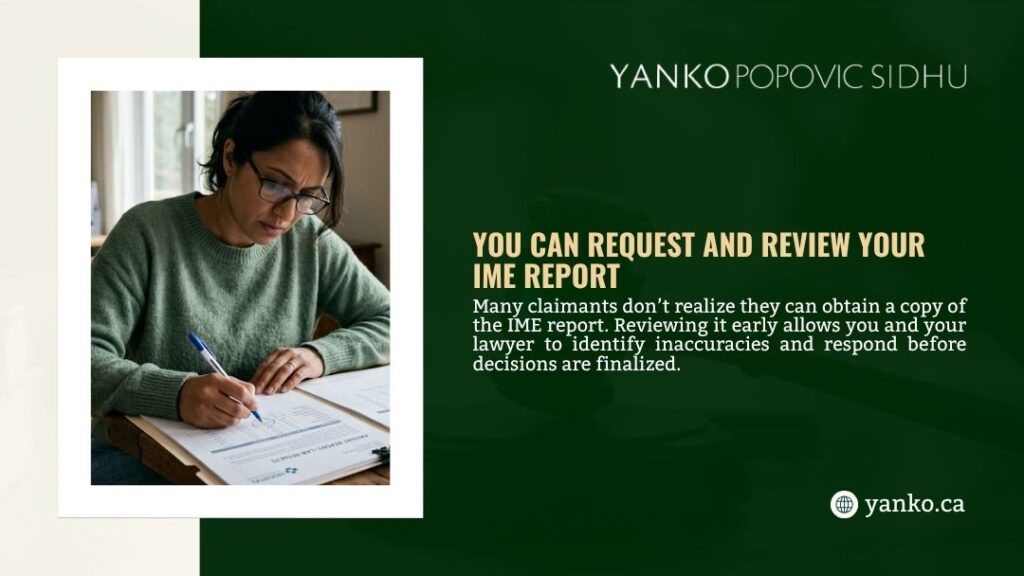
Yes, an IME report can be challenged, especially if it does not accurately reflect your condition or contradicts your treating physician’s findings. Lawyers typically challenge IME reports by identifying inconsistencies between the report and your medical records, highlighting gaps in the doctor’s assessment, or questioning the methodology used during the evaluation.
In more complex cases, expert witnesses, such as specialists or treating physicians, may provide additional medical opinions to counter the IME findings. If a dispute escalates, the report may also be scrutinized in court, where its admissibility and credibility can be challenged through cross-examination.
Common IME Mistakes That Can Hurt Your Case
Even small mistakes during an IME can weaken your claim.
| Mistake | Impact |
| Inconsistent Statements | Raises credibility concerns |
| Exaggerating Symptoms | Reduces trust in your claim |
| Lack of Preparation | Leads to conflicting answers |
| Ignoring Observations | Behavior may contradict claims |
Avoiding these issues can significantly improve how your case is perceived.
Insurance Company Tactics During IMEs
Insurance companies rely on independent medical examinations as part of their broader claim evaluation strategy. While the process is presented as neutral, there are underlying concerns about how these assessments are used.
One issue involves potential bias. Since the insurer typically selects and pays the examining physician, the evaluation may lean toward limiting liability. This doesn’t mean every IME is unfair, but it does mean the process is not entirely detached from the insurer’s interests.
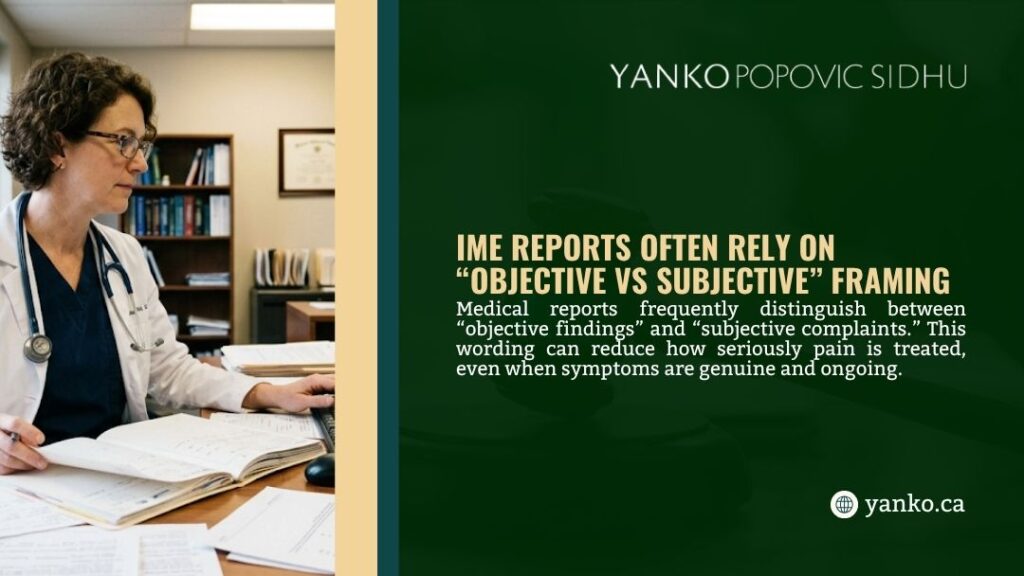
Another important factor is how reports are framed. The wording used in an IME report can shape how your injury is interpreted. Subtle language choices, such as describing symptoms as subjective or noting a lack of objective findings, can influence whether your condition is viewed as serious or minor. Over time, these distinctions can affect benefit approvals, treatment coverage, and settlement negotiations.
Here’s what most people don’t realize: even when the medical findings are accurate, the way they are presented can shift how your claim is interpreted. And that’s where things can go wrong.
For a deeper understanding of how insurers approach claims, it’s worth reviewing common insurance adjuster tactics after a car accident. Recognizing these patterns can help you approach your IME with greater awareness and avoid missteps that could affect your case.
When You Should Speak to a Personal Injury Lawyer
An IME can have lasting consequences on your claim, especially when injuries are serious or recovery timelines are uncertain. This is where legal guidance becomes more than helpful; it becomes necessary.
A personal injury lawyer protects your rights by ensuring they are respected throughout the process. Before the exam, they can explain what to expect, review your medical history, and help you prepare for questions that may arise. After the exam, they assess the IME report and determine whether its conclusions are fair, consistent, and supported by evidence.
Case strategy also plays a critical role. If the IME findings conflict with your treating physician’s opinion, a lawyer can take steps to challenge the report. This may include obtaining additional expert opinions or addressing inconsistencies that could weaken your claim.
At Yanko Popovic Sidhu, clients work directly with experienced lawyers from the outset. There are no intermediaries managing files behind the scenes. This hands-on approach allows for a deeper understanding of each case and ensures that every detail, especially those related to IMEs, is handled with care and precision.
Whether your situation involves a motor vehicle collision or a premises liability issue, speaking with a car accident lawyer in Calgary or an experienced slip and fall lawyer can help you move forward with clarity and confidence.
IME Checklist
Before reviewing the checklist, remember that preparation and consistency are key throughout the process.
| Stage | Key Action |
| Before Exam | Review medical history |
| During Exam | Be honest and consistent |
| After Exam | Document your experience |
Following these steps can help you stay prepared and avoid unnecessary risks.
FAQs about Independent Medical Exam
Can PR be rejected after medical?
In immigration contexts, yes. However, in injury claims, IMEs affect benefits and compensation decisions rather than residency.
What are the warning signs that I need a check-up?
Persistent pain, limited mobility, or worsening symptoms should prompt medical evaluation.
What is the IME diagnosis?
It is the medical opinion formed by the IME doctor based on the evaluation and records reviewed.
Who pays for an IME?
In most cases, the insurance company requesting the exam covers the cost.
Can you refuse an IME?
Refusing may affect your claim or benefits. Legal advice is recommended before declining.
What happens if the IME disagrees with my doctor?
Conflicting opinions may lead to disputes, which can require legal intervention or further evaluations.
How should I act during an IME?
Be honest, consistent, and cooperative. Avoid exaggeration or minimizing symptoms.
Why Understanding IMEs Can Protect Your Claim
Knowing what to expect at independent medical exam isn’t just about preparation; it’s about protecting your future. These evaluations can shape how insurers view your injury, your recovery, and your right to compensation.
A well-prepared claimant stands a better chance of presenting a consistent and credible case. And when legal support is involved, the balance shifts even further in your favor.
If you’re facing an IME or dealing with an injury claim, getting the right guidance early can help you avoid costly mistakes. Speaking with a lawyer before the exam can help you avoid costly mistakes and protect your claim from the start.