A parking lot accident who is at fault question does not have a one-size-fits-all answer. Fault depends on right of way, driver conduct, Alberta negligence law, and insurance fault determination rules.
In this article, we clarify how liability is determined, dispel common myths about 50/50 fault, explain how insurance companies assess responsibility, and outline how fault can directly affect compensation in Alberta in 2026.
Parking Lot Accident Who Is at Fault?
When people search for parking lot accident cases, what they usually want is certainty. They want someone to say, It’s always the driver backing up, or It’s automatically 50/50. But that’s not how Alberta law works.
A parking lot accident is analyzed under negligence principles. The driver who failed to exercise reasonable care while driving a vehicle is typically responsible. Insurance companies look at movement, visibility, traffic signs, right of way, and whether a vehicle was legally parked.
Parking lots are not lawless zones. Even in a private parking lot accident, fault determination rules still apply. Alberta courts consider who had control of their vehicle, who had the duty to yield, and whether either driver created a foreseeable risk.
So, when asking about a parking lot accident, who is at fault, the better question becomes: who breached the duty of care?
According to Canadian data, low-speed collisions, including accidents in parking lots, account for a significant share of urban property damage claims each year. While severe injury is less common, the financial impact through auto insurance claims is substantial. Here’s the thing: speed doesn’t determine liability. Conduct does.
Are Parking Lot Accidents Always 50/50?
One of the most persistent myths surrounding parking lot accidents about who is at fault is the belief that every car accident in a parking lot is automatically shared blame. That assumption is wrong.
Alberta follows contributory negligence principles. If both drivers contributed to the accident in the parking lot who is at fault scenarios, the fault can be apportioned. But it does not default to 50/50.
For example, if one driver ignores traffic signs while another moves cautiously but misjudges space, fault may be split 75/25. If one driver clearly violates the right of way, liability may fall entirely on that driver. Below is how fault percentage affects compensation:
| Fault Allocation | $100,000 Injury Claim | Adjusted Compensation |
| 0% Fault | $100,000 | $100,000 |
| 25% Fault | $100,000 | $75,000 |
| 50% Fault | $100,000 | $50,000 |
| 75% Fault | $100,000 | $25,000 |
A 50/50 accident considered at fault does not erase your right to recover damages. It reduces your award proportionally. This is where many drivers misunderstand the fault analysis of parking lot accidents. Shared responsibility reduces compensation, but it does not eliminate it.
How Insurance Companies Determine Fault in Parking Lot Accidents
When a car accident in parking lot who is at fault becomes disputed, insurance companies apply fault determination rules. Adjusters review damage patterns, driver statements, surveillance footage, and witness accounts. They examine whether a vehicle was leaving a parking spot, reversing simultaneously, or entering feeder lanes without yielding. Here’s what happens during fault analysis:
| Evidence Reviewed | Why It Matters |
| Damage location | Reveals the angle of impact |
| Vehicle movement | Identifies active driver |
| Traffic signs | Establishes right of way |
| Surveillance footage | Confirms driver behavior |
| Witness statements | Supports or contradicts accounts |
Insurance companies may also assess prior driving history. And here’s the problem: some adjusters attempt to shift partial blame to reduce payout exposure. If you’re dealing with an insurance company blaming you for an accident scenario, understanding adjuster tactics is critical. Alberta drivers can review common insurance adjuster tactics in car accident cases.
Fault affects not only settlement but also insurance premiums. Even a partial fault finding can increase rates.
Common Parking Lot Accident Scenarios and Who Is at Fault
Parking lot collision fault analysis depends heavily on the situation. Below is a structured breakdown of frequent accident types.
| Scenario | Likely Fault Outcome | Legal Reasoning |
| Backing into a moving vehicle | Reversing the driver liable | Duty to ensure a clear path |
| Two vehicles reversing | Often shared fault | Both failed to confirm safety |
| Hit a parked car | Moving the driver liable | The parked vehicle had no duty |
| Leaving a parking space into feeder lane | Exiting driver liable | Must yield to through traffic |
| Car crash in the parking lot intersection | The driver who ignored the signage | Right-of-way violation |
| Hit and run in the parking lot | Fleeing driver liable | Criminal negligence |
| Parking lot fender bender at low speed | Depends on lane control | Failure to maintain a lookout |
If you hit a parked car, liability is typically straightforward. The vehicle that was legally parked bears no responsibility. But in accidents in a parking lot where both drivers are in motion, determining fault in parking lot accident cases becomes more nuanced.
When a driver rear-ends someone who is at fault inside a parking aisle, the presumption often favors the lead vehicle. However, sudden stops without reason may complicate the analysis.
Private Parking Lot Accident vs Public Road Rules
A common misconception is that a private parking lot accident operates under a different legal standard than a collision on a public roadway. In reality, the duty to drive with reasonable care applies in both environments. The difference lies not in whether negligence applies, but in how traffic control is structured and enforced.
On public roads, statutory rules under Alberta’s Traffic Safety Act clearly define right of way, lane use, and signaling requirements. In a private parking lot accident, signage and painted markings still matter, but enforcement mechanisms differ. Police involvement may be limited unless injury, criminal conduct, or major property damage is involved. Here’s how the legal framework compares:
| Legal Factor | Public Road Collision | Private Parking Lot Accident |
| Governing Law | The Traffic Safety Act strictly applies | Negligence law still applies; traffic rules influence liability |
| Right of Way | Clearly defined by statute | Determined by signage, layout, and reasonable care |
| Police Reporting | Often mandatory above the damage threshold | Required in injury, hit and run, or significant damage |
| Insurance Response | Standard auto insurance coverage | The same auto insurance coverage applies |
| Fault Analysis | Based on statutory violations and conduct | Based on conduct, signage, visibility, and reasonable driver behavior |
| Enforcement | Active traffic enforcement | Limited enforcement unless serious circumstances |
Even in a private parking lot accident, drivers must yield when leaving a parking space, observe feeder lanes, and respect posted traffic signs. A driver who ignores directional arrows or fails to check blind spots may still be found responsible.
So when evaluating a parking lot accident who is at fault scenario, the key issue remains the same in both locations: who failed to exercise reasonable care under the circumstances?
Does Insurance Cover Parking Lot Accidents?
Another common question is whether insurance covers parking lot accidents under auto policies. In Alberta, basic auto insurance covers property damage and bodily injury resulting from a parking lot accident. However, fault determines which insurer pays.
Does car insurance cover parking lot damage if you are partially at fault? Yes, but your deductible applies, and premiums may increase. If you face an insurance denial of your car accident claim, legal guidance may become necessary. Here’s how coverage typically works:
| Fault Finding | Coverage Impact |
| Not at fault | The other driver’s insurer pays |
| Partially at fault | Reduced payout |
| Fully at fault | Your policy responds |
| Hit and run | Uninsured motorist coverage applies |
Insurance Bureau of Canada confirms that collision coverage applies regardless of whether the incident occurred on a public roadway or private lot.
What Happens If You Get Hit in a Parking Lot?
A car accident in a parking lot often happens suddenly and at low speed. Because of that, many drivers underestimate the legal and insurance consequences. That can be a costly mistake.
If you are involved in an accident in a parking lot, where it is uncertain who is at fault, your first step is to secure the scene. Move vehicles if safe, but only after documenting positions. Photographs of the parking space, feeder lanes, and visible traffic signs help establish context later.
Exchange insurance and identification information. If the other driver leaves, it becomes a hit-and-run. Alberta law treats leaving the scene seriously, and uninsured motorist coverage may apply.
Notify your insurer promptly. Provide facts, not assumptions. Avoid statements that suggest fault before a full review. Insurance companies conduct their own investigation to determine who is at fault in a parking lot accident.
If injuries appear minor, still monitor symptoms. Soft tissue injuries and concussions sometimes surface hours later. Medical documentation strengthens any personal injury claim tied to a parking lot accident, in a dispute over who is at fault.
When insurance adjusters request recorded statements, proceed carefully. Statements taken too soon can complicate fault determination in parking lot accident cases.
How Fault Affects Your Personal Injury Settlement
Fault in a parking lot accident who is at fault dispute has direct financial consequences. Under Alberta law, damages include pecuniary losses such as income loss and non-pecuniary damages such as pain and suffering compensation.
A shared fault finding reduces total compensation proportionally. For example, a $200,000 injury award reduced by 40% fault leaves $120,000 payable.
Those pursuing personal injury claims in Alberta should understand valuation principles. When injuries are significant, consultation with a car accident lawyer Calgary professional may be appropriate. Parking lot car accidents rarely cause catastrophic harm, but spinal or brain trauma can occur at low speeds. Severe cases may involve complex medical assessments.
Key Alberta Statistics on Parking Lot Accidents
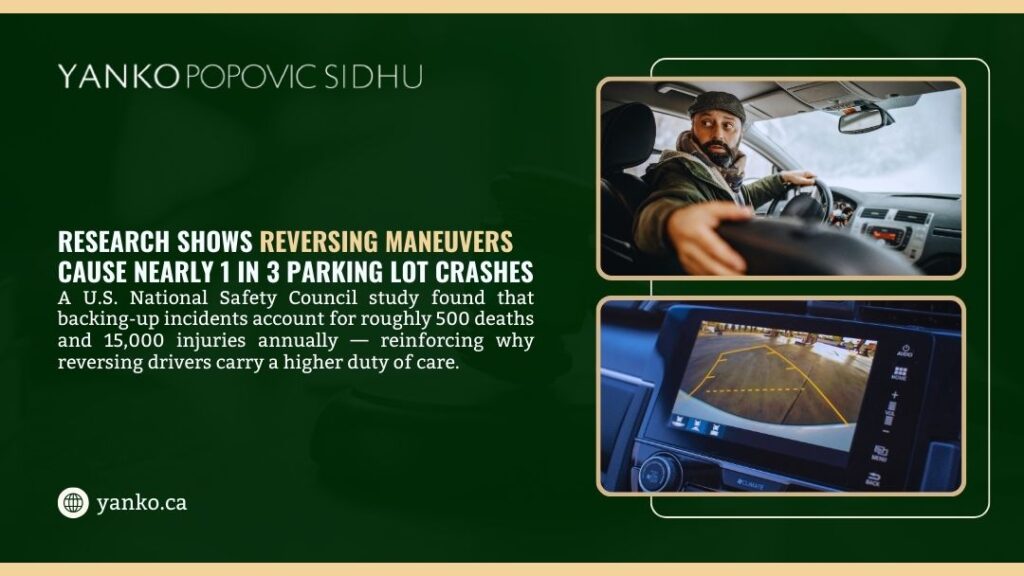
Parking lot accidents rarely make headlines, yet they represent a meaningful share of property damage claims across Alberta. Transport Canada’s national collision data shows that low-speed urban crashes account for a substantial percentage of reported incidents annually. Although fatalities are uncommon in parking lot car accidents, injury claims and repair costs contribute significantly to auto insurance payouts.
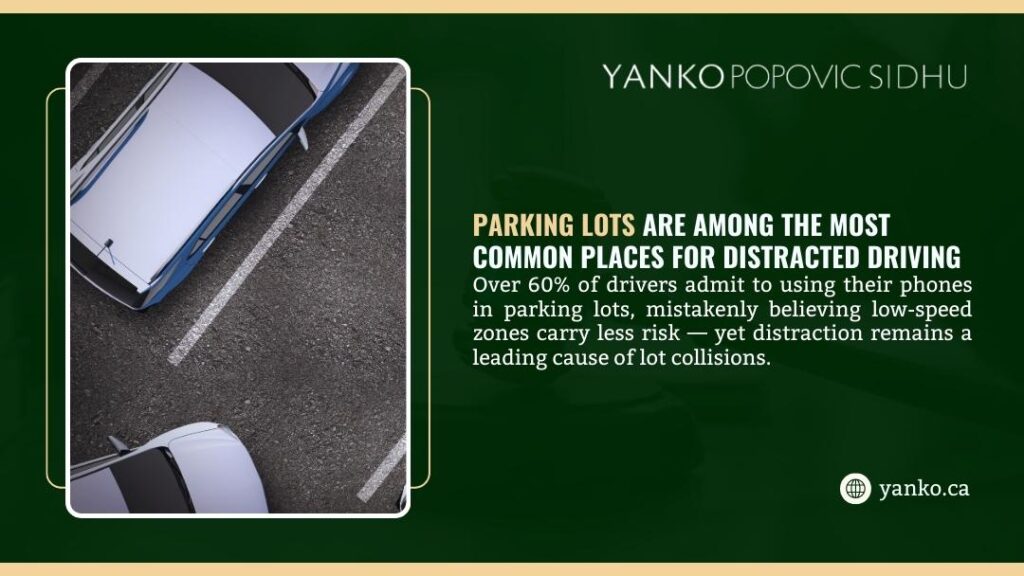
Alberta Transportation’s traffic collision statistics show that driver distraction/inattention and failure to yield are recurring contributing factors in many urban casualty collisions, patterns that often show up in parking lot accident fault findings as well.
The numbers reinforce a simple point. Even low-speed accidents in a parking lot carry financial and legal consequences, especially when fault becomes contested.
When Liability Questions Turn Into Financial Risk
A parking lot accident who is at fault issue may look minor at first. But once insurers begin assigning percentages, the impact can escalate quickly. Reduced compensation, higher premiums, and contested claims often follow.
If you are facing an insurance company that disputes your version of events, unfairly shifts blame, or offers a settlement that does not reflect your losses, experienced legal guidance matters.
Yanko Popovic Sidhu provides direct lawyer-to-client representation in serious injury and insurance disputes across Alberta. From the first consultation, you deal with an experienced lawyer who handles your file personally. No intermediaries. No runaround.
If a parking lot accident who is at fault dispute threatens your financial recovery, speak with a team that understands Alberta fault law and fights to protect your rights from start to finish.