Contributory negligence can shrink your payout after a crash, even when the other driver clearly messed up. Alberta uses a shared-fault system that reduces compensation based on your percentage of responsibility.
This guide explains how contributory negligence Alberta car accident claims works in real life, how insurers argue shared fault, and what evidence actually moves the needle.
Contributory negligence Alberta car accident
In Alberta, the contributory negligence Alberta car accident rules mean this: if you’re the injured party, but a court (or an insurer negotiating a settlement) decides you contributed to the accident, your compensation can drop by your share of fault. The law doesn’t usually cancel your case just because you’re partially at fault. It usually discounts what you can recover.
Here’s how contributory negligence Alberta car accident math tends to work in plain terms. Imagine your total damages are assessed at $100,000. If you’re found 20% responsible for the accident, your recovery can fall to about $80,000. That’s the core idea behind contributory negligence in Alberta car accident claims: shared fault reduces the award.
This matters because many car accident cases don’t look like a movie scene with one obvious villain and one flawless victim. They look like real roads, real weather, real human behavior, and real split-second decisions. And that’s exactly why insurance companies love contributory negligence Alberta car accident arguments: it’s one of the quickest ways to cut exposure without admitting much.
What is Contributory Negligence? And how does it affect you?
It’s a legal concept used in injury law when the injured party’s own actions, choices, or omissions helped cause the crash or helped make the injuries worse. In contributory negligence Alberta car accident disputes, this is sometimes described as shared fault or being partially at fault, but the practical question stays the same: what portion of responsibility for the accident sits with you?
How does it affect you? It affects you in two main places that people often mix up.
First, contributory negligence in Alberta car accident findings can reduce compensation because you’re blamed for part of the collision itself. Second, contributory negligence in Alberta car accident findings can also reduce compensation when you’re blamed for worsening your own injuries, even if you didn’t cause the crash. Seatbelt disputes fall into this second bucket, which is why wearing a seatbelt shows up in so many personal injury claims.
So if you’re thinking, “I wasn’t perfect, but I didn’t deserve this,” you’re not alone. Contributory negligence in Alberta car accident law isn’t about perfection. It’s about apportionment, how the system assigns degrees of fault and then ties money to those percentages. Alberta publishes the Contributory Negligence Act through its Open Government portal, which is the statutory foundation for this approach.
Understanding contributory negligence in Alberta car accident cases
A good way to understand contributory negligence car accident cases is to separate crash fault from injury fault.
Crash fault asks: Who caused the collision? Was someone following too closely, running a red, changing lanes without checking, speeding, or driving distracted? Injury fault asks: Did anything the injured party did, like failing to wear a seatbelt, make the injuries worse than they otherwise would’ve been?
That distinction can sound academic, but it becomes very real when settlement numbers get discussed. In Alberta car accident negotiations, contributory negligence often turns on the insurer’s ability to frame your behavior as either a cause of the crash or a cause of greater harm. The difference changes how your file is argued, how experts get used, and how credible a shared fault position sounds.
This is also why insurers push contributory negligence in Alberta car accident narratives early. The earlier they plant it, the more likely it sticks, especially if the initial collision report is thin, witnesses disappear, or medical documentation lags.
How Alberta courts determine fault and degrees of fault
Fault isn’t always black and white. Many collisions involve multiple contributing actions, speeding, late braking, poor visibility, lane changes, distraction, or weather conditions.
Degrees of fault are determined using evidence such as:
| Evidence type | What can it prove | Who usually controls it |
| Police collision report and diagrams | initial narrative, statements, scene details | police services/request process |
| Photos of vehicle damage and roadway | point of impact, angles, speed indicators | drivers, witnesses, tow yard |
| Dashcam / nearby security video | lane position, signals, timing | drivers, businesses, city systems |
| Witness statements | independent confirmation of key moments | witnesses/lawyers gather |
| Vehicle data (where available) | speed, braking, inputs | manufacturer systems/experts |
| Medical documentation | injury mechanism, severity, timelines | clinics, hospitals, specialists |
When contributory negligence Alberta car accident disputes become serious, experts can enter the picture, reconstruction professionals, engineers, and medical specialists. Insurers don’t commission those out of charity. They do it because fault percentages can be expensive.
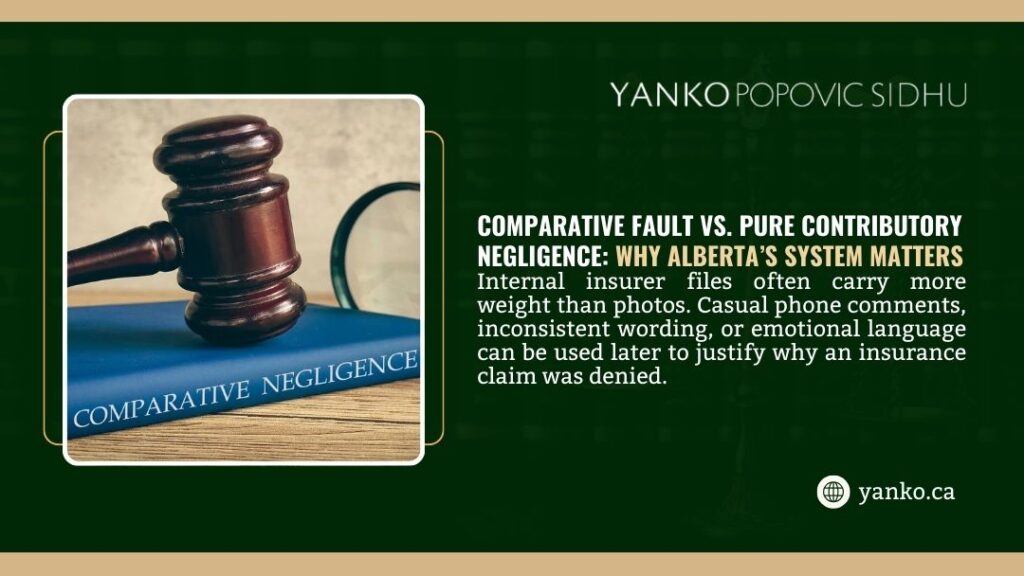
Common ways insurance companies argue you contributed to the accident
In contributory negligence Alberta car accident files, insurers tend to repeat the same themes because they often work. The tactics aren’t mysterious; they’re just persistent.
They’ll say you were too fast for conditions, even if you were under the posted limit. They’ll say you failed to keep a proper lookout. They’ll say you changed lanes at the wrong moment or didn’t signal long enough. If the crash is a rear-end collision, they may argue you stopped “too suddenly,” especially when they can’t easily dispute that the following driver was too close.
What makes contributory negligence in Alberta car accident arguments slippery is that they often blend possible with provable. A lot of things are possible at an accident scene. Far fewer are supported by reliable evidence.
And then there’s the seatbelt angle. Failing to wear a seatbelt doesn’t necessarily mean you caused the crash, but it can become a contributory negligence Alberta car accident argument about damages: “Your injuries would’ve been less severe if you buckled up.” This comes up so often because seatbelt effectiveness is well supported in safety research. For example, the U.S. NHTSA states that buckling up in the front seat can reduce fatal injury risk by about 45% in passenger cars.
What does partially at fault do to your personal injury claim
If you’re partially at fault, the Alberta car accident rules usually reduce your compensation proportionally. That applies to a wide range of damages that show up in personal injury cases: pain and suffering, income loss, future care, and other losses tied to the injury.
It’s worth saying out loud: contributory negligence Alberta car accident reductions can feel unfair when you’re already hurt and already stressed. But the system is built around comparative responsibility. And that’s why accurate fault allocation matters so much.
How contributory negligence reduces damages (simple example)
| Total damages assessed | Fault assigned to the injured party | Estimated payable amount |
| $100,000 | 10% | $90,000 |
| $100,000 | 25% | $75,000 |
| $100,000 | 50% | $50,000 |
The tricky part is that contributory negligence Alberta car accident arguments don’t only show up at the end. They show up at the start, in the way the insurer frames your statement, your medical timeline, and your reasonableness. It’s why people feel like they’re being cross-examined by an adjuster when they’re just trying to explain what happened.
50/50 fault car accident settlement in Alberta: what it usually looks like
A 50/50 split is one of the most misunderstood outcomes in contributory negligence in car accident cases. People hear “50/50” and assume it means nobody gets paid. Not usually. It generally means the injured party’s damages get cut in half.
Where it gets messy is when the file includes multiple heads of damage. Some categories may be easier to prove than others. Some may be capped or limited depending on the injury classification. And insurers may try to stack arguments: “You’re 50% at fault, and your injuries are minor, and your treatment wasn’t necessary, and your wage loss isn’t supported.” That’s how a contributory negligence dispute turns into a full-on pressure campaign.
Minor Injury Regulation and shared fault: where the cap fits in 2026
Alberta’s minor injury framework can intersect with contributory negligence car accident claims in a way that surprises people: caps and fault reductions can stack.
The Superintendent of Insurance bulletin indicates that effective January 1, 2026, the maximum minor injury cap amount increases from $6,182 to $6,306. That figure is tied to non-pecuniary damages in minor injury situations, which is one reason insurers care so much about how injuries are characterized.
Here’s the part that matters. If an insurer argues your injury falls under the cap and also argues contributory negligence, Alberta car accident shared fault, those two constraints can compress your pain-and-suffering recovery significantly.
How a cap and shared fault can combine (illustrative only)
| Scenario (non-pecuniary only) | Starting amount | Fault reduction | Estimated result |
| Injury treated as minor (2026 cap) | $6,306 | 0% | $6,306 |
| Injury treated as minor (2026 cap) | $6,306 | 25% | $4,729.50 |
| Injury treated as minor (2026 cap) | $6,306 | 50% | $3,153 |
That’s not a promise of outcome; it’s the arithmetic that explains why contributory negligence in Alberta car accident disputes can feel like a squeeze. It’s also why careful documentation matters: what the injury is, how it impacts function, what recovery looks like, and whether it truly qualifies as “minor” under the legal framework.
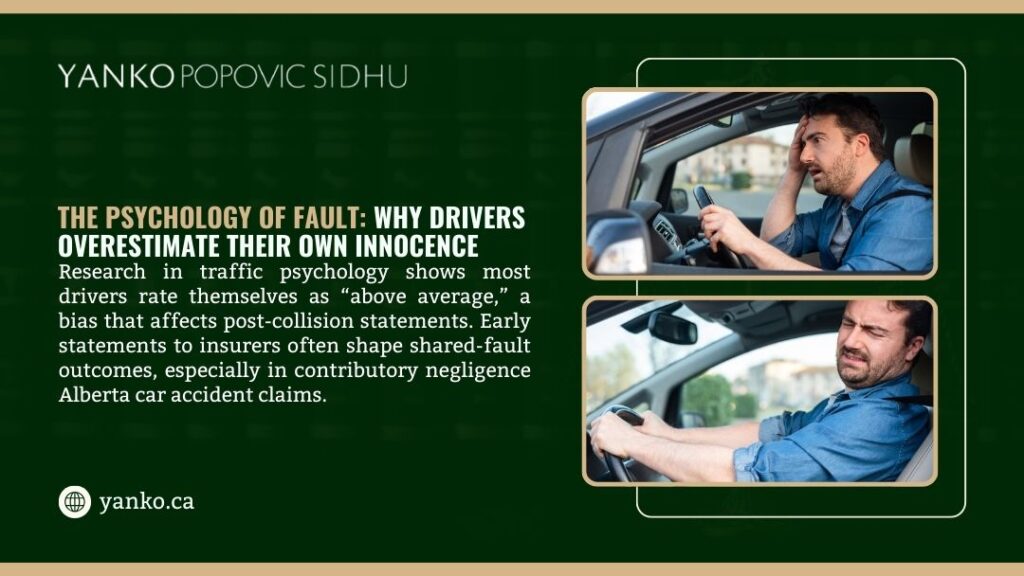
Why this topic matters right now: collisions and real-world risk
Nobody needs scare tactics to understand Alberta roads can be rough. The province publishes collision statistics that show the scale of road trauma each year and break down contributing factors. Alberta’s Collision Statistics report (2023) is one example of the kind of reporting used across safety and policy discussions.
Zooming out to a national lens, Transport Canada’s collision statistics report thousands of serious injuries annually in Canada, and it tracks trends in injuries and fatalities. These numbers don’t decide your case, but they do explain why insurers systematize contributory negligence in Alberta car accident responses. They handle volume; you live the consequences.
For Calgary specifically, the city’s safer mobility annual briefing reported collision counts for 2024, including fatal collisions and injury collisions on Calgary roads, while also noting that reporting thresholds can affect property-damage-only numbers.
What to do after a crash so contributory negligence doesn’t get pinned on you later
Contributory negligence in Alberta car accident claims is won and lost in the details people forget to capture. You don’t need to act like a private investigator at the roadside, but you do need to protect the basics that later become facts.
If you can safely document the scene, do it. If you can identify witnesses, do it. If the other driver apologizes or admits fault, note it, because memories have a funny way of evolving once insurance calls start. If you feel symptoms, don’t downplay them. Understatement can look like inconsistency later, and inconsistency is rocket fuel for contributory negligence Alberta car accident arguments.
One more thing: be careful with adjuster calls. It’s not that every adjuster is out to get you; it’s that their job includes limiting payout. If you want a clearer sense of what insurers do behind the scenes, understand the insurance adjuster tactics.
Case review: what a personal injury lawyer looks at first
A serious contributory negligence Alberta car accident case review usually starts with two timelines that must line up.
Timeline one is the crash narrative: roadway, weather, traffic control, speed, lane position, perception-reaction time, and impact dynamics. Timeline two is the injury narrative: symptom onset, treatment, imaging, functional limitations, work impacts, and prognosis.
The reason lawyers care about both is simple. Contributory negligence Alberta car accident disputes often hinges on a weak link. If the crash facts look strong but the medical documentation looks patchy, the insurer will attack damages. If medical evidence is excellent but crash facts are unclear, they’ll attack fault. Your file needs both legs to stand.
If your matter involves a straightforward MVA claim, the firm’s Calgary car accident lawyer support provides a sense of how these files are typically approached from intake to resolution.
When to speak with a car accident lawyer in Calgary about contributory negligence
If contributory negligence Alberta car accident language shows up early, especially phrases like shared fault, you were partially at fault, or we’re assigning you X% responsibility, that’s a sign the insurer is already pricing your claim down.
You don’t need to wait for a lawsuit threat to get clarity. A short consult can help you understand whether the contributory negligence Alberta car accident position is grounded in evidence or is just a bargaining tactic. It can also help you avoid common mistakes that unintentionally strengthen the insurer’s version of events.If your crash involved something more specific, like a hit-and-run, which often triggers separate proof problems. Different fact patterns create different contributory negligence Alberta car accident pressure points.
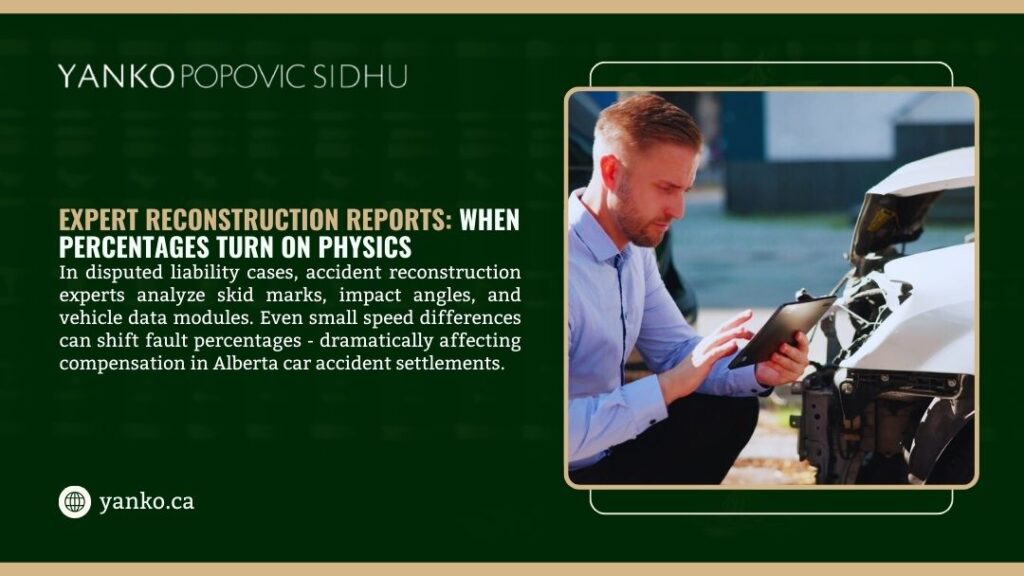
Final Thoughts
Contributory negligence Alberta car accident claims aren’t about legal theory, they’re about percentages, and percentages directly affect your compensation. Shared fault can reduce your recovery significantly, especially if the evidence isn’t structured properly from the start.
If you believe an insurer is overstating your responsibility, don’t ignore it. In a contributory negligence Alberta car accident dispute, small percentage shifts can mean thousands of dollars.
Book a free consultation today to protect your position, challenge inflated fault allegations, and make sure your claim is built on evidence, not assumptions.