A level 4 dog bite settlement sounds like it should come with a neat price tag. It does not. In real claims, a level 4 dog bite settlement depends on what the bite did to tissue, nerves, function, appearance, and mental health, plus how clearly you can prove liability and future costs.
A level 4 dog bite involves one to four punctures from a single bite with at least one puncture deeper than half the length of the dog’s canine teeth, often with bruising or lacerations when the dog holds on or shakes.
In Calgary and Southern Alberta, the smartest way to think about a level 4 dog bite settlement is as a damages project backed by evidence, not a viral “average dog bite settlement amounts” number pulled from another jurisdiction. Canada has its own damages framework, and Alberta cases rise and fall on documentation quality and legal theory far more than internet averages.
What is a level 4 dog bite, and why do insurers care
A level 4 dog bite sits in the first tier, where many adjusters stop treating the incident like a nuisance and start treating it like a liability file with long-tail risk. The bite definition matters because it signals depth, infection risk, nerve involvement, and scarring potential. The official scale spells it out in clinical terms: punctures deeper than half the canine length, with possible deep bruising and tearing when the dog clamps and shakes.
A level 4 dog bite settlement usually tracks three predictable pressure points.
| Pressure Point | What It Involves | Why It Drives Settlement Value |
| Escalating medical care | Deep puncture wounds requiring irrigation, antibiotics, tetanus review, possible rabies protocol, and follow-up care for infection or debridement | Higher and ongoing medical costs signal injury severity and increase documented damages |
| Functional risk | Elevated risk of long-term impairment, especially with hand bites, which are common in adult emergency department cases and are prone to complications | Hand injuries affect daily function and work capacity, making claims harder to resolve and more expensive |
| Appearance and psychological harm | Facial lacerations, permanent scarring, and post-traumatic symptoms such as anxiety or avoidance behaviors | Non-economic damages become significant, often outweighing the initial ER bill in settlement negotiations |
Dog bite levels: level 1 to level 6
People search “dog bite levels” because the scale offers a shorthand for severity. The Dunbar scale has six levels, and the step from a level 3 bite to a level 4 bite is mainly depth and tissue damage, not just pain.
Levels of dog bites and what they usually mean for claims
| Level of dog bites | Typical wound description (Dunbar scale) | What it often means for a claim |
| Level 1 dog bite | Threat display or snap with no skin contact | Usually no claim value unless unusual psychological harm is documented |
| Level 2 dog bite | Teeth touch skin, no vertical puncture; may leave a dog bite mark | Minor dog bite settlement may exist if medical care, infection, or time off work occurs |
| Level 3 dog bite | One to four punctures, none deeper than half canine length | Level 3 dog bite settlement values often hinge on scarring and function; “is a level 3 dog bite dangerous” depends on location/infection risk |
| Level 4 dog bite | One to four punctures with at least one deeper than half canine length; bruising/tearing possible | Level 4 dog bite settlement risk rises due to surgery, nerve damage, scarring, PTSD, and future care |
| Level 5 dog bite | Multiple level 4 bites or multiple attacks with level 4 severity | Level 5 dog bite settlement amount often reflects permanent impairment and long-term care |
| Level 6 dog bite | Fatality | Wrongful death litigation, dependency losses, estate claims |
A level 4 dog bite settlement also differs from a level 2 dog bite settlement or level 1 dog bite settlement because the deeper wound forces real proof: wound depth notes, suture records, antibiotics, plastic surgery consults, scar evolution photos, and often specialist assessments. Without that paper trail, insurers push the file down toward “minor dog bite settlement” logic, even when the injury feels severe.
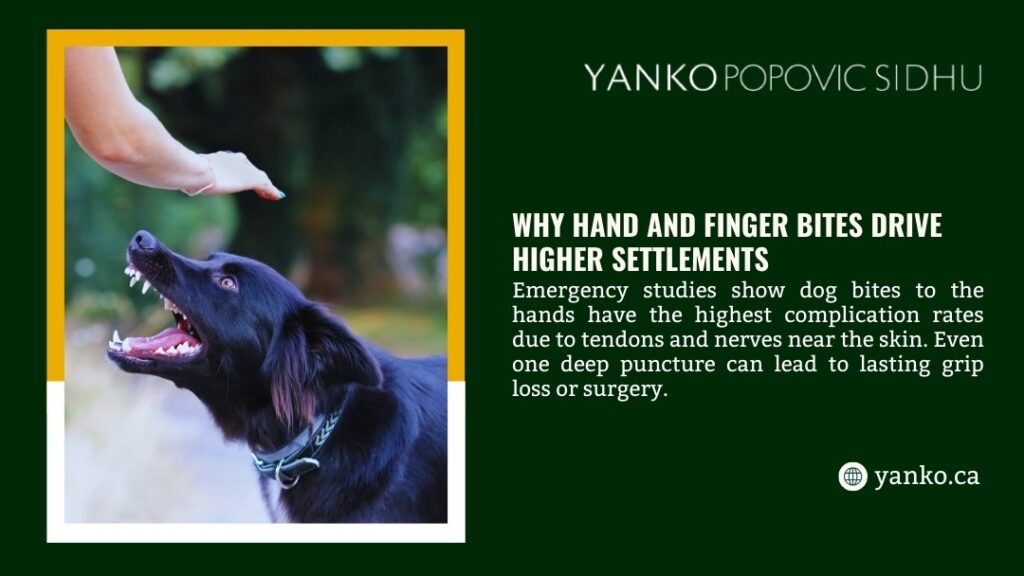
Level 4 dog bite settlement amount in Alberta: what “average” can and cannot mean
For Calgary and Southern Alberta, a level 4 dog bite settlement amount usually depends on these case drivers:
Medical intensit: Deep punctures with infection complications, tendon damage, nerve involvement, or surgery land in a different universe than a clean deep puncture that heals without complication.
Location and function: A level 4 bite to the hand that reduces grip strength can cost more than a deeper bite to a low-impact area because it can disrupt work and daily tasks. A face bite can raise value due to permanent scarring and reconstructive needs.
Psychological harm: PTSD, panic symptoms, sleep disruption, and fear responses matter when documented by qualified clinicians. A level 4 dog bite settlement tends to increase when emotional trauma is measurable and persistent.
Insurance coverage: Many dog bite settlements are constrained by policy limits. Even a strong file hits a ceiling if the defendant has limited coverage and limited assets.
Dog bite compensation categories
A level 4 dog bite settlement has two main parts: quantifiable losses (medical expenses, lost income) and non-quantifiable losses (pain and suffering, loss of enjoyment of life, emotional trauma).
In Canada, the Supreme Court of Canada established an upper limit on non-pecuniary damages in 1978, setting the cap at $100,000 for pain and suffering. Courts have since treated that limit as a ceiling, reserving awards at or near it for the most catastrophic injuries, while adjusting its practical application over time through inflation and judicial discretion.
In Canada, non-pecuniary damages have a Supreme Court cap that began as $100,000 in 1978 and rises with inflation; legal commentary places it in the mid-$400,000 range in recent years, reserved for the most catastrophic cases.
What goes into dog bite compensation in Alberta-style valuation
| Compensation category | What counts | What proof moves the needle |
| Medical expenses | ER, antibiotics, wound care, therapy, specialist consults, scar treatment, psychological care | Itemized receipts, chart notes, referrals, and prognosis opinions |
| Income loss | Missed work, reduced capacity, self-employed disruption | Pay stubs, employer letters, tax returns, and job duty evidence |
| Out-of-pocket | Travel, medications, and childcare during appointments | Receipts and a simple expense log |
| Pain and suffering | Physical pain, loss of enjoyment, and sleep disruption | Consistent medical notes, symptom timeline, functional limits |
| Emotional trauma | Anxiety, PTSD, fear avoidance, mood changes | Psychological assessment, treatment records, and standardized measures, when available |
| Scarring and disfigurement | Permanent scar, facial impact, need for revision | High-quality photos over time, plastic surgery opinion, scar maturation evidence |
A level 4 dog bite settlement often arises when the file shows future costs. Scar management and plastic surgery can stretch beyond the initial healing window. That does not mean every scar produces a large payout. It means insurers take permanent change seriously when a doctor supports it.
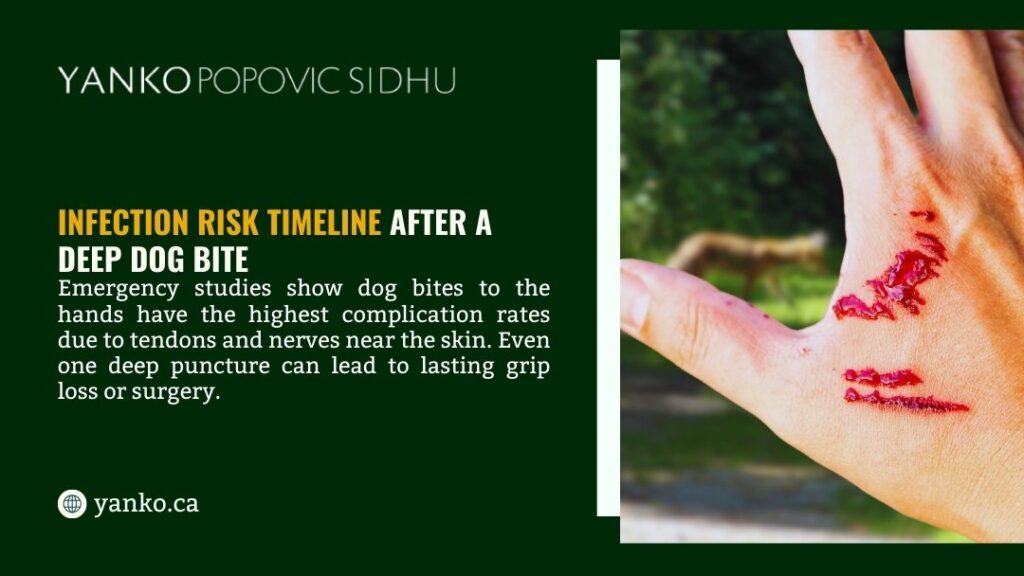
Liability in Calgary and Southern Alberta: how you actually prove responsibility
Liability can run through negligence, occupiers’ duties, and the facts around control, foreseeability, and reasonable precautions. Legal commentary on Alberta dog bite claims commonly frames owner liability through negligence or occupiers’ responsibility, depending on where the bite occurred and what the owner or property occupier did to prevent harm.
Calgary also has a Responsible Pet Ownership Bylaw regime, and the city has publicly stated that serious aggressive dog incidents can lead to mandatory court appearances and fines up to $10,000. That does not automatically equal civil compensation, but it can produce helpful evidence and admissions in the background of a level 4 dog bite settlement.
The legal “win condition” for a level 4 dog bite settlement is usually straightforward: show the dog bite incident happened, show damages, show fault and causation, and reduce room for the defence to blame the victim. On that last point, many bite disputes turn into arguments about provocation, trespass, or assumption of risk. Evidence that the victim acted reasonably and the owner failed to control the dog can matter as much as the medical file.
Common Alberta liability routes and the evidence that supports them
| Legal theory pathway | Where it fits | Evidence that tends to matter |
| Owner negligence | Unleashed dog, poor control, known risk, failure to warn | Prior complaints, leash/containment facts, witness statements, bylaw reports |
| Occupier responsibility | Bite on someone’s property where a visitor safety duty exists | Property rules, knowledge of the dog, failure to separate the dog from visitors |
| Bylaw enforcement facts | Calgary incidents investigated under the RPO bylaw | City reports, charges, admissions, and animal control documentation |
A separate but important time risk sits outside liability: limitation periods. Alberta’s Limitations Act sets time rules that often function as a two-year window in many personal injury contexts, and missing it can kill leverage. A level 4 dog bite settlement does not need to be finished within two years, but you usually need formal steps taken before the deadline to preserve the claim.
Evidence that actually changes a level 4 dog bite settlement
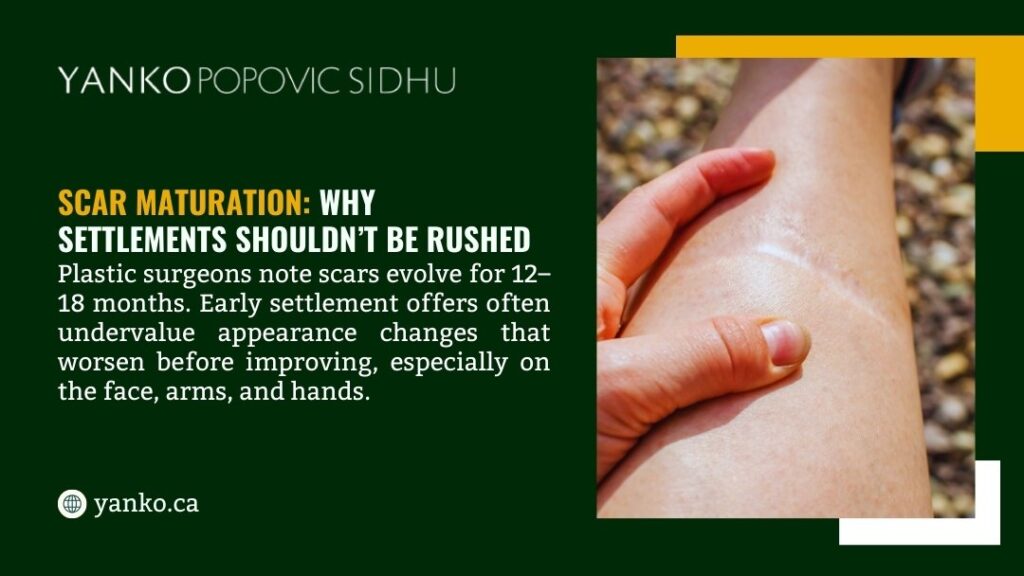
A level 4 dog bite settlement rises when the medical record captures depth, function, and future risk in plain language. Deep puncture notes matter. Photos matter, especially because bruising and tearing can fade fast. A scar looks worse at month two than at month twelve; insurers know this and will cherry-pick the most flattering photo if you let them. A clean file shows the full healing arc.
Mental health evidence matters too. Canada’s injury surveillance reporting highlights that bites often occur at home or another home, often in routine settings, which is exactly why victims can develop persistent fear responses and avoidance. A clinician’s notes beat a personal journal every day of the week.
How to negotiate a dog bite settlement without getting lowballed
A level 4 dog bite settlement negotiation is usually lost in one of three ways: early recorded statements that oversimplify symptoms, a rushed settlement before scar maturation and functional prognosis, or a demand package that focuses on feelings but not proof.
A disciplined approach looks more boring than TikTok advice, which is exactly why it works.
First, treat the claim like a file, not a story. Provide a timeline of treatment, confirm follow-ups, attach receipts, and ask treating providers for clear comments on future needs. Second, separate what is temporary from what is permanent. If your doctor cannot say the scar is permanent yet, you do not pretend it is; you document it and plan a reassessment. Third, price the future. If therapy, scar revision, or counselling is likely, it belongs in the math.
Then you negotiate from leverage. That leverage can come from liability clarity, documentation strength, and readiness to escalate. If you need a local legal lens on this process, Yanko Popovic Sidhu lays out Alberta’s claim path in its guide to navigating a personal injury claim in Alberta, and that framework transfers cleanly into dog bite files because the proof logic stays the same even when the accident type changes.
When a level 4 bite turns into a level 5 dog bite problem
A level 5 dog bite typically means multiple level 4 bites or multiple attacks with level 4 severity. In settlement terms, this often signals sustained attack behaviour, larger wound burden, higher infection risk, and greater psychological harm. A level 5 dog bite settlement amount often rises because the injuries look less like an isolated lapse and more like a dangerous dog event that could have been prevented with proper control.
Conclusion: Where this leaves you, and what to do next
A level 4 dog bite settlement in Calgary and Southern Alberta is rarely driven by an “average payout” figure. Results turn on evidence: the depth of the wounds, loss of function (especially to the hands), the permanence of scarring, psychological impact, future care needs, and, critically, who failed to control a known risk. Strong outcomes come from building a file that tells that full story and supports it with medical, functional, and liability proof.
If you need counsel with a focused track record in dog bite claims, you can start with Yanko Popovic Sidhu. Working with a Calgary dog bite lawyer experienced in serious injury cases is a practical starting point. Understanding how Alberta courts approach pain and suffering and other non-pecuniary damages is equally important, since those factors often shape the upper end of a level 4 dog bite settlement. For a broader sense of how settlements are evaluated across injury types, you can contact us for a clear, practical discussion of how these cases are valued and what that means for your situation.