A brain injury settlement in Alberta is rarely straightforward; it depends on the evidence, the diagnosis, and how Alberta law treats injury categories. In 2025, compensation for brain injuries in Calgary often ranges from $25,000 to over $1 million, depending on whether the case involves a mild concussion or a severe traumatic brain injury (TBI).
Alberta’s Minor Injury Regulation cap sits at $6,182, but it does not apply to proven brain injuries, meaning there’s no artificial limit on non-pecuniary damages.
Victims must act within two years under Alberta’s Limitations Act. Settlements factor in medical expenses, income loss, pain and suffering, and long-term care. The strongest cases come with detailed neuropsychological assessments, clear work-impact proof, and consistent medical follow-ups.
At Yanko Popovic Sidhu, one of Calgary’s longest-standing personal injury law firms with over 40 years of service, our team has secured compensation for everything from mild concussion cases to catastrophic brain injuries resulting in permanent disability.
This guide breaks down what determines value, how insurers assess brain injury claims, and how you can prove your case under Alberta law to reach a fair and lawful settlement.
Brain Injury Settlement: Calgary Context, Alberta Rules, and the Evidence That Moves Insurers
A brain injury settlement in Alberta turns on two things: the quality of proof and the fit with local law. Alberta claims sit inside a framework that rewards clear medical evidence, precise earnings analysis, and early attention to limitation deadlines.
The better the record, the stronger the leverage at negotiation and mediation. The weaker the record, the more an insurer discounts both pain and long-term impact.
Alberta’s Limitations Act sets a basic two-year window from when a claimant knew, or ought to have known, a claim was warranted. Miss the window and the case can be statute-barred. The clock often starts well before symptoms fully stabilize, so prompt legal advice matters.
Alberta’s Minor Injury Regulation places a cap on non-pecuniary damages for certain soft-tissue injuries from motor vehicle accidents. The cap is inflation-indexed and sits at $6,182 for claims arising on or after January 1, 2025. True brain injuries are not “minor” within that regulation’s definition; the cap does not govern a proven brain injury settlement.
What Counts as “Brain Injury” for Settlement Purposes
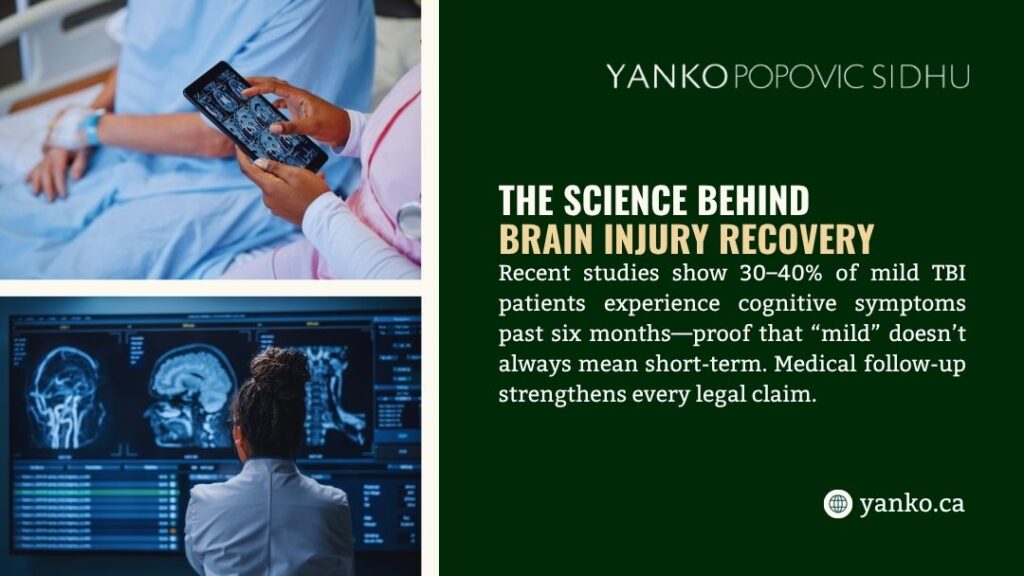
A brain injury settlement starts with diagnosis and credible causation. Concussion and mild traumatic brain injury (mTBI) often present with normal CT/MRI yet produce measurable cognitive, vestibular, and mood deficits.
Moderate to severe TBI can include positive imaging, loss of consciousness, post-traumatic amnesia, and focal deficits. Alberta files lean heavily on neuropsychology, neurologists, neuroradiology, where indicated, and functional capacity evaluations to translate symptoms into economic loss.
| Clinical lens | Evidence that strengthens a brain injury claim |
| Acute care | Ambulance run sheets, ER records, Glasgow Coma Scale entries, loss-of-consciousness details, and early cognitive complaints noted by third parties. |
| Diagnostics | CT/MRI were positive; diffusion tensor imaging in select cases; vestibular testing; sleep studies if fatigue and sleep disturbance persist. |
| Neuropsychology | Standardized batteries linking attention, memory, processing speed, and executive function to work limitations; validity testing enhances credibility. |
| Functional evidence | Occupational therapy, vocational assessments, and functional capacity evaluations are tied to job demands and activities of daily living. |
| Longitudinal proof | Family, employer, and co-worker observations documenting change from pre-injury baseline; school or performance records for students and apprentices. |
Factors That Drive a Brain Injury Settlement Higher—or Lower
Settlement value grows with clarity. Alberta adjusters weigh proof of diagnosis, objective and credible measurement of deficits, and economic modeling. The table below maps the common levers.
| Driver | Why does it change a brain injury settlement |
| Diagnosis severity | Concussion with rapid resolution tends to resolve for less; moderate or severe TBI tied to work loss and care needs pushes value higher. |
| Symptom duration | Persistent headaches, light/noise intolerance, vertigo, mood disorder, and cognitive deficits beyond the early months move non-pecuniary and special damages upward. |
| Work impact | Reduced hours, demotion, forced career change, or full disability create substantial past and future income loss claims with tax gross-up and negative contingencies. |
| Age and trajectory | A younger worker with a derailed career path can justify a larger present value of future income loss than a claimant near retirement. |
| Co-morbid injuries | Cervical injuries, vestibular dysfunction, facial fractures, or orthopedic harm can amplify both pain/suffering and functional loss. |
| Comparative credibility | Consistent reporting, normal life effort, and clean social media beat records that suggest exaggeration; credibility is a multiplier. |
| Mitigation and care | Completion of treatment protocols and reasonable job searches strengthens damages and limits insurer “failure to mitigate” arguments. |
Typical Settlement Ranges: From Concussion to Severe TBI
No two files align, and Alberta courts assess each case on its facts. That said, reference ranges help claimants and insurers anchor negotiations. Canadian and Alberta sources indicate that concussion cases can range from the tens of thousands up to low six figures where symptoms persist; moderate TBI often lands in the mid-six-figure range when income loss and care costs are clear; severe TBI can extend into seven figures. Examples below illustrate the spectrum.
| Injury level | Illustrative information from public sources |
| Mild concussion with short recovery | United States and Canada commentary places many short-duration concussion settlements around $20,000–$80,000, higher where symptoms linger. |
| Moderate TBI with measurable deficits | Canadian guidance shows $85,000–$240,000 for non-pecuniary and basic loss components, rising with income loss and care costs. |
| Severe TBI with permanent impairment | Alberta examples include trial or settlement results in the high six figures to seven figures when lifetime earnings and care are proven. One reported Alberta case exceeded $1.6 million. |
Calgary context matters. Local wages, union schedules, oil and gas roles, and trades apprenticeships change earning baselines. A brain injury settlement that recognizes a lost Red Seal path or safety-critical role can look different from a desk job with flexible accommodations.
Yanko’s own public articles echo these ranges with Alberta-specific examples, including a mild TBI result over $500,000 where cognitive impacts affected earning capacity.

Damages Heads in an Alberta Brain Injury Settlement
A thorough brain injury settlement quantifies every compensable head of damage. Alberta files typically include the following categories, with evidence tailored to each.
| Damage head | Alberta-focused proof and notes |
| Pain and suffering (non-pecuniary) | Not capped for proven brain injuries; level set by case law, symptom severity, and chronicity. |
| Past income loss | T4S, ROEs, pay stubs, union records, supervisor letters; apply net income approach with proper deductions and setoffs. |
| Future earning capacity | Vocational opinions, labor market stats, productivity loss models, promotion probabilities, and negative contingencies. |
| Past out-of-pocket medical | Receipts for therapies, medications, devices, transport to treatment, and paid help. |
| Future care costs | Life-care planners and OT reports with frequency, unit costs, and replacement cycles; present-value discounting. |
| Housekeeping capacity | Replacement services evidence and economic calculations if chronic deficits persist. |
| Special damages | Vision therapy, vestibular rehab, neuro-optometry, sleep clinics, cognitive rehab, and assistive tech were justified. |
| Interest and tax treatment | Appropriate application of interest; future loss tax gross-ups where warranted. |
Proof that Persuades Calgary Adjusters and Alberta Courts
Insurers scrutinize causation and the gap between complaints and function. A brain injury settlement improves as your file links pre-injury baseline to post-injury change with neutral third-party observations. Family and co-workers anchor credibility, but clinicians carry the weight. A neuropsychologist’s results paired with a realistic vocational plan often drive negotiations.
| Insurer position | Response from a well-built file |
| “Symptoms are subjective.” | Validity-checked neuropsych testing, vestibular metrics, and structured OT observations show measurable deficits. |
| “You can work.” | Detailed job-duties analysis, safety concerns, error rates, and employer affidavits show reduced reliability in complex or safety-critical tasks. |
| “No imaging proof.” | Literature shows that many concussions lack positive imaging; function, not only pictures, sets the value. |
| “Just a minor sprain.” | The Minor Injury Regulation cap does not govern proven brain injuries; cite diagnostic notes and expert opinions. |
Medical-Legal Strategy That Works in Alberta
A strong brain injury settlement builds a consistent, neutral record.
| Step | Execution detail |
| Treat and document | Follow clinical plans; attend therapy; keep a symptom and work log that aligns with medical notes rather than social media highlights. |
| Specialist depth | Seek neurology, neuropsychology, vestibular therapy, and, where indicated, neuro-optometry for convergence issues and visual-induced headaches. |
| Work reality check | Secure letters from supervisors about errors, slower productivity, or safety concerns; align vocational testing to those deficits. |
| Home and community | Record changes in household roles, childcare, and social tolerance; third-party affidavits trump self-assessments. |
| Economic modeling | Use Alberta-relevant wages, union scales, and benefits; apply tax gross-up and discount rates that reflect local precedent. |
How Insurers Discount and How Calgary Claimants Counter
Adjusters lean on common talking points. Alberta claimants answer with targeted proof.
| Insurer line | Credible counter |
| “Symptoms resolved.” | Longitudinal testing shows persistent deficits; employer letters confirm reduced reliability and safety concerns. |
| “Pre-existing condition.” | Baseline records and witness testimony establish a clear pre-injury function; apportionment is limited to actual aggravation, not speculation. |
| “Return to work occurred.” | A partial return with accommodations can still support income loss, a limited promotion path, and housekeeping claims. |
| “Just soft tissue, capped.” | Medical evidence demonstrates brain involvement; MIR cap does not limit this brain injury settlement. |
Alberta Action Plan After a Suspected Brain Injury
A short, disciplined plan preserves value in a brain injury settlement.
| Step | What to do in Calgary and Southern Alberta |
| Clinical pathway | Seek assessment, follow referrals, and keep every appointment; gaps invite denial. |
| Evidence capture | Preserve phone photos of the scene, names of witnesses, employer notes, and all receipts. |
| Legal timing | Call counsel early to track the two-year limitation and lock down evidence. |
| Employer communication | Discuss safe duties in writing; do not over-promise endurance or tolerance that medical notes cannot support. |
| Settlement posture | Avoid premature offers; build the record first so your brain injury settlement reflects the real loss profile. |
What a Lawyer Actually Does on a Brain Injury File in Alberta
The work is methodical. First, fix the liability story: who caused the crash, fall, or malpractice, and how to prove it with witnesses and records. Second, lock down medical causation with well-chosen specialists rather than an endless cascade of assessments. Third, fit work loss and future care into Alberta-sensible economic models, not generic templates. Finally, set a negotiation timeline that leaves room for mediation but does not reward delay.
Local knowledge matters. Calgary files often involve union roles, safety-sensitive jobs, or fly-in-fly-out rotations. Those realities change the return-to-work picture and the dollar value of lost opportunities. When the record reflects that reality, a brain injury settlement lands far closer to full compensation.
Examples of How Specific Facts Alter Settlement Value
| Fact pattern | Likely impact on a brain injury settlement |
| Apprentice electrician with persistent vestibular symptoms | Safety issues and lost Red Seal path can raise future income loss well beyond non-pecuniary damages. |
| Junior engineer with slowed processing speed and migraines | Promotion path and project responsibility erode; damages lean on neuropsych data and supervisor affidavits. |
| Hospitality worker with late-night shift intolerance | Fewer employable roles and fewer premium-pay hours; economist models the earnings gap over decades. |
| Parent with reduced multi-task capacity | Loss of housekeeping and increased paid help; add future care hours where justified by OT evidence. |

Take Control of Your Brain Injury Settlement Today
A brain injury settlement is not just a payout; it’s the financial foundation that supports your recovery, medical care, and long-term security. The number depends on the facts you can prove, and every day without proper documentation risks undervaluing your claim.
At Yanko Popovic Sidhu, we have handled over 10,000 personal injury cases and helped clients across Calgary and Southern Alberta recover millions in compensation for head trauma, concussions, and severe TBIs. Our experience with Alberta’s legal and medical systems gives clients an edge when facing powerful insurers.
If you or a loved one has sustained a brain injury in a car accident, fall, or medical negligence, speak directly with our Calgary brain injury lawyers to evaluate your claim, secure vital medical evidence, and protect your right to fair compensation under Alberta law.
Visit Brain Injury Lawyer, Calgary, or call our Calgary office to start your confidential consultation. Every step you take now shapes the value of your future settlement.