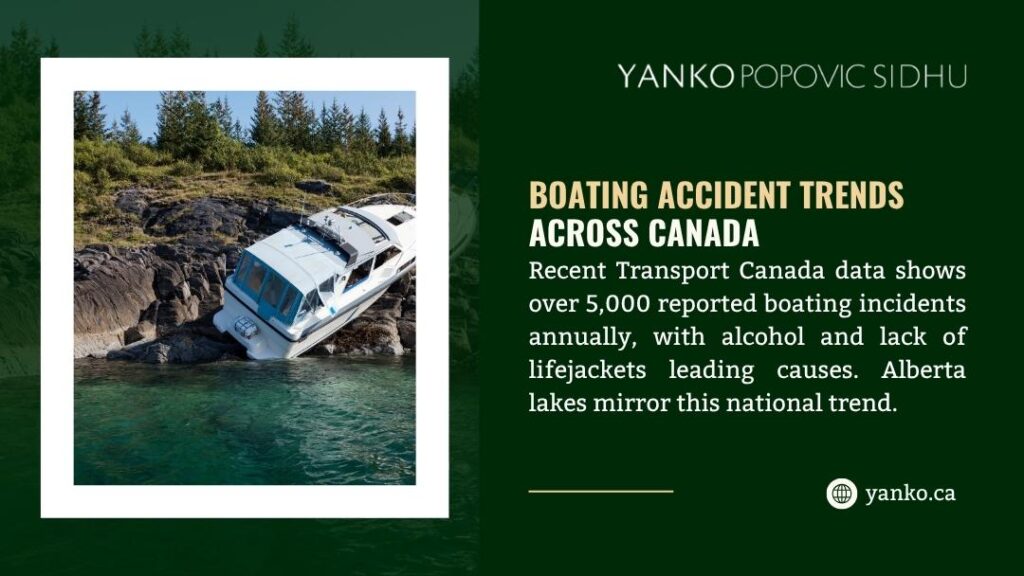
Each summer, Alberta sees hundreds of recreational boating incidents across lakes and rivers like Chestermere, Sylvan Lake, and the Bow River. According to Transport Canada and the Lifesaving Society, roughly 100 to 120 recreational boating deaths occur nationwide each year, with many more serious, non-fatal injuries involving propellers, collisions, and capsized vessels. In Alberta alone, water-related emergency responses have risen over 20% in the past five years, often linked to impaired operation or lack of safety equipment.
A boat accident settlement refers to the total financial compensation paid to victims or their families after a boating crash caused by negligence. This settlement often covers medical bills, rehabilitation, lost wages, pain and suffering, and future care costs.
While some minor cases settle for a few thousand dollars, catastrophic injury or wrongful death claims can reach six- or seven-figure sums, depending on the extent of injuries and the available insurance coverage under Canada’s Marine Liability Act (MLA).
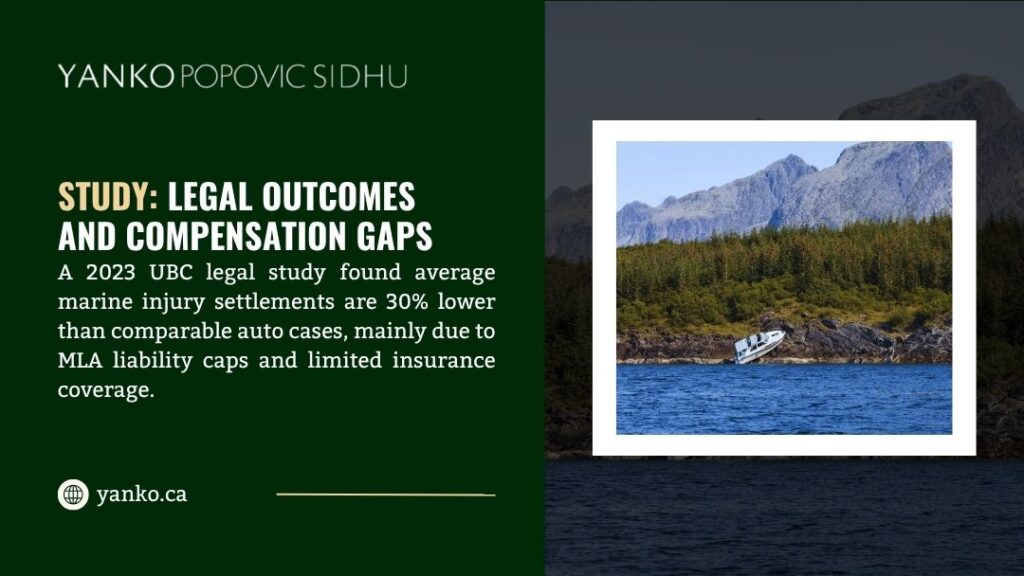
Unlike car accident settlements, which fall under Alberta’s Insurance Act, boat accident settlements are guided primarily by federal marine law. The MLA not only defines who can claim but also sets global caps on compensation, often around $1 million to $1.5 million for all victims in a single incident, unless reckless conduct by the operator removes that limit.
In Alberta, claimants generally have two years from the date of the boating accident, or the date they became aware of the injury and its cause, to start legal action. Missing this limitation can forfeit your right to compensation entirely. Victims who suffered brain injuries, spinal cord trauma, or long-term disability typically pursue their claims through specialized personal injury lawyers who understand both marine and provincial law.
Ultimately, a successful boat accident settlement depends on clear proof of negligence, detailed documentation of financial and medical losses, and strategic negotiation with the insurer or the boat owner.
For residents of Calgary and Southern Alberta, firms such as Yanko Popovic Sidhu, with over 40 years of experience and a track record of millions recovered, provide the combination of local insight and marine law expertise needed to secure a fair settlement.
Why a boat accident settlement is not just another car accident claim
Most Albertans know the drill for car accidents. You deal with auto insurers, Section B benefits, and Alberta’s motor vehicle legislation. Boat accident cases live in a different legal world.
A serious boat accident settlement in Alberta usually flows from federal marine law, not from the same regime that covers car accidents. Pleasure craft, fishing boats, pontoons, jet skis, and small tour vessels on Alberta lakes and rivers fall under the Marine Liability Act (MLA). That statute sets the basic framework for liability, limits of compensation, and time limits for boat accident claims.
The key differences compared to car accidents are clear.
| Issue | Car accidents in Alberta | Boat accident settlement in Alberta |
| Governing law | Alberta Traffic Safety Act, Insurance Act, and related regulations | Federal Marine Liability Act plus Alberta negligence law |
| Insurance structure | Mandatory auto insurance and standard benefits | Mix of marine liability policies, homeowner coverage, and compulsory passenger insurance on some vessels. |
| Liability caps | No general global cap on all victims in one crash | MLA caps total recoverable personal injury damages for many smaller vessels, unless reckless conduct breaks that cap. |
| Typical accident context | Intersections, highways, city streets | Lakes and rivers, often with weather, wakes, submerged hazards, and alcohol involved. |
Because of this, a boat accident settlement demands legal analysis that respects both marine law and Alberta personal injury practice. A law firm that treats a boat collision like a routine car crash risks leaving compensation on the table, or worse, missing limitation issues that can bar the claim.
Who can seek a boat accident settlement in Alberta?
If you were injured in a boating accident on an Alberta lake or river, you probably care less about legal theory and more about whether you and your family can claim compensation. The law gives rights to several groups.
First, the person injured in a boating accident has a direct claim. That includes passengers on a pleasure craft, people on another vessel struck in a collision, water-skiers or tubers towed behind a boat, or even swimmers or paddlers hit or swamped by a careless boat owner or operator.
Second, in fatal boat accident cases, the Marine Liability Act lets close family members seek compensation for wrongful deaths tied to a marine incident. Spouses, dependent children, and sometimes other family members can claim for loss of support, loss of care and guidance, and funeral expenses.
Third, in some situations, people who rescue others or who suffer losses while trying to avoid a collision also fit within the pool of victims with boat accident claims.
The common thread is this: if another person’s negligence on the water caused your injuries or a family member’s death, you likely have grounds to pursue a boat accident settlement in Alberta. The challenge lies in proving fault and then navigating the MLA caps and insurance layers.
Laws that shape a boat accident settlement in Alberta
Marine Liability Act and pleasure craft
The Marine Liability Act sits at the center of most boat accident cases in Canada. It sets out who can sue, which courts can hear the claim, how fault works between vessels, and the limits of liability for shipowners.
For most Alberta pleasure craft and small passenger vessels under 300 tons, the MLA caps total compensation for personal injuries and deaths across all victims from one marine incident, at a global limit.
Older commentary and case law often refer to a one-million-dollar cap, and more recent amendments and international protocols have raised global limits closer to a combined $1.5 million for all personal injury claims in a single incident.
That cap does not always apply. If a plaintiff proves that the boat owner or operator acted in a way that was not just negligent but “reckless” and with knowledge that damage would probably result, the defendant can lose the right to limit liability.
Limitation periods for boat accident claims
Time limits in boat accident cases are strict. Under both Alberta’s Limitations Act and the Marine Liability Act framework, many boat accident claims must be filed within about two years of the accident or of the date when the injured person reasonably knew about the injury and its cause.
In some marine contexts, the limitation can extend to three years, depending on whether the injured person qualifies as a passenger in the narrow sense used in the MLA, and on how the incident fits within Canada’s implementation of international marine conventions.
The safe approach is simple: if you want a fair boat accident settlement after a serious crash in Alberta, treat the two-year mark as a hard deadline and speak with personal injury lawyers as early as possible. Evidence on the water disappears fast, witnesses move, and weather records get harder to track down as time passes.
Interaction with Alberta personal injury law
Although the MLA governs marine liability and caps, the core of a boat accident settlement still follows the familiar Canadian negligence framework. You must prove that the boat owner or operator owed you a duty of care, breached that duty by careless conduct, and caused your injuries or the wrongful death in question.
Courts also apply the Supreme Court of Canada’s cap on non-pecuniary damages. In Alberta, that cap sits at roughly $415,000 for the most severe cases, such as catastrophic brain injury or quadriplegia, after inflation adjustment, with most boat accident settlements falling below that maximum.
The rest of the claim, income loss, loss of housekeeping capacity, care costs, and family dependency in wrongful death lawsuits, does not have the same type of judge-made cap, though the MLA limits still place a ceiling in many boat accident cases.
What a boat accident settlement can cover in Alberta
A thorough boat accident settlement aims to restore, in monetary terms, the losses caused by the crash as far as the law allows. In serious boat accident cases, those losses extend far beyond the first hospital visit.
The main categories often look like this.
| Damage category | How it applies in boat accident cases |
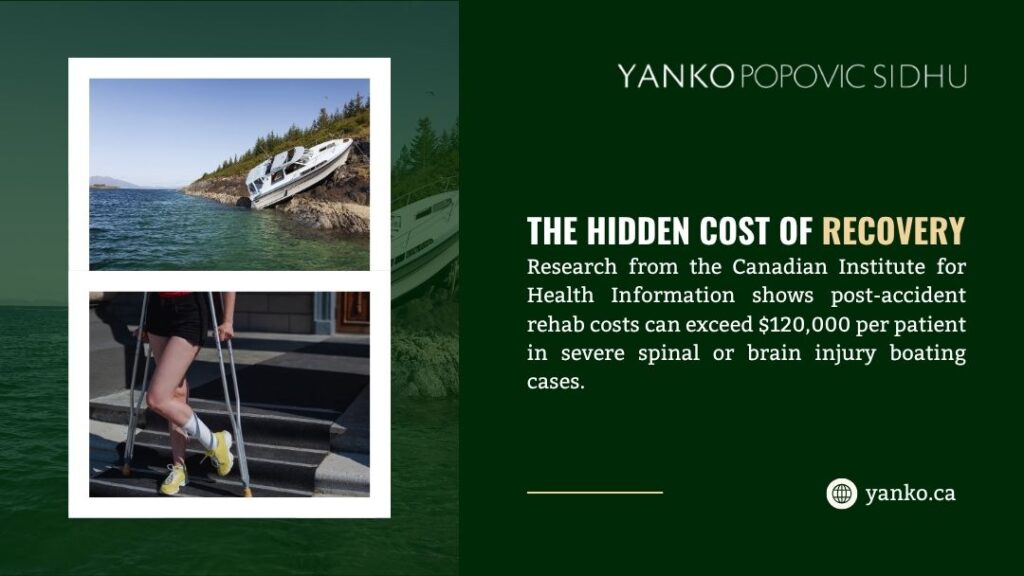
| Medical bills and rehab costs | Emergency treatment, surgery, hospital stays, physio, occupational therapy, psychological treatment, prescriptions, assistive devices, and future care for long-term boat accident injuries. |
| Lost wages and loss of earning capacity | The income you already lost from time off work, plus the gap between your pre-accident earning path and your likely future earnings after the injuries. This is a major driver of higher boat accident settlement values for younger workers or people in skilled trades and professions. |
| Pain, suffering, and loss of enjoyment | Non-pecuniary damages for physical pain, loss of lifestyle, loss of hobbies such as boating or sports, within the Supreme Court of Canada cap. |
| Family claims in wrongful deaths | Support for spouses, children, and sometimes other family members after fatal boat accident cases, including loss of income, household services, and guidance. |
| Housekeeping and caregiving losses | Cost of replacing the unpaid work in the home that the injured person can no longer do, along with the extra support family members must provide. |
| Out-of-pocket expenses | Travel to appointments, parking, home modifications, vehicle changes, and similar direct costs. |
| Property loss | Damage to boats, personal items, and sometimes dock or shoreline structures, subject to MLA caps for non-personal-injury losses. |
In real boat accident settlements, medical bills, ongoing care, and lost wages often overshadow the other categories. In catastrophic cases involving brain injury or spinal cord damage, lifetime care and income loss can push the total above the MLA limits for smaller vessels, which is why early analysis of the applicable cap is so important.
Factors that shape the value of a boat accident settlement
There is no universal “average boat accident settlement” number that fits Alberta. LegalZoom and other sources highlight wide swings in settlement values even within one jurisdiction, and those ranges are even broader once you factor in MLA caps and international protocols. What matters more are the levers that raise or lower your specific boat accident settlement.
| Factor | Effect on a boat accident settlement |
| Severity of injury | More serious boat accident injuries, such as fractures, traumatic brain injury, or spinal cord injury, raise both care costs and non-pecuniary damages. |
| Long-term impact on work | A short-term soft tissue injury will not produce the same settlement as permanent loss of earning capacity in a skilled trade or professional role. |
| Age and family responsibilities | Younger victims and those with dependent family members often face higher lifetime income loss and broader family impact, which can drive higher settlement figures within the applicable cap. |
| Conduct of the boat owner or operator | Clear evidence of impairment, excessive speed, lack of required safety equipment, or disregard of weather conditions strengthens liability and, in some cases, can break MLA limitation rights. |
| Shared fault | If you failed to wear a lifejacket, rode with an impaired driver, or ignored obvious hazards, the court may reduce your boat accident settlement through contributory negligence. |
| Number of victims and MLA cap | When several people suffer serious injuries or wrongful deaths in the same incident, everyone must share the same global limit under the Marine Liability Act unless the cap is lifted. |
| Insurance structure | A well-insured commercial operator or tour company offers more room for a full boat accident settlement than an uninsured private boat owner with few assets, even when fault is clear. |
| Quality of evidence | Prompt scene photos, witness statements, police and Coast Guard records, and expert reports on speed, visibility, and impact all add weight to your claim. Weak evidence makes it easier for an insurance company to dispute both liability and damages. |
An experienced legal team that understands both marine law and Alberta personal injury practice will track each of these factors in detail before putting any boat accident settlement number on the table.
Typical timelines for boat accident settlements in Alberta
Every case moves at its own pace, but most Alberta boat accident settlements follow a familiar path.
| Stage | What usually happens | Indicative timeframe |
| Immediate response | Medical care, reports to police or RCMP, Transport Canada, or local authorities, notice to the boat owner, and any known insurer. | First hours and days |
| Early legal review | Collection of photos, scene information, witness details, basic liability analysis under the Marine Liability Act, and Alberta negligence rules. | First weeks |
| Medical stabilization | Doctors assess prognosis, rehab starts, and specialist opinions on long-term impact begin to form. Settlement discussion too early at this stage often favors the insurance company. | First 3 to 12 months, depending on injury |
| Formal claim and investigations | Statement of claim filed within the limitation period, defense response, document exchange, questioning of parties, expert reports on liability and damages. | Roughly months 6 to 24 in many serious cases |
| Negotiation and mediation | Once medical and vocational evidence is reasonably clear, structured settlement talks or mediation take place with the insurer or boat owner. | |
| Trial if no settlement | If the parties cannot agree on a fair boat accident settlement, the case proceeds to trial, where a judge (and sometimes a jury) sets the award, still subject to MLA limits where they apply. |
Minor boat accident claims with clear liability and full recovery can be resolved earlier. Catastrophic injury cases linked to quadriplegia, severe brain injury, or wrongful deaths can run for several years before a final boat accident settlement or judgment, especially where MLA limitation issues, multiple defendants, or complex insurance structures arise.
How insurers look at boat accident claims
From the injured person’s side, a boat accident settlement is about medical bills, lost wages, and the strain on family members. For an insurance company, it is a risk calculation within policy limits and MLA caps.
Insurers scrutinize three main areas: liability, causation, and quantum (the size of the claim). They explore any argument that you were partly at fault for the boating accident, that some of your symptoms come from earlier issues rather than the crash, or that your income loss is smaller than claimed.
They also keep a close eye on the MLA global compensation cap. In multi-victim boat accident cases, an insurer may push early, modest settlement offers in the hope that injured people accept low amounts before full case values and the number of claimants becomes clear.
That is why taking the first boat accident settlement offer rarely makes sense without full legal advice and a clear view of the long-term medical and financial impact of the crash.
Serious boat accident injuries and high-value settlements
On Alberta lakes and rivers, many boat accidents lead to bruises and short-term soft tissue strains. Others are life-changing. Transport Canada and national drowning research show that Canada sees around 100 to 120 recreational boating fatalities each year, with many more serious but non-fatal injuries tied to capsizing, ejection from vessels, and collisions at speed.
The injuries that drive higher boat accident settlement amounts include:
- traumatic brain injury from blunt force or oxygen loss after immersion
- spinal cord injury from high-energy impact or diving from unstable decks
- severe fractures and orthopedic damage
- burns from fuel ignition or onboard fires
- psychological trauma after near-drowning or loss of family members
For these types of boat accident cases, settlement analysis must track both Canadian personal injury caps and the MLA global limit. Young workers with a brain injury who can no longer return to their trade, parents who suffer spinal cord injury with permanent mobility loss, or families who lose a primary wage earner in wrongful deaths all face losses that can easily exceed a million dollars over a lifetime.
Where catastrophic injury is involved, it often makes sense to pair a boat accident settlement claim with focused injury expertise. For example, if a boating crash leaves you with a serious brain injury, a dedicated brain injury lawyer can focus on cognitive deficits, vocational loss, and long-term care planning while the marine law team addresses MLA and insurance issues. You can see how our firm approaches these cases on the dedicated brain injury page at Yanko Brain Injury Lawyer in Calgary.
Similar logic applies to spinal cord injuries, burns, and other catastrophic outcomes. The marine law side defines the pot of available compensation; the injury side justifies the size of your slice.
Steps that protect your boat accident settlement after an incident
If you were injured in a boating accident in Alberta, early steps can have a direct effect on your eventual boat accident settlement. People often feel overwhelmed, especially when the crash happens during what was meant to be a quiet day on the lake with family members. A calm, methodical approach helps protect your rights.
First, health comes. Seek medical care right away, even if you feel “basically fine” after the shock fades. Many head and neck injuries, and even subtle brain injury, only show clear symptoms hours or days later. Early records matter when you negotiate a boat accident settlement with an insurance company.
Second, document the scene as much as circumstances allow. Photos of vessel positions, damage, navigation markers, weather, shoreline, and visible injuries can help experts reconstruct how the boating accident happened. Collect names and contact details for witnesses and for the boat owner or operator.
Third, obtain incident numbers and reports. Police, RCMP, or local rescue authorities often prepare reports of more serious boat accident cases. In some situations, Transport Canada or marine enforcement units also become involved. Those records frequently shape both liability findings and settlement discussions.
Fourth, avoid giving detailed recorded statements to an insurance company before you know the legal landscape. Casual comments on shared fault, alcohol, lifejacket use, or speed can later be used to lower your boat accident settlement.
Fifth, speak with qualified personal injury lawyers who have real experience with boat accident claims in Alberta and who understand both the Marine Liability Act and the Supreme Court of Canada approach to personal injury damages. Early legal advice does not lock you into litigation, but it does conserve evidence and prevent self-inflicted harm to your case.
Next steps if you want to move your boat accident settlement forward
A serious boating crash on an Alberta lake or river changes more than a weekend. It alters health, income, and the daily lives of entire families. The law does not promise an easy route back to normal, but it does provide a path to compensation for those injured in a boating accident and for family members who face wrongful deaths tied to marine negligence.
A carefully prepared boat accident settlement draws on three pillars: clear proof of fault under the Marine Liability Act, a precise calculation of medical bills and long-term financial losses under Alberta personal injury law, and a firm stance with the insurance company that keeps your claim within limitation periods and above low early offers.
If you want focused guidance on a potential boat accident settlement in Calgary or anywhere in Southern Alberta, you can reach Yanko Alberta directly through the main site at Yanko Popovic Sidhu Personal Injury Law Firm.
The firm offers a free consultation and no upfront legal fees, so you can speak with a senior personal injury lawyer about your boat accident case, your medical bills, and your lost wages before you decide how to proceed.