An atv accident settlement in Calgary and Southern Alberta depends on two things more than anything else: clear fault and clear medical proof. Alberta law also imposes real deadlines, and insurers move fast when they sense gaps in records, mixed stories, or “shared blame.”
This guide explains what an atv accident settlement can cover, what drives value up or down, how insurance actually responds in common Alberta ATV scenarios, and what to do so your atv accident settlement reflects the true cost of the injury.
ATV Accident Settlement: What It Covers in Alberta
When people search “atv accident settlement,” they usually mean one practical question: what money can I recover, and what does it take to get it? In Alberta, an atv accident settlement typically aims to compensate you for losses caused by someone else’s negligence.
That can include financial losses such as medical bills and income loss, plus non-financial harm such as pain and suffering. The hard part is not the list. The hard part is proof, timing, and how the insurance company frames the story.
A clean atv accident settlement starts with documents that match your reality. Medical records matter because they anchor the timeline. Bills matter because they show the out-of-pocket cost. Employment records matter because insurers test lost wages claims aggressively. If you suffer long term complications, the atv accident settlement must account for future care, future income impact, and the day-to-day limits that do not show up on a receipt.
The strongest atv accident settlements also respect a basic rule: settlement value tracks the injury’s demonstrated impact, not the injury’s label. A traumatic brain injury diagnosis carries weight, but what moves an atv accident settlement is what that brain injury does to memory, work pace, mood, stamina, and independence. The same goes for spinal cord injuries, chronic pain, fractures that never quite heal, and psychological harm after violent crashes.
To keep this concrete, here is what an atv accident settlement often contains, and what insurers usually demand before they take numbers seriously.
| ATV accident settlement category | What it pays for | What evidence usually persuades an insurer or court in Alberta |
| Medical bills and treatment costs | Ambulance costs, prescriptions, therapy, assistive devices, rehab, travel for care | Medical records, receipts, referral notes, treatment plans |
| Lost wages | Time off work, reduced hours, missed opportunities | Employer letters, pay stubs, tax records, and attendance logs |
| Future income loss | Lower earning capacity if you cannot return to the same work | Specialist prognosis, functional testing, vocational evidence |
| Pain and suffering | Physical pain and loss of enjoyment of life | Consistent medical charting, credible personal history, and corroboration from family or co-workers |
| Future care and long-term support | Ongoing therapy, home assistance, and equipment | Prognosis reports, cost of care estimates, care plans |
An atv accident settlement can also include costs tied to housekeeping capacity, caregiving needs, and other practical losses, depending on the facts. Your job is to document what changed. Your lawyer’s job is to translate that change into a defensible accident claim that survives scrutiny.
The Biggest Factors That Change an ATV Accident Settlement
An atv accident settlement is not a lottery ticket. It behaves more like a case file scorecard. Each major factor either adds strength or injects doubt. Doubt is expensive.
Fault clarity sits at the top. If liability looks obvious, say, reckless driving, impairment, speeding on a trail with other riders, unsafe passenger behaviour encouraged by the driver, or ignoring known hazards, then an atv accident settlement tends to move faster and higher. If facts look messy, no witnesses, conflicting stories, no photos, and delayed medical visits, then insurers discount the claim.
Injury severity is the next driver, but “severity” means the medical story has to be stable. Early in an atv accident case, symptoms evolve. That uncertainty slows settlement. A rushed atv accident settlement often underpays because the long term outcome has not crystallized. Insurers know this and sometimes push quick deals with “full and final” releases before you fully understand what you will need in six months.
Your documentation quality matters more than most people expect. If you were injured in an atv crash and you saw a doctor, but you minimized symptoms, skipped follow-ups, or refused recommended therapy, the insurance company may argue the injury was minor or self-limited. That argument hits pain and suffering, future care, and sometimes even wage loss. A strong atv accident settlement usually follows a consistent treatment arc that makes sense.
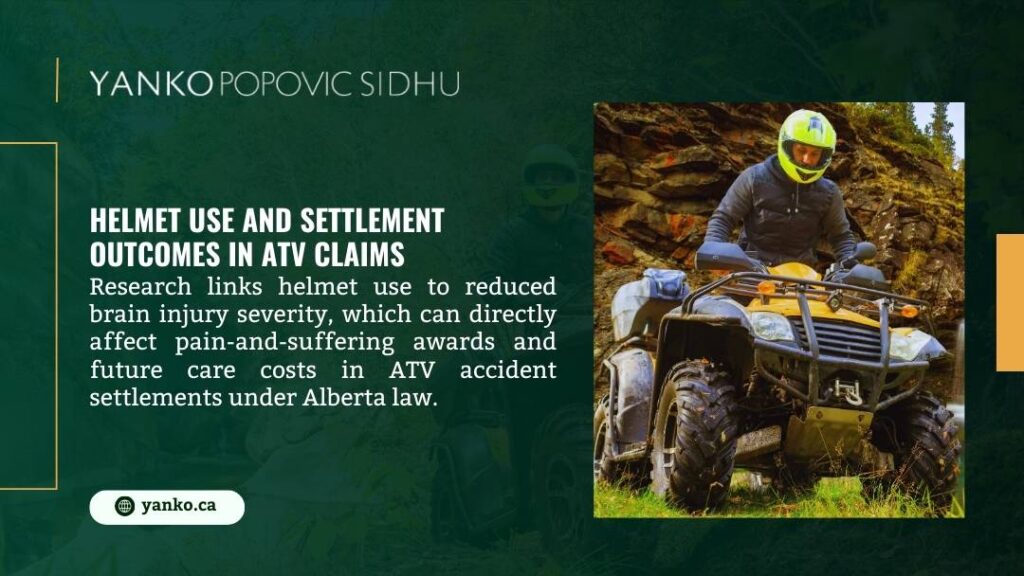
Comparative fault can also reshape an atv accident settlement. If the insurer argues you contributed, no helmet, riding as a passenger in unsafe conditions, riding on prohibited terrain, risky speed, alcohol use, ignoring warnings, then the settlement math shifts. Even when you still deserve compensation, shared blame can reduce the number or prolong negotiations.
Insurance limits often cap reality. This is where ATV claims differ from many vehicle accidents. Some ATV situations rely on off-highway vehicle coverage, sometimes homeowner coverage, sometimes auto coverage, depending on the collision context. The available policy limits can determine the ceiling for an atv accident settlement, even when damages exceed that ceiling.
Finally, credibility decides close cases. Credibility means consistent statements, consistent medical reporting, and a story that holds up under basic questions. A single careless social media post can harm an atv accident settlement when it contradicts your reported limitations.
Fault Rules in ATV Accident Cases in Alberta
Many talk about fault. They say “you must prove negligence,” then move on. In Alberta, that line is true, but it is not helpful until you map it onto real ATV scenarios.
If you were injured in an atv accident caused by another rider’s reckless driving, your legal claim often looks like a standard negligence file: duty of care, breach, causation, damages. The evidence usually includes scene photos, witness statements, police or incident reports, and medical records. The more objective your proof, the less room insurers have to “interpret” facts.
If your atv accident involves a collision with a truck or car, a true motor vehicle accident scenario, fault analysis may follow the same broad approach as road collisions: driving decisions, right-of-way, speed, visibility, and impairment.
Transport Canada reports serious injuries and fatalities each year in Canadian motor vehicle collisions, and those broader safety trends matter because insurers rely on standardized collision analysis frameworks.
If you were a passenger injured in an atv, the legal options can feel awkward when the driver is a friend or relative. That discomfort is common in Alberta practice. The key point is that most atv accident claims are paid by an insurance company, not by someone writing a personal cheque, provided the relevant policy applies. This is exactly why insurance exists. It also explains why insurers work so hard to narrow coverage and limit damages.
If you were injured on private land, the “where” changes which policy may respond, but it does not erase the duty to take reasonable care. Property conditions, signage, known hazards, and supervision can matter. So can the conduct of an ATV owner who lends a machine to an inexperienced rider.
In Calgary and Southern Alberta, rural settings add another twist: many serious atv accidents happen away from immediate medical access. A delayed ambulance call or a delayed medical assessment can later become a fight about causation.
That can reduce an atv accident settlement if you let the insurer claim the injury worsened for reasons unrelated to the crash. The fix is simple: document the timeline early, then let medical professionals speak through records.
Insurance Company Pathways That Pay ATV Accident Settlements
In Alberta, insurance for off-highway vehicles often includes third-party liability and accident benefits in situations such as riding on public land or certain road contexts. Alberta-based insurers and brokers explain that third-party liability and accident benefits can be mandatory depending on where and how the ATV operates, and that the coverage exists to address injuries and claims.
That matters for an atv accident settlement because the first settlement question is not “how hurt are you?” It is “what policy pays?” Once you identify the right policy path, you can evaluate realistic settlement value and strategy.
Three common payment pathways show up in Alberta ATV files.
First, liability coverage is linked to the ATV or rider. If the driver caused the atv accident, third-party liability coverage may pay your atv accident settlement, up to policy limits, plus legal costs to defend the insured.
Second, auto insurance pathways in ATV vs vehicle accidents. When an ATV collides with a motor vehicle accident scenario on or near a roadway, you may face overlapping coverage questions. Sorting this early avoids wasted time and helps you focus your accident claim where it actually pays.
Third, other insurance that may respond, depending on the facts. Some cases raise homeowner or occupier liability issues, particularly on private land. Insurers often resist broad interpretation, so a careful coverage analysis can make or break an atv accident settlement.
If your crash involved impaired or reckless driving by another party, that can add leverage. Juries and adjusters tend to treat those files differently because the conduct looks worse and the risk of trial exposure rises.
The same compensation principles apply when an ATV collision involves a car or truck. Alberta insurers assess fault, medical impact, income disruption, and long-term consequences in much the same way they do after roadway crashes, which is why understanding how car accident compensation works in Alberta can clarify how damages are calculated in these mixed vehicle cases.
Evidence That Actually Moves an ATV Accident Settlement
Most people think an atv accident settlement depends on how “bad” the crash looked. In reality, insurers pay for what they cannot easily argue against. Your best leverage is organized proof.
| Evidence Type | What It Shows | Common Insurance Pushback | What Preserves Settlement Value |
| Medical records | Injury onset, progression, and outcome | Injury was minor or unrelated | Early diagnosis and consistent follow-up |
| Brain injury evidence | Cognitive, neurological, and sleep disruption | Symptoms are subjective | Objective findings and stable symptom history |
| Spinal injury documentation | Functional and neurological impairment | Recovery expected | Imaging and specialist prognosis |
| Income and job records | Actual work and income loss | Work was still possible | Employer confirmation and medical limits |
| Long-term earnings evidence | Future income reduction | Loss is speculative | Vocational and medical support |
| Crash scene photos | Severity and fault indicators | Impact was minimal | Clear terrain, damage, and equipment images |
| Witness accounts | Independent confirmation of events | Memory is unreliable | Early, consistent statements |
| Treatment continuity | Medical seriousness | Gaps weaken credibility | Logical, uninterrupted care |
| Record consistency | Overall claim credibility | The story keeps changing | One aligned narrative across all documents |
When an ATV crash involves head trauma, a brain injury claim often becomes central to the case. These injuries may not be immediately visible, yet they can affect cognition, behavior, and work capacity, making them a major driver of ATV accident settlement value once supported by medical evidence.
What to Do After You’re Injured in an ATV, Without Damaging Your Claim
After an atv accident, your first job is health. Your second job is protecting the record. Those two goals align more than people think.
Seek medical assessment as soon as possible, even if you believe you “just got shaken up.” Canada-wide injury data shows injuries remain a major driver of emergency department use and hospital care each year, and that broader reality is why clinicians take injury mechanisms seriously when you present early.
Report the incident when appropriate. If police attend, obtain the file number. If the incident occurs on private land, document who owned the land, who owned the ATV, and who supervised the ride.
Do not give a recorded statement to an insurance company until you understand what policy applies and what questions matter. Adjusters often ask apparently harmless questions that later turn into a comparative fault argument. A single casual line, “I felt okay at first,” can become a tool to devalue an atv accident settlement.
Keep a simple record of symptoms and limits. Not a dramatic diary, not a novel, just a plain timeline. When pain and suffering become a dispute, that timeline helps medical providers and lawyers present a coherent story.
If your injury includes neurological symptoms or back symptoms, take it seriously. Long-term problems often start as “minor” symptoms that never fully resolve.
Timeline: How Long Does an ATV Accident Settlement Take in Alberta
People want speed. Insurers exploit that desire. A fair atv accident settlement usually arrives when two things settle: the medical prognosis and the evidence picture.
Here is a practical timeline model that matches how many Alberta atv accident cases develop, even though every file differs.
| ATV accident settlement stage | What happens | What you should focus on |
| Initial weeks | Treatment begins, symptoms documented, coverage identified | Medical care, consistent reporting, and evidence preservation |
| Following months | Recovery path becomes clearer, work impact documented | Follow treatment, document work limits, and avoid narrative drift |
| Settlement window | Demand package, negotiations, possibly mediation | Strong medical records, clear loss calculation, realistic strategy |
| If disputed | Lawsuit steps, expert evidence, pressure points | Consistency, patience, and preparation for trial leverage |
Alberta Deadlines: Limitation Periods You Cannot Ignore
Alberta imposes a basic two-year limitation period in many personal injury matters, tied to discoverability, the point where you knew or ought to have known you had an injury linked to someone’s fault and that a legal claim made sense. Lawyers and legal commentators routinely summarize this as a two-year window to commence a claim in most standard injury scenarios.
This matters for an atv accident settlement because insurers sometimes slow-walk files, then act shocked when you run out of time. Do not let them control the calendar. If you suspect your atv accident claim may require formal steps, get legal advice early enough to preserve your rights.
Special situations can change limitation analysis, including claims involving minors or unique benefit endorsements and policy wording. The core practical message remains simple: treat the limitation issue as urgent, even if your medical recovery takes time.
Common Injuries That Drive High-Value ATV Accident Settlements
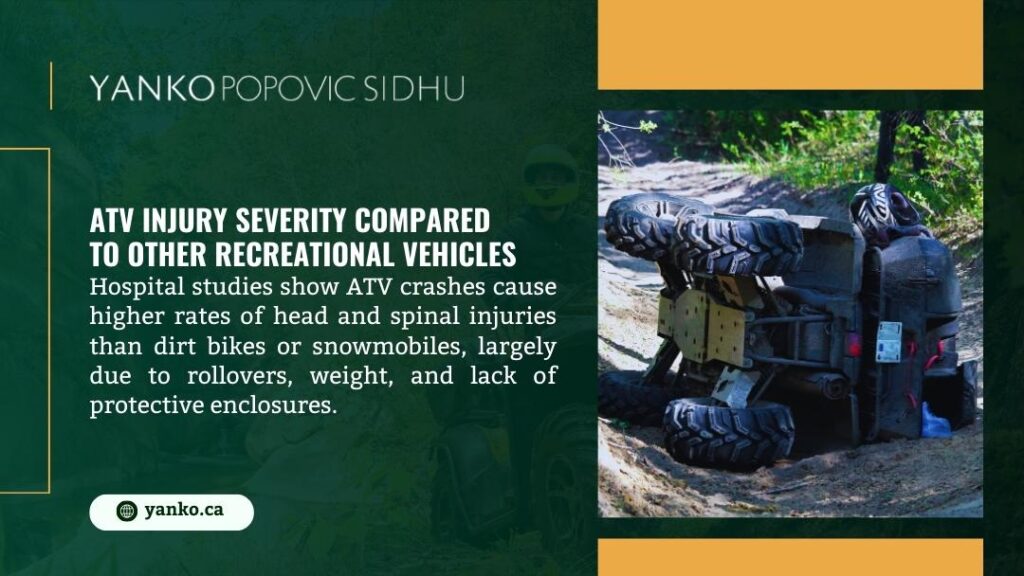
ATV crashes produce a specific injury mix: high-energy impacts, ejections, rollovers, and collisions with fixed objects. Research that analyzes ATV-related injury hospitalizations highlights how serious these injuries can be across age groups, with head injuries and severe trauma patterns showing up repeatedly.
National Canadian data also reports an average of about 100 deaths per year from unintentional ATV events across provinces and territories during 2013–2019, which underlines the high-risk nature of these incidents.
In settlement terms, the injuries that tend to raise atv accident settlement value are those that leave persistent limitations or measurable impairment: traumatic brain injury, spinal cord injuries, complex fractures, chronic pain syndromes, and psychological trauma tied to serious crashes. When these injuries affect work, parenting, and independent living, the atv accident settlement analysis must include future costs, not just what already happened.
When to Speak With Personal Injury Lawyers About an ATV Accident Settlement
You do not need a lawyer for every scrape. You do need one when the atv accident settlement stakes are real: time off work, ongoing symptoms, head trauma, broken bones, surgery, long-term rehab, disputed fault, or an insurance company that acts “friendly” while gathering leverage.
A free consultation can help you understand legal options without committing to a lawsuit. Many Alberta personal injury lawyers work on a contingency fee basis, which means legal fees come from the result rather than upfront payments, so the financial barrier is lower than most people assume.
Protect Your ATV Accident Settlement Before the Record Goes Cold
An atv accident settlement in Calgary and Southern Alberta rises or falls on proof, consistency, and timing. If you were injured in an atv crash, treat it like the serious legal claim it can become. Get medical assessment, keep records tight, and avoid casual insurer conversations that lock you into an incomplete story.
The insurance company will try to narrow your accident claim to the cheapest version of events. Your job is to make sure the record reflects the real injury, the real costs, and the real long-term impact.
If you want a case-specific view of what your atv accident settlement could look like under Alberta law, book a free consultation with a firm that focuses on injury claims and knows how insurers evaluate atv accident cases in Calgary and Southern Alberta.
Start with their personal injury claims for Alberta, then speak with counsel once you have your medical records and basic incident details in hand.